PUBLISHER: Global Market Insights Inc. | PRODUCT CODE: 1928932

PUBLISHER: Global Market Insights Inc. | PRODUCT CODE: 1928932
Personal Care Appliances Market Opportunity, Growth Drivers, Industry Trend Analysis, and Forecast 2026 - 2035
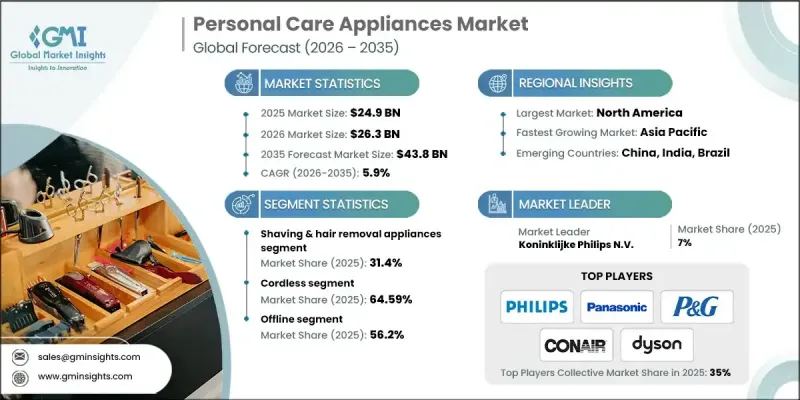
The Global Personal Care Appliances Market was valued at USD 24.9 billion in 2025 and is estimated to grow at a CAGR of 5.9% to reach USD 43.8 billion by 2035.
The growth is fueled by increasing consumer awareness of wellness and a strong emphasis on operational efficiency, prompting demand for advanced grooming and self-care devices. Consolidation through mergers and acquisitions among major players has accelerated innovation, expanded product lines, and strengthened market presence. Traditional manual grooming tools such as razors and hand-held brushes are increasingly seen as less effective and ergonomically outdated, making high-tech appliances more appealing. Energy-efficient motors, long-lasting lithium-ion batteries, and sustainable materials in modern personal care systems reduce environmental impact and resonate with consumers seeking eco-conscious alternatives. Growth is further supported by rising e-commerce adoption, expansion of the middle-class consumer base, and a growing preference for smart, connected devices in North America, Europe, and the Asia-Pacific region, where commercial viability continues to improve.
| Market Scope | |
|---|---|
| Start Year | 2025 |
| Forecast Year | 2026-2035 |
| Start Value | $24.9 Billion |
| Forecast Value | $43.8 Billion |
| CAGR | 5.9% |
The shaving & hair removal appliances segment accounted for 31.4% share in 2025. The segment benefits from increasing interest in precision grooming and the rising popularity of body hair management among men. These appliances are favored for daily personal use, reflecting a strong demand for high-capacity, reliable systems capable of providing professional-grade results at home.
The cordless devices segment captured 64.59% share in 2025, generating USD 16.1 billion. Their popularity stems from enhanced mobility, convenience, and productivity. The integration of lithium-ion batteries and wireless charging has further improved usability and reliability. Consumers increasingly prefer cordless appliances for travel and on-the-go grooming, underscoring a shift toward portable, smart devices that minimize clutter and maximize efficiency.
North America Personal Care Appliances Market reached USD 9.1 billion in 2025 and is projected to grow at a CAGR of 6.7% through 2035. The United States drives regional growth through its mature market, strong adoption of premium grooming products, and investments in smart home technologies. IoT-enabled personal care devices providing personalized tracking and professional-quality results have become a standard for modern households, driving the market forward.
Leading companies in the Global Personal Care Appliances Market include Dyson Limited, Conair Corporation, Philips, Procter & Gamble Co., Panasonic Corporation, Andis Company, Shiseido Company, Spectrum Brands, Inc., Wahl Clipper Corporation, Lion Corporation, Havells India, Helen of Troy, Flyco, Colgate-Palmolive Company, and Groupe SEB. Companies in the Global Personal Care Appliances Market strengthen their foothold through multiple strategies. They focus on product innovation, integrating smart features, IoT capabilities, and energy-efficient technologies to enhance user experience. Strategic mergers, acquisitions, and partnerships expand geographic reach and diversify product portfolios. Premiumization and targeted marketing campaigns highlight advanced performance and design.
Table of Contents
Chapter 1 Methodology and Scope
- 1.1 Market scope and definition
- 1.2 Research design
- 1.2.1 Research approach
- 1.2.2 Data collection methods
- 1.3 Data mining sources
- 1.3.1 Global
- 1.3.2 Regional/Country
- 1.4 Base estimates and calculations
- 1.4.1 Base year calculation
- 1.4.2 Key trends for market estimation
- 1.5 Primary research and validation
- 1.5.1 Primary sources
- 1.6 Forecast model
- 1.7 Research assumptions and limitations
Chapter 2 Executive Summary
- 2.1 Industry 360° synopsis
- 2.2 Key market trends
- 2.2.1 Regional
- 2.2.2 Product type
- 2.2.3 Consumer group
- 2.2.4 Power supply
- 2.2.5 End-use
- 2.2.6 Distribution channel
- 2.3 CXO perspectives: Strategic imperatives
- 2.3.1 Key decision points for industry executives
- 2.3.2 Critical success factors for market players
- 2.4 Future outlook and strategic recommendations
Chapter 3 Industry Insights
- 3.1 Industry ecosystem analysis
- 3.1.1 Supplier landscape
- 3.1.2 Profit margin
- 3.1.3 Value addition at each stage
- 3.1.4 Factor affecting the value chain
- 3.2 Industry impact forces
- 3.2.1 Growth drivers
- 3.2.1.1 Rise in male grooming & self-care
- 3.2.1.2 Smart & connected ecosystems
- 3.2.1.3 Sustainability & eco-design
- 3.2.2 Industry pitfalls & challenges
- 3.2.2.1 High cost of premium devices
- 3.2.2.2 Proliferation of counterfeit products
- 3.2.3 Opportunities
- 3.2.3.1 AI-driven personalization
- 3.2.3.2 Travel-friendly & cordless designs
- 3.2.1 Growth drivers
- 3.3 Growth potential analysis
- 3.4 Future market trends
- 3.5 Technology and innovation landscape
- 3.5.1 Current technological trends
- 3.5.2 Emerging technologies
- 3.6 Price trends
- 3.6.1 By region
- 3.6.2 By type
- 3.7 Regulatory landscape
- 3.7.1 Standards and compliance requirements
- 3.7.2 Regional regulatory frameworks
- 3.7.3 Certification standards
- 3.8 Porter';s analysis
- 3.9 PESTEL analysis
Chapter 4 Competitive Landscape, 2025
- 4.1 Introduction
- 4.2 Company market share analysis
- 4.2.1 By region
- 4.2.1.1 North America
- 4.2.1.2 Europe
- 4.2.1.3 Asia Pacific
- 4.2.1.4 Latin America
- 4.2.1.5 Middle East and Africa
- 4.2.1 By region
- 4.3 Company matrix analysis
- 4.4 Competitive analysis of major market players
- 4.5 Competitive positioning matrix
- 4.6 Key developments
- 4.6.1 Mergers & acquisitions
- 4.6.2 Partnerships & collaborations
- 4.6.3 New product launches
- 4.6.4 Expansion plans
Chapter 5 Market Estimates & Forecast, By Product Type, 2022 - 2035, (USD Billion) (Million Units)
- 5.1 Key trends
- 5.2 Shaving & hair removal appliances
- 5.2.1 Electric shavers
- 5.2.2 Trimmers & epilators
- 5.2.3 IPL hair removal devices
- 5.2.4 Other (nose & ear trimmers)
- 5.3 Hair styling appliances
- 5.3.1 Hair dryers
- 5.3.2 Hair straighteners
- 5.3.3 Curling irons and wands
- 5.3.4 Hair clippers and trimmers
- 5.4 Oral care appliances
- 5.4.1 Electric toothbrushes
- 5.4.2 Water flossers
- 5.4.3 Whitening devices
- 5.5 Skin care appliances
- 5.5.1 Anti-aging devices
- 5.5.1.1 Microcurrent
- 5.5.1.2 LED light therapy
- 5.5.1.3 Radiofrequency treatment devices
- 5.5.2 Facial cleansing tools
- 5.5.3 Facial massagers
- 5.5.4 Other (ultrasonic pore extractors)
- 5.5.1 Anti-aging devices
- 5.6 Massage & relaxation appliances
- 5.6.1 Hair growth stimulation
- 5.6.2 Foot and leg massagers
- 5.6.3 Electric body massagers
- 5.6.4 Muscle massage guns
- 5.7 Others
Chapter 6 Market Estimates & Forecast, By Consumer Group, 2022 - 2035, (USD Billion) (Million Units)
- 6.1 Key trends
- 6.2 Men
- 6.3 Women
- 6.4 Unisex
Chapter 7 Market Estimates & Forecast, By Power Supply, 2022 - 2035, (USD Billion) (Million Units)
- 7.1 Key trends
- 7.2 Corded
- 7.3 Cordless
Chapter 8 Market Estimates & Forecast, By End Use, 2022 - 2035, (USD Billion) (Million Units)
- 8.1 Key trends
- 8.2 Residential
- 8.3 Commercial
Chapter 9 Market Estimates & Forecast, By Distribution Channel, 2022 - 2035, (USD Billion) (Million Units)
- 9.1 Key trends
- 9.2 Online channels
- 9.2.1 E-commerce platforms
- 9.2.2 Company websites
- 9.3 Offline channels
- 9.3.1 Specialty stores
- 9.3.2 Supermarkets and hypermarkets
- 9.3.3 Department stores
Chapter 10 Market Estimates and Forecast, By Region, 2022 - 2035 (USD Billion) (Million Units)
- 10.1 Key trends
- 10.2 North America
- 10.2.1 U.S.
- 10.2.2 Canada
- 10.3 Europe
- 10.3.1 Germany
- 10.3.2 UK
- 10.3.3 France
- 10.3.4 Italy
- 10.3.5 Spain
- 10.4 Asia Pacific
- 10.4.1 China
- 10.4.2 Japan
- 10.4.3 India
- 10.4.4 Australia
- 10.4.5 South Korea
- 10.5 Latin America
- 10.5.1 Brazil
- 10.5.2 Mexico
- 10.5.3 Argentina
- 10.6 Middle East and Africa
- 10.6.1 South Africa
- 10.6.2 Saudi Arabia
- 10.6.3 UAE
Chapter 11 Company Profiles
- 11.1 Andis Company
- 11.2 Colgate-Palmolive Company
- 11.3 Conair Corporation
- 11.4 Dyson Limited
- 11.5 Flyco
- 11.6 Groupe SEB
- 11.7 Havells India
- 11.8 Helen of Troy
- 11.9 Koninklijke Philips N.V.
- 11.10 Lion Corporation
- 11.11 Panasonic Corporation
- 11.12 Procter & Gamble Co.
- 11.13 Shiseido Company
- 11.14 Spectrum Brands, Inc.
- 11.15 Wahl Clipper Corporation

