PUBLISHER: Global Market Insights Inc. | PRODUCT CODE: 1928964

PUBLISHER: Global Market Insights Inc. | PRODUCT CODE: 1928964
Two Wheeler Market Opportunity, Growth Drivers, Industry Trend Analysis, and Forecast 2026 - 2035
The Global Two Wheeler Market was valued at USD 170.7 billion in 2025 and estimated to grow at a CAGR of 5.9% to reach USD 285.6 billion by 2035.
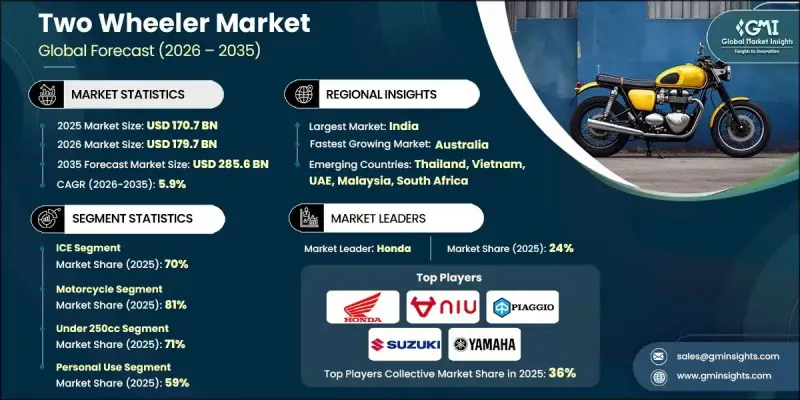
Market expansion is driven by the rapid rise in electric vehicle producers across multiple regions and the growing global emphasis on cleaner and more sustainable transportation. Environmental awareness and regulatory pressure are accelerating the shift toward electric two-wheelers, which is reshaping personal mobility patterns worldwide. Ongoing technological progress is improving vehicle performance, efficiency, and usability, supporting wider adoption across both developed and developing economies. As global efforts to reduce emissions increase, acceptance of electric mobility solutions is increasing steadily. At the same time, the industry is evolving in response to changing consumer preferences, urban congestion challenges, and advancements in vehicle engineering. Electric motorcycles and scooters are gaining broader acceptance due to supportive policy frameworks and increasing demand for environmentally responsible transportation options, positioning the two-wheeler market as a key contributor to future mobility ecosystems.
| Market Scope | |
|---|---|
| Start Year | 2025 |
| Forecast Year | 2026-2035 |
| Start Value | $170.7 Billion |
| Forecast Value | $285.6 Billion |
| CAGR | 5.9% |
The internal combustion engine segment accounted for 70% share in 2025 and is projected to register a CAGR of 5% between 2026 and 2035. In developing economies, ICE two-wheelers continue to attract buyers due to their lower upfront cost compared to electric alternatives. Affordable pricing, broad product availability, and strong distribution networks make these vehicles a practical choice for cost-sensitive consumers. The presence of extensive refueling infrastructure further supports the sustained demand for ICE-powered two-wheelers.
The motorcycles segment held 81% share in 2025 and is expected to grow at a CAGR of 5.9% from 2026 to 2035. Rising urban populations and increasing pressure on public transportation systems are encouraging greater reliance on motorcycles as a convenient and economical mode of travel. Their maneuverability, low operating costs, and ease of parking make them well-suited for daily commuting, particularly in densely populated urban areas.
India Two Wheeler Market held 21% share and generated USD 26.9 billion in 2025. Unlike mature markets where two-wheelers are often used for leisure, the Indian market is primarily driven by daily transportation needs. Purchasing decisions in the country are heavily influenced by affordability, fuel efficiency, and long-term reliability, making two-wheelers an essential mobility solution for a broad consumer base.
Key companies operating in the Global Two Wheeler Market include Yamaha, Honda, Bajaj, Hero, Suzuki, Royal Enfield, Piaggio, Yadea, Kawasaki, BMW Motorrad, and Harley-Davidson. Companies in the two wheeler market are reinforcing their market positions through product diversification, investment in electric mobility, and expansion across high-growth regions. Manufacturers are focusing on cost optimization and localized production to improve affordability and strengthen supply chains. Strategic investments in research and development are enabling continuous improvements in performance, efficiency, and design. Many players are also enhancing dealer networks and after-sales services to improve customer engagement and brand loyalty.
Table of Contents
Chapter 1 Methodology & Scope
- 1.1 Research approach
- 1.2 Quality Commitments
- 1.2.1 GMI AI policy & data integrity commitment
- 1.2.1.1 Source consistency protocol
- 1.2.1 GMI AI policy & data integrity commitment
- 1.3 Research Trail & Confidence Scoring
- 1.3.1 Research Trail Components
- 1.3.2 Scoring Components
- 1.4 Data Collection
- 1.4.1 Partial list of primary sources
- 1.5 Data mining sources
- 1.5.1 Paid sources
- 1.5.1.1 Sources, by region
- 1.5.1 Paid sources
- 1.6 Base estimates and calculations
- 1.6.1 Base year calculation for any one approach
- 1.7 Forecast model
- 1.7.1 Quantified market impact analysis
- 1.7.1.1 Mathematical impact of growth parameters on forecast
- 1.7.1 Quantified market impact analysis
- 1.8 Research transparency addendum
- 1.8.1 Source attribution framework
- 1.8.2 Quality assurance metrics
- 1.8.3 Our commitment to trust
Chapter 2 Executive Summary
- 2.1 Industry 3600 synopsis, 2022 - 2035
- 2.2 Key market trends
- 2.2.1 Regional
- 2.2.2 Vehicle
- 2.2.3 Propulsion
- 2.2.4 Displacement
- 2.2.5 End use
- 2.2.6 Distribution channel
- 2.3 TAM Analysis, 2026-2035
- 2.4 CXO perspectives: Strategic imperatives
- 2.4.1 Executive decision points
- 2.4.2 Critical success factors
- 2.5 Future outlook and strategic recommendations
Chapter 3 Industry Insights
- 3.1 Industry ecosystem analysis
- 3.1.1 Supplier landscape
- 3.1.2 Profit margin analysis
- 3.1.3 Cost structure
- 3.1.4 Value addition at each stage
- 3.1.5 Factor affecting the value chain
- 3.1.6 Disruptions
- 3.2 Industry impact forces
- 3.2.1.1 Growth drivers
- 3.2.1.2 Rise in demand for electric two-wheelers
- 3.2.1.3 Technological advancements in battery and motor systems
- 3.2.1.4 Expansion of urbanization and traffic congestion
- 3.2.1.5 High fuel prices and environmental concerns
- 3.2.2 Industry pitfalls and challenges
- 3.2.2.1 High initial cost of electric vehicles
- 3.2.2.2 Infrastructure limitations for electric vehicles
- 3.2.3 Market opportunities
- 3.2.3.1 Expansion of electric vehicle adoption
- 3.2.3.2 Growth in emerging markets
- 3.2.3.3 Integration of smart technology
- 3.2.3.4 Government-backed infrastructure development
- 3.3 Growth potential analysis
- 3.4 Regulatory landscape
- 3.4.1 North America
- 3.4.1.1 Federal regulatory framework
- 3.4.1.2 State-level regulatory variations
- 3.4.1.3 Canadian regulatory environment
- 3.4.2 Europe
- 3.4.2.1 EU regulatory framework
- 3.4.2.2 CE marking and compliance requirements
- 3.4.2.3 National implementation variations
- 3.4.2.4 Personal mobility device regulations
- 3.4.2.5 Motorcycle safety and PPE regulations
- 3.4.3 Asia Pacific
- 3.4.3.1 Chinese regulatory framework
- 3.4.3.2 Indian regulatory environment
- 3.4.3.3 ASEAN harmonization efforts
- 3.4.3.4 Japanese regulatory framework
- 3.4.3.5 Other regional variations
- 3.4.4 Latin America
- 3.4.4.1 Brazilian regulatory framework
- 3.4.4.2 Mexican regulatory environment
- 3.4.4.3 Regional harmonization efforts
- 3.4.5 Middle East & Africa
- 3.4.5.1 Gulf cooperation council (GCC) framework
- 3.4.5.2 South African regulatory environment
- 3.4.5.3 Regional development initiatives
- 3.4.1 North America
- 3.5 Porter';s analysis
- 3.6 PESTEL analysis
- 3.7 Technology and innovation landscape
- 3.7.1 Current technological trends
- 3.7.2 Emerging technologies
- 3.8 Price trends
- 3.8.1 By region
- 3.8.2 By product
- 3.9 Production statistics
- 3.9.1 Production hubs
- 3.9.2 Consumption hubs
- 3.9.3 Export and import
- 3.10 Cost breakdown analysis
- 3.11 Patent analysis
- 3.12 Sustainability and environmental aspects
- 3.12.1 Sustainable practices
- 3.12.2 Waste reduction strategies
- 3.12.3 Energy efficiency in production
- 3.12.4 Eco-friendly Initiatives
- 3.12.5 Carbon footprint considerations
- 3.13 Consumer buying behavior & preference analysis
- 3.14 Total cost of ownership (TCO) analysis
- 3.15 Brand perception & loyalty analysis
- 3.16 Electric two-wheeler ecosystem deep dive
- 3.16.1 Battery swapping vs fixed battery models
- 3.16.2 Charging infrastructure readiness
- 3.16.3 Battery leasing & subscription models
Chapter 4 Competitive Landscape, 2025
- 4.1 Introduction
- 4.2 Company market share analysis
- 4.2.1 North America
- 4.2.2 Europe
- 4.2.3 Asia Pacific
- 4.2.4 LATAM
- 4.2.5 MEA
- 4.3 Competitive analysis of major market players
- 4.4 Competitive positioning matrix
- 4.5 Strategic outlook matrix
- 4.6 Key developments
- 4.6.1 Mergers & acquisitions
- 4.6.2 Partnerships & collaborations
- 4.6.3 New Product Launches
- 4.6.4 Expansion Plans and funding
Chapter 5 Market Estimates & Forecast, By Vehicle, 2022 - 2035 ($Mn, Units)
- 5.1 Key trends
- 5.2 Motorcycles
- 5.2.1 Cruiser motorcycles
- 5.2.2 Sport motorcycles
- 5.2.3 Touring motorcycles
- 5.2.4 Standard/naked motorcycles
- 5.2.5 Adventure/dual-sport motorcycles
- 5.2.6 Off-road/dirt motorcycles
- 5.3 Scooters
- 5.3.1 Maxi scooters
- 5.3.2 Moped-style scooters
Chapter 6 Market Estimates & Forecast, By Propulsion, 2022 - 2035 ($Mn, Units)
- 6.1 Key trends
- 6.2 ICE
- 6.3 Electric
Chapter 7 Market Estimates & Forecast, By Displacement, 2022 - 2035 ($Mn, Units)
- 7.1 Key trends
- 7.2 Under 250cc
- 7.3 250cc-500cc
- 7.4 500cc-1000cc
- 7.5 Above 1000cc
Chapter 8 Market Estimates & Forecast, By End Use, 2022 - 2035 ($Mn, Units)
- 8.1 Key trends
- 8.2 Personal use
- 8.3 Commercial
Chapter 9 Market Estimates & Forecast, By Distribution Channel, 2022 - 2035 ($Mn, Units)
- 9.1 Key trends
- 9.2 Offline
- 9.3 Online
Chapter 10 Market Estimates & Forecast, By Region, 2022 - 2035 ($Mn, Units)
- 10.1 Key trends
- 10.2 North America
- 10.2.1 US
- 10.2.2 Canada
- 10.3 Europe
- 10.3.1 UK
- 10.3.2 Germany
- 10.3.3 France
- 10.3.4 Italy
- 10.3.5 Spain
- 10.3.6 Poland
- 10.3.7 Netherlands
- 10.3.8 Belgium
- 10.4 Asia Pacific
- 10.4.1 China
- 10.4.2 India
- 10.4.3 Japan
- 10.4.4 South Korea
- 10.4.5 Taiwan
- 10.4.6 Myanmar
- 10.4.7 Thailand
- 10.4.8 Vietnam
- 10.4.9 Singapore
- 10.4.10 Indonesia
- 10.4.11 ANZ
- 10.5 Latin America
- 10.5.1 Brazil
- 10.5.2 Argentina
- 10.5.3 Mexico
- 10.6 MEA
- 10.6.1 UAE
- 10.6.2 Saudi Arabia
- 10.6.3 South Africa
Chapter 11 Company Profiles
- 11.1 Global Players
- 11.1.1 Bajaj
- 11.1.2 Hero
- 11.1.3 Honda
- 11.1.4 Piaggio
- 11.1.5 Suzuki
- 11.1.6 TVS
- 11.1.7 Yamaha
- 11.2 Premium Motorcycle Brands
- 11.2.1 BMW Motorrad
- 11.2.2 Ducati
- 11.2.3 Harley-Davidson
- 11.2.4 KTM
- 11.2.5 Royal Enfield
- 11.2.6 Kawasaki
- 11.3 Electric Two Wheeler Manufacturers
- 11.3.1 Ather
- 11.3.2 Ola Electric
- 11.3.3 Revolt
- 11.3.4 Ultraviolette
- 11.3.5 Yadea
- 11.3.6 Zero Motorcycles
- 11.3.7 Niu Technologies

