PUBLISHER: Global Market Insights Inc. | PRODUCT CODE: 1936521

PUBLISHER: Global Market Insights Inc. | PRODUCT CODE: 1936521
Europe Communication-Based Train Control Market Opportunity, Growth Drivers, Industry Trend Analysis, and Forecast 2026 - 2035
Europe Communication-Based Train Control Market was valued at USD 750.3 million in 2025 and is estimated to grow at a CAGR of 7.8% to reach USD 1.58 billion by 2035.
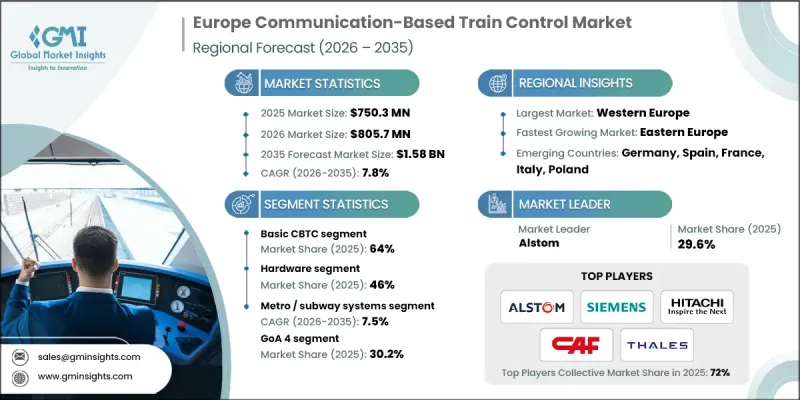
The market is expanding as European rail operators accelerate large-scale digital modernization of rail infrastructure to meet long-term mobility, safety, and capacity objectives. Public and institutional funding across the region supports the transition toward advanced signaling and train control architectures that enable seamless cross-border operations and higher network efficiency. Communication-based train control systems are increasingly adopted to improve network throughput by reducing train spacing, which is essential for handling rising passenger volumes in dense urban and intercity rail corridors. Sustainability commitments across Europe further strengthen investment momentum, as rail operators prioritize energy-efficient and low-emission public transportation systems. The growing adoption of automated train operation, along with the integration of artificial intelligence and predictive analytics, continues to enhance operational reliability, safety performance, and system appeal for both metropolitan and longer-distance rail services.
| Market Scope | |
|---|---|
| Start Year | 2025 |
| Forecast Year | 2026-2035 |
| Start Value | $750.3 Million |
| Forecast Value | $1.58 Billion |
| CAGR | 7.8% |
The basic CBTC systems segment accounted for 64% share in 2025 and is expected to grow at a CAGR of 6.5% from 2026 to 2035. These systems remain widely deployed due to their ability to deliver precise train positioning, improved operational efficiency, and higher line capacity through reduced headways. However, their closed architecture limits interoperability, making them more suitable for isolated or newly developed rail networks where multi-vendor integration is not required.
The hardware segment held a 46% share in 2025 and is forecast to grow at a CAGR of 6.3% through 2035. CBTC hardware across Europe is evolving toward modular, compact designs that support onboard and trackside deployment. Increased reliance on radio-based communication, redundant control units, and energy-efficient components supports fully automated operations. Hardware development now emphasizes cybersecurity resilience, long service life, and seamless compatibility with digital signaling and automation platforms.
Germany Communication-Based Train Control Market reached USD 109.4 million in 2025. Market growth is supported by a strong national focus on rail digitalization and the adoption of interoperable system architectures that reduce dependency on single vendors. Open standards, interface compatibility, and long-term infrastructure integration play a central role in procurement decisions, reflecting Germany's structured and engineering-driven approach to rail modernization.
Key companies operating in the Europe Communication-Based Train Control Market include Siemens Mobility, Alstom, Thales, Hitachi Rail, ABB, Wabtec, CAF, Knorr-Bremse, Nippon Signal, and Mitsubishi Electric's European operations. Companies active in the Europe communication-based train control market strengthen their market position through technology standardization, long-term infrastructure partnerships, and investment in interoperable solutions. Suppliers focus on developing open-architecture systems that reduce vendor lock-in and align with regional regulatory requirements. Continuous innovation in automation, cybersecurity, and digital signaling enhances system reliability and safety. Firms also prioritize modular hardware and scalable software to support phased upgrades of existing rail networks. Strategic collaborations with rail operators enable customized deployments and lifecycle support services. Additionally, expanding local engineering capabilities and after-sales support networks helps companies secure long-term contracts and reinforce their competitive presence across Europe.
Table of Contents
Chapter 1 Methodology
- 1.1 Research approach
- 1.2 Quality commitments
- 1.3 GMI AI policy & data integrity commitment
- 1.4 Research trail & confidence scoring
- 1.4.1 Research trail components
- 1.4.2 Scoring components
- 1.5 Data collection
- 1.5.1 Partial list of primary sources
- 1.6 Data mining sources
- 1.6.1 Paid sources
- 1.7 Base estimates and calculations
- 1.7.1 Base year calculation
- 1.8 Forecast model
- 1.9 Research transparency addendum
Chapter 2 Executive summary
- 2.1 Industry 360° synopsis
- 2.2 Key market trends
- 2.2.1 Regional
- 2.2.2 System
- 2.2.3 Component
- 2.2.4 Train
- 2.2.5 Automation grade
- 2.3 TAM analysis, 2026-2035
- 2.4 CXO perspectives: Strategic imperatives
- 2.4.1 Executive decision points
- 2.4.2 Critical success factors
- 2.5 Future outlook
- 2.6 Strategic recommendations
Chapter 3 Industry Insights
- 3.1 Industry ecosystem analysis
- 3.1.1 Supplier landscape
- 3.1.2 Profit margin
- 3.1.3 Cost structure
- 3.1.4 Value addition at each stage
- 3.1.5 Factor affecting the value chain
- 3.1.6 Disruptions
- 3.2 Industry impact forces
- 3.2.1 Growth drivers
- 3.2.1.1 Rail infrastructure modernization & regulatory mandates
- 3.2.1.2 demand for higher capacity & service efficiency
- 3.2.1.3 Sustainability & public transport prioritization
- 3.2.1.4 Technological innovation adoption
- 3.2.2 Industry pitfalls and challenges
- 3.2.2.1 High implementation & integration costs
- 3.2.2.2 Complex interoperability & standardization issues
- 3.2.3 Market opportunities
- 3.2.3.1 Expansion of urban & suburban rail networks
- 3.2.3.2 Cross-border interoperability programs
- 3.2.3.3 Integration with smart cities & digital infrastructure
- 3.2.3.4 Retrofitting legacy lines for digital control
- 3.2.1 Growth drivers
- 3.3 Growth potential analysis
- 3.4 Regulatory landscape
- 3.4.1 Western Europe
- 3.4.1.1 Federal Railway Authority (EBA) Regulations
- 3.4.1.2 French Rail Safety Authority (EPSF) Regulations
- 3.4.1.3 Eisenbahn-Bau- und Betriebsordnung (EBO)
- 3.4.2 Northern Europe
- 3.4.2.1 Danish Transport Authority Rail Regulations
- 3.4.2.2 Swedish Transport Agency Rail Regulations
- 3.4.2.3 Finnish Transport and Communications Agency (Traficom) Rail Regulations
- 3.4.3 Southern Europe
- 3.4.3.1 Italian Railway Technical Standards
- 3.4.3.2 Spanish State Railway Safety Agency (AESF) Regulations
- 3.4.3.3 EU Rail Safety Directive (EU 2016/798)
- 3.4.4 Eastern Europe
- 3.4.4.1 Office of Rail Transport (UTK) Regulations
- 3.4.4.2 Railway Authority (Drazni u-ad) Regulations
- 3.4.4.3 National Railway Safety Framework
- 3.4.1 Western Europe
- 3.5 Porter's analysis
- 3.6 PESTEL analysis
- 3.7 Technology and innovation landscape
- 3.7.1 Current technological trends
- 3.7.2 Emerging technologies
- 3.8 Cost breakdown analysis
- 3.8.1 Vendor cost structure
- 3.8.2 Implementation of cost components
- 3.8.3 Ongoing operational costs
- 3.8.4 Indirect customer costs
- 3.9 Patent analysis
- 3.10 Sustainability and environmental aspects
- 3.10.1 Sustainable practices
- 3.10.2 Waste reduction strategies
- 3.10.3 Energy efficiency in production
- 3.10.4 Eco-friendly initiatives
- 3.10.5 Carbon footprint considerations
- 3.11 Future trends & their impact
- 3.11.1 Autonomous train operations (GoA 4) expansion
- 3.11.2 FRMCS migration timeline & market impact
- 3.11.3 AI & machine learning integration trajectory
- 3.11.4 Quantum communication for ultra-secure CBTC
- 3.12 Digitalization & smart mobility integration
- 3.12.1 CBTC as digital railway backbone
- 3.12.2 Mobility-as-a-service (maas) integration
- 3.12.3 Smart city & urban transit ecosystem convergence
- 3.12.4 Real-time passenger information systems
- 3.13 Customer buying criteria
- 3.13.1 Technology maturity & proven track record
- 3.13.2 Total cost of ownership (TCO) vs capital cost
- 3.13.3 Interoperability & standards compliance
- 3.13.4 Local presence & after-sales support
- 3.14 Investment & funding landscape
- 3.14.1 Connecting Europe facility (CEF) funding
- 3.14.2 Horizon Europe research funding
- 3.14.3 Recovery & resilience facility allocations
- 3.14.4 Venture capital investment trends
Chapter 4 Competitive Landscape, 2025
- 4.1 Introduction
- 4.2 Company market share analysis
- 4.2.1 Western Europe
- 4.2.2 Northern Europe
- 4.2.3 Southern Europe
- 4.2.4 Eastern Europe
- 4.3 Competitive analysis of major market players
- 4.4 Competitive positioning matrix
- 4.5 Strategic outlook matrix
- 4.6 Key developments
- 4.6.1 Mergers & acquisitions
- 4.6.2 Partnerships & collaborations
- 4.6.3 New product launches
- 4.6.4 Expansion plans and funding
Chapter 5 Market Estimates & Forecast, By System, 2022 - 2035 ($Mn)
- 5.1 Key trends
- 5.2 Basic CBTC
- 5.3 Interoperable CBTC (I-CBTC)
Chapter 6 Market Estimates & Forecast, By Component, 2022 - 2035 ($Mn)
- 6.1 Key trends
- 6.2 Hardware
- 6.2.1 Onboard equipment (Train control units)
- 6.2.2 Trackside equipment
- 6.2.3 Zone controllers & radio blocks
- 6.3 Software
- 6.3.1 System integration software
- 6.3.2 Predictive maintenance software
- 6.3.3 Cloud-based CBTC platforms
- 6.3.4 Data analytics & optimization software
- 6.3.5 Cybersecurity software
- 6.4 Services
- 6.4.1 Installation & commissioning
- 6.4.2 System integration
- 6.4.3 Maintenance & support
- 6.4.4 Training services
- 6.4.5 Consulting & technical support
Chapter 7 Market Estimates & Forecast, By Train, 2022 - 2035 ($Mn)
- 7.1 Key trends
- 7.2 Metro / subway systems
- 7.3 Light rail & trams
- 7.4 Commuter rail
- 7.5 High-speed rail
- 7.6 Freight rail
Chapter 8 Market Estimates & Forecast, By Automation Grade, 2022 - 2035 ($Mn)
- 8.1 Key trends
- 8.2 GoA 1
- 8.3 GoA 2
- 8.4 GoA 3
- 8.5 GoA 4
Chapter 9 Market Estimates & Forecast, By Region, 2022 - 2035 ($Mn)
- 9.1 Key trends
- 9.2 Northern Europe
- 9.2.1 Denmark
- 9.2.2 Finland
- 9.2.3 Iceland
- 9.2.4 Norway
- 9.2.5 Sweden
- 9.2.6 Rest of Northern Europe
- 9.3 Western Europe
- 9.3.1 Germany
- 9.3.2 France
- 9.3.3 Netherlands
- 9.3.4 Belgium
- 9.3.5 Luxembourg
- 9.3.6 Rest of Western Europe
- 9.4 Southern Europe
- 9.4.1 Italy
- 9.4.2 Spain
- 9.4.3 Portugal
- 9.4.4 Greece
- 9.4.5 Slovenia
- 9.4.6 Rest of Southern Europe
- 9.5 Eastern Europe
- 9.5.1 Poland
- 9.5.2 Czech Republic
- 9.5.3 Slovakia
- 9.5.4 Hungary
- 9.5.5 Romania
- 9.5.6 Rest of Eastern Europe
Chapter 10 Company Profiles
- 10.1 Global companies
- 10.1.1 ABB
- 10.1.2 Alstom
- 10.1.3 Hitachi Rail
- 10.1.4 Indra Sistemas
- 10.1.5 Knorr-Bremse
- 10.1.6 Nippon Signal
- 10.1.7 Schneider Electric
- 10.1.8 Siemens Mobility
- 10.1.9 Thales
- 10.1.10 Wabtec
- 10.2 Regional players
- 10.2.1 CAF
- 10.2.2 Cisco Systems
- 10.2.3 Cubic Transportation Systems
- 10.2.4 EKE-Electronics
- 10.2.5 Funkwerk
- 10.2.6 Mermec / Angel
- 10.2.7 Network Rail
- 10.2.8 Nokia
- 10.2.9 Pintsch Bamag (Schaltbau)
- 10.2.10 Stadler Rail
- 10.3 Emerging players
- 10.3.1 Angelo Holding
- 10.3.2 Argenia Railway Technologies
- 10.3.3 LS ELECTRIC
- 10.3.4 Mitsubishi Electric
- 10.3.5 Nexxiot Rail
- 10.3.6 Straffic

