PUBLISHER: Global Market Insights Inc. | PRODUCT CODE: 1936528

PUBLISHER: Global Market Insights Inc. | PRODUCT CODE: 1936528
Dicyclopentadiene (DCPD) Market Opportunity, Growth Drivers, Industry Trend Analysis, and Forecast 2026 - 2035
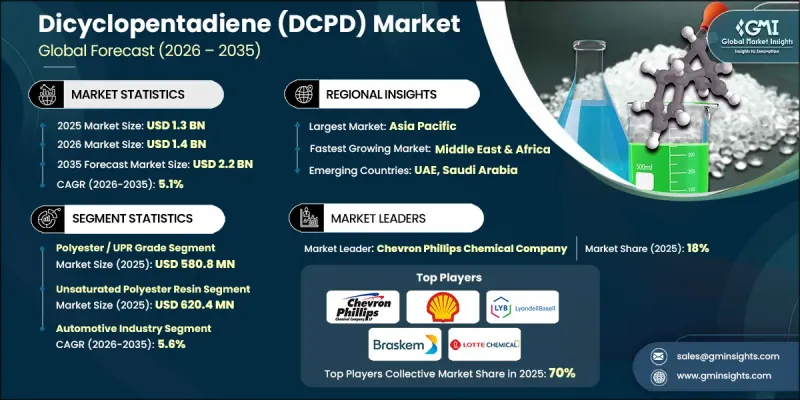
The Global Dicyclopentadiene Market was valued at USD 1.3 billion in 2025 and is estimated to grow at a CAGR of 5.1% to reach USD 2.2 billion by 2035.
The rising sophistication of the pharmaceutical packaging industry is creating demand for high-performance packaging solutions, where DCPD-derived hydrocarbon resins and adhesives play a critical role in formulations. Although pharmaceutical packaging does not directly consume large volumes of DCPD, its expansion drives the adoption of advanced resin and adhesive intermediates in protective and tamper-evident systems to meet strict safety and compliance requirements. This, in turn, strengthens the broader DCPD value chain across chemicals and specialty materials. Another significant driver is the automotive sector's shift toward lightweight, high-performance materials, with unsaturated polyester and poly-DCPD composites increasingly utilized in body panels, bumpers, and structural components to meet fuel efficiency and emission reduction targets. These composites provide high strength-to-weight ratios, making them attractive for transportation applications, while DCPD enhances the mechanical and thermal performance of resin systems, boosting adoption in automotive and aerospace segments.
| Market Scope | |
|---|---|
| Start Year | 2025 |
| Forecast Year | 2026-2035 |
| Start Value | $1.3 Billion |
| Forecast Value | $2.2 Billion |
| CAGR | 5.1% |
The polyester/UPR grade segment accounted for USD 580.8 million in 2025, driven by its extensive use in unsaturated polyester resins across construction, automotive, marine, and infrastructure applications. Its popularity is linked to fiberglass-reinforced plastics, molded composites, and corrosion-resistant materials, where the balance of cost and performance is essential.
The unsaturated polyester resin (UPR) segment generated USD 620.4 million in 2025, as DCPD-based UPRs offer mechanical strength, corrosion resistance, cost efficiency, and processability for panels, pipes, fiberglass-reinforced components, and structural materials, making them indispensable in construction, automotive, marine, and infrastructure sectors.
North America Dicyclopentadiene Market accounted for 21% share in 2025, with the United States leading the region due to its well-developed petrochemical infrastructure and strong demand from automotive, construction, and advanced materials industries. Growth is fueled using DCPD-based resins and poly-DCPD composites in lightweight vehicles, infrastructure repair, and corrosion-resistant applications. Ongoing investments in petrochemical capacity along the Gulf Coast and increased deployment of high-performance polymers and composites are strengthening supply security in the region.
Key players operating in the Global Dicyclopentadiene Market include NOVA Chemicals Corporation, Zeon Corporation, Chevron Phillips Chemical Company, Shell Chemicals, Braskem, LOTTE Chemical, Formosa Chemicals & Fibre Corporation, Core Molding Technologies, Mitsui Chemicals, LyondellBasell Industries, Eastman Chemical Company, and LG Chem. Companies in the Dicyclopentadiene (DCPD) Market are enhancing their foothold by investing heavily in R&D to develop high-performance resin and composite solutions tailored to end-use industries such as automotive, aerospace, and construction. Strategic collaborations with OEMs and specialty chemical manufacturers ensure early integration of DCPD-based composites and adhesives into new product lines. Firms are expanding production capacities, improving supply chain efficiency, and enhancing regional distribution networks to meet rising global demand. Product innovation, cost optimization, and development of multifunctional resin systems are being leveraged to differentiate offerings, while compliance with international standards strengthens credibility. Additionally, companies focus on sustainability, lightweighting solutions, and technical support services to drive adoption and maintain a competitive edge across key applications.
Table of Contents
Chapter 1 Methodology & Scope
- 1.1 Market scope and definition
- 1.2 Research design
- 1.2.1 Research approach
- 1.2.2 Data collection methods
- 1.3 Data mining sources
- 1.3.1 Global
- 1.3.2 Regional/Country
- 1.4 Base estimates and calculations
- 1.4.1 Base year calculation
- 1.4.2 Key trends for market estimation
- 1.5 Primary research and validation
- 1.5.1 Primary sources
- 1.6 Forecast model
- 1.7 Research assumptions and limitations
Chapter 2 Executive Summary
- 2.1 Industry 3600 synopsis
- 2.2 Key market trends
- 2.2.1 Regional
- 2.2.2 Grade
- 2.2.3 Application
- 2.2.4 End Use Industry
- 2.3 TAM Analysis, 2026-2035
- 2.4 CXO perspectives: Strategic imperatives
- 2.4.1 Executive decision points
- 2.4.2 Critical success factors
- 2.5 Future Outlook and Strategic Recommendations
Chapter 3 Industry Insights
- 3.1 Industry ecosystem analysis
- 3.1.1 Supplier Landscape
- 3.1.2 Profit Margin
- 3.1.3 Value addition at each stage
- 3.1.4 Factor affecting the value chain
- 3.1.5 Disruptions
- 3.2 Industry impact forces
- 3.2.1 Growth drivers
- 3.2.1.1 Growing demand for lightweight composites in automotive & aerospace
- 3.2.1.2 Wind energy expansion driving Poly-DCPD RIM demand
- 3.2.1.3 Rising pharmaceutical packaging demand
- 3.2.2 Industry pitfalls and challenges
- 3.2.2.1 Raw material supply uncertainty
- 3.2.2.2 Capital-intensive production infrastructure
- 3.2.3 Market opportunities
- 3.2.3.1 Self-healing polymer applications in wind energy
- 3.2.3.2 3D printing & additive manufacturing
- 3.2.1 Growth drivers
- 3.3 Growth potential analysis
- 3.4 Regulatory landscape
- 3.4.1 North America
- 3.4.2 Europe
- 3.4.3 Asia Pacific
- 3.4.4 Latin America
- 3.4.5 Middle East & Africa
- 3.5 Porter's analysis
- 3.6 PESTEL analysis
- 3.7 Price trends
- 3.7.1 By region
- 3.7.2 Product type
- 3.8 Future market trends
- 3.9 Technology and Innovation Landscape
- 3.9.1 Current technological trends
- 3.9.2 Emerging technologies
- 3.10 Patent Landscape
- 3.11 Trade statistics (HS code) (Note: the trade statistics will be provided for key countries only)
- 3.11.1 Major importing countries
- 3.11.2 Major exporting countries
- 3.12 Sustainability and environmental aspects
- 3.12.1 Sustainable practices
- 3.12.2 Waste reduction strategies
- 3.12.3 Energy efficiency in production
- 3.12.4 Eco-friendly initiatives
- 3.13 Carbon footprint considerations
Chapter 4 Competitive Landscape, 2024
- 4.1 Introduction
- 4.2 Company market share analysis
- 4.2.1 By region
- 4.2.1.1 North America
- 4.2.1.2 Europe
- 4.2.1.3 Asia Pacific
- 4.2.1.4 LATAM
- 4.2.1.5 MEA
- 4.2.1 By region
- 4.3 Company matrix analysis
- 4.4 Competitive analysis of major market players
- 4.5 Competitive positioning matrix
- 4.6 Key developments
- 4.6.1 Mergers & acquisitions
- 4.6.2 Partnerships & collaborations
- 4.6.3 New product launches
- 4.6.4 Expansion plans
Chapter 5 Market Estimates and Forecast, By Grade, 2022 - 2035 (USD Million) (Kilo Tons)
- 5.1 Key trends
- 5.2 Ultra-high purity grade
- 5.3 High purity grade
- 5.4 Polyester / UPR Grade
- 5.5 Hydrocarbon resin grade
- 5.6 Crude DCPD
Chapter 6 Market Estimates and Forecast, By Application, 2022 - 2035 (USD Billion) (Kilo Tons)
- 6.1 Key trends
- 6.2 Unsaturated Polyester Resin
- 6.3 Hydrocarbon Resins
- 6.4 EPDM Elastomers
- 6.5 Cyclic Olefin Copolymer (COC) & Polymer (COP)
- 6.6 Poly-DCPD
- 6.7 Others
Chapter 7 Market Estimates and Forecast, By End Use Industry, 2022 - 2035 (USD Billion) (Kilo Tons)
- 7.1 Key trends
- 7.2 Automotive industry
- 7.3 Marine industry
- 7.4 Construction
- 7.5 Packaging industry
- 7.6 Aerospace & defense
- 7.7 Others
Chapter 8 Market Estimates and Forecast, By Region, 2022 - 2035 (USD Billion) (Kilo Tons)
- 8.1 Key trends
- 8.2 North America
- 8.2.1 U.S.
- 8.2.2 Canada
- 8.3 Europe
- 8.3.1 Germany
- 8.3.2 UK
- 8.3.3 France
- 8.3.4 Spain
- 8.3.5 Italy
- 8.3.6 Rest of Europe
- 8.4 Asia Pacific
- 8.4.1 China
- 8.4.2 India
- 8.4.3 Japan
- 8.4.4 Australia
- 8.4.5 South Korea
- 8.4.6 Rest of Asia Pacific
- 8.5 Latin America
- 8.5.1 Brazil
- 8.5.2 Mexico
- 8.5.3 Rest of Latin America
- 8.6 Middle East and Africa
- 8.6.1 Saudi Arabia
- 8.6.2 South Africa
- 8.6.3 UAE
- 8.6.4 Rest of Middle East and Africa
Chapter 9 Company Profiles
- 9.1 Chevron Phillips Chemical Company
- 9.2 Shell Chemicals
- 9.3 Braskem
- 9.4 LyondellBasell Industries
- 9.5 LOTTE Chemical
- 9.6 NOVA Chemicals Corporation
- 9.7 Zeon Corporation
- 9.8 Formosa Chemicals & Fibre Corporation
- 9.9 Core Molding Technologies
- 9.10 Mitsui Chemicals
- 9.11 Eastman Chemical Company
- 9.12 LG Chem

