PUBLISHER: Global Market Insights Inc. | PRODUCT CODE: 1936571

PUBLISHER: Global Market Insights Inc. | PRODUCT CODE: 1936571
Pots and Planters Market Opportunity, Growth Drivers, Industry Trend Analysis, and Forecast 2026 - 2035
The Global Pots and Planters Market was valued at USD 18.3 billion in 2025 and is estimated to grow at a CAGR of 5.4% to reach USD 30.6 billion by 2035.
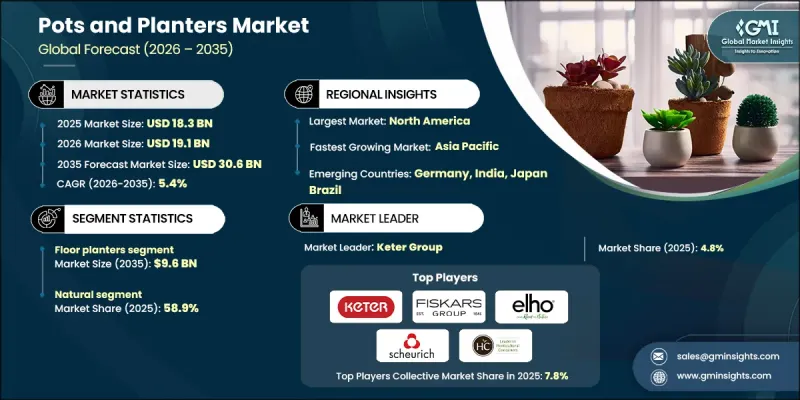
The market is benefiting from the growing trend of urban gardening, increased interest in home decoration, and the rising adoption of indoor gardening practices in apartments and urban spaces. Consumers are increasingly seeking both functional and aesthetically appealing planters, which has encouraged manufacturers to innovate with designs that suit indoor and outdoor environments. Eco-conscious choices are also driving growth, as more buyers prefer products made from sustainable materials such as terracotta, bamboo, recycled plastics, and ceramic. The increasing emphasis on low-maintenance gardening and sustainability, along with urbanization, has fueled market expansion while enhancing competition and providing consumers with a wider range of options. Manufacturers are responding with advanced product innovations, including self-watering and eco-friendly planters, to cater to diverse consumer needs.
| Market Scope | |
|---|---|
| Start Year | 2025 |
| Forecast Year | 2026-2035 |
| Start Value | $18.3 Billion |
| Forecast Value | $30.6 Billion |
| CAGR | 5.4% |
The floor planters segment generated USD 6.2 billion in 2025 and is anticipated to reach USD 9.6 billion by 2035. Floor planters are widely adopted for their convenience in adding greenery to both commercial and residential spaces. Customizable options in terms of size, color, shape, and materials such as metal, plastic, and ceramic further boost their appeal, allowing seamless integration into varied interior and exterior designs.
The natural materials segment accounted for 58.9% share in 2025. Pots and planters made from terracotta, clay, ceramic, and wood are increasingly preferred by environmentally conscious consumers, combining durability, aesthetic appeal, and sustainability. Manufacturers are scaling production of these eco-friendly products to meet growing demand while reinforcing their commitment to green initiatives.
U.S. Pots and Planters Market held 64.3% share in 2025. The country's market growth is driven by rising residential landscaping projects, urban gardening trends, and growing consumer interest in indoor plants. Government initiatives promoting sustainable and water-efficient landscaping practices further support demand. The accessibility of products through major retail chains and e-commerce platforms also contributes to market expansion by ensuring easy availability for consumers.
Key players shaping the Global Pots and Planters Market include Anderson Pots, Belden Plastics, Bloem Living, Crescent Garden, Deroma, East Jordan Plastics, Elho, Fiskars, HC Companies, Keter, Lechuza, Novelty Manufacturing, Poppelmann, Scheurich, and Teraplast. Companies in the pots and planters market are adopting multiple strategies to strengthen their presence and capture market share. They focus on developing eco-friendly and sustainable product lines to meet the rising demand for environmentally conscious solutions. Innovation in design, such as self-watering systems and modular planters, enhances product functionality and appeals to urban gardeners. Strategic partnerships and collaborations with retailers and online marketplaces increase product visibility and distribution reach. Brands are also investing in marketing campaigns that emphasize sustainability and lifestyle benefits, strengthening brand loyalty.
Table of Contents
Chapter 1 Methodology & Scope
- 1.1 Market scope and definition
- 1.2 Research design
- 1.2.1 Research approach
- 1.2.2 Data collection methods
- 1.3 Data mining sources
- 1.3.1 Global
- 1.3.2 Regional/Country
- 1.4 Base estimates and calculations
- 1.4.1 Base year calculation
- 1.4.2 Key trends for market estimation
- 1.5 Primary research and validation
- 1.5.1 Primary sources
- 1.6 Forecast model
- 1.7 Research assumptions and limitations
Chapter 2 Executive Summary
- 2.1 Industry 360° synopsis
- 2.2 Key market trends
- 2.2.1 Regional
- 2.2.2 Type
- 2.2.3 Material
- 2.2.4 Price
- 2.2.5 Installation
- 2.2.6 Category
- 2.2.7 End Use
- 2.2.8 Distribution Channel
- 2.3 CXO perspectives: Strategic imperatives
- 2.3.1 Key decision points for industry executives
- 2.3.2 Critical success factors for market players
- 2.4 Future outlook and strategic recommendations
Chapter 3 Industry Insights
- 3.1 Industry ecosystem analysis
- 3.1.1 Supplier landscape
- 3.1.2 Profit margin
- 3.1.3 Value addition at each stage
- 3.1.4 Factor affecting the value chain
- 3.2 Industry impact forces
- 3.2.1 Growth drivers
- 3.2.1.1 Urbanization and small-space gardening trends
- 3.2.1.2 Rising demand for sustainable and eco-friendly products
- 3.2.1.3 Increase in DIY gardening and landscaping projects
- 3.2.2 Industry pitfalls & challenges
- 3.2.2.1 High competition and price sensitivity
- 3.2.2.2 Dependence on seasonal demand
- 3.2.3 Opportunities
- 3.2.3.1 Growth in sustainable and eco-friendly pots and planters
- 3.2.3.2 expansion of smart & self-watering solutions growth potential analysis
- 3.2.1 Growth drivers
- 3.3 Future market trends
- 3.4 Technology and innovation landscape
- 3.4.1 Current technological trends
- 3.4.2 Emerging technologies
- 3.5 Price trends
- 3.5.1 By product type
- 3.5.2 By region
- 3.6 Regulatory landscape
- 3.6.1 Standards and compliance requirements
- 3.6.2 Regional regulatory frameworks
- 3.6.3 Certification standards
- 3.7 Trade statistics (HS Code- 6115.95)
- 3.7.1 Major importing countries
- 3.7.2 Major exporting countries
- 3.8 Gap analysis
- 3.9 Risk assessment and mitigation
- 3.10 Porter's analysis
- 3.11 PESTEL analysis
- 3.12 Consumer behaviour analysis
- 3.12.1 Purchasing patterns
- 3.12.2 Preference analysis
- 3.12.3 Regional variations in consumer behaviour
- 3.12.4 Impact of e-commerce on buying decisions
Chapter 4 Competitive Landscape, 2025
- 4.1 Introduction
- 4.2 Company market share analysis
- 4.2.1 By region
- 4.2.1.1 North America
- 4.2.1.2 Europe
- 4.2.1.3 Asia Pacific
- 4.2.1.4 Latin America
- 4.2.1.5 Middle East and Africa
- 4.2.1 By region
- 4.3 Company matrix analysis
- 4.4 Competitive analysis of major market players
- 4.5 Competitive positioning matrix
- 4.6 Key developments
- 4.6.1 Mergers & acquisitions
- 4.6.2 Partnerships & collaborations
- 4.6.3 New product launches
- 4.6.4 Expansion plans
Chapter 5 Market Estimates & Forecast, By Type, 2022-2035 (USD Billion) (Million Units)
- 5.1 Key trends
- 5.2 Floor planters
- 5.3 Hanging planters
- 5.4 Wall-mounted planters
- 5.5 Tabletop planters
- 5.6 Vertical planters
- 5.7 Others (self-watering planters)
Chapter 6 Market Estimates & Forecast, By Material, 2022-2035 (USD Billion) (Million Units)
- 6.1 Key trends
- 6.2 Natural
- 6.2.1 Terracotta
- 6.2.2 Ceramic
- 6.2.3 Clay
- 6.2.4 Stone
- 6.2.5 Wood
- 6.2.6 Concrete
- 6.3 Synthetic
- 6.3.1 Plastic
- 6.3.2 Fiberglass
- 6.3.3 Others (recycled materials, etc.)
Chapter 7 Market Estimates & Forecast, By Price, 2022-2035 (USD Billion) (Million Units)
- 7.1 Key trends
- 7.2 Low
- 7.3 Medium
- 7.4 High
Chapter 8 Market Estimates & Forecast, By Installation, 2022-2035 (USD Billion) (Million Units)
- 8.1 Key trends
- 8.2 Interior space
- 8.3 Exterior space
Chapter 9 Market Estimates & Forecast, By Category, 2022-2035 (USD Billion) (Million Units)
- 9.1 Key trends
- 9.2 Smart
- 9.3 Conventional
Chapter 10 Market Estimates & Forecast, By End Use, 2022-2035 (USD Billion) (Million Units)
- 10.1 Key trends
- 10.2 Residential
- 10.3 Commercial
- 10.3.1 Institutes
- 10.3.2 HoReCa
- 10.3.3 Retail
- 10.3.4 Healthcare
- 10.3.5 Corporates
- 10.3.6 Others (spa centers, airports and transportation hubs, etc.)
Chapter 11 Market Estimates & Forecast, By Distribution Channel, 2022-2035 (USD Billion) (Million Units)
- 11.1 Key trends
- 11.2 Online
- 11.2.1 E-Commerce
- 11.2.2 Company website
- 11.3 Offline
- 11.3.1 Supermarkets/Hypermarkets
- 11.3.2 Specialty Stores
- 11.3.3 Others (Individual stores, Departmental stores, etc.)
Chapter 12 Market Estimates & Forecast, By Region, 2022-2035 (USD Billion) (Million Units)
- 12.1 Key trends
- 12.2 North America
- 12.2.1 U.S.
- 12.2.2 Canada
- 12.3 Europe
- 12.3.1 Germany
- 12.3.2 France
- 12.3.3 UK
- 12.3.4 Italy
- 12.3.5 Spain
- 12.4 Asia Pacific
- 12.4.1 China
- 12.4.2 India
- 12.4.3 Japan
- 12.4.4 South Korea
- 12.4.5 Australia
- 12.5 Latin America
- 12.5.1 Brazil
- 12.5.2 Mexico
- 12.5.3 Argentina
- 12.6 MEA
- 12.6.1 South Africa
- 12.6.2 Saudi Arabia
- 12.6.3 UAE
Chapter 13 Company Profiles
- 13.1 Anderson Pots
- 13.2 Belden Plastics
- 13.3 Bloem Living
- 13.4 Crescent Garden
- 13.5 Deroma
- 13.6 East Jordan Plastics
- 13.7 Elho
- 13.8 Fiskars
- 13.9 HC Companies
- 13.10 Keter
- 13.11 Lechuza
- 13.12 Novelty Manufacturing
- 13.13 Poppelmann
- 13.14 Scheurich
- 13.15 Teraplast

