PUBLISHER: Global Market Insights Inc. | PRODUCT CODE: 1936585

PUBLISHER: Global Market Insights Inc. | PRODUCT CODE: 1936585
Flexible AC Transmission Systems Market Opportunity, Growth Drivers, Industry Trend Analysis, and Forecast 2026 - 2035
The Global Flexible AC Transmission Systems Market was valued at USD 1.3 billion in 2025 and is estimated to grow at a CAGR of 8.3% to reach USD 2.8 billion by 2035.
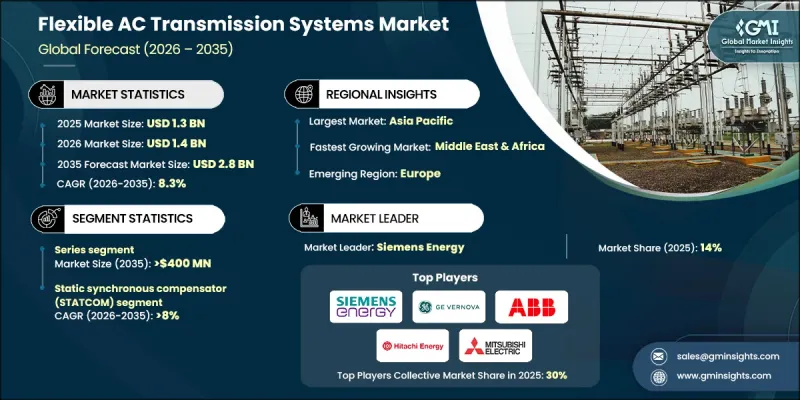
Market growth is driven by rising investment in transmission infrastructure as utilities upgrade aging grids to manage higher electricity flows and increasing operational complexity. Power networks are under growing pressure due to rapid renewable energy integration, which introduces variability, voltage instability, and intermittency challenges. As conventional power plants are gradually retired, modern grids increasingly rely on inverter-based generation, intensifying the need for advanced power flow control and voltage regulation solutions. Grid modernization initiatives across developed and emerging economies are accelerating the adoption of FACTS technologies, supported by continuous improvements in power electronics. Advanced converter-based solutions now offer faster response times, enhanced controllability, and improved efficiency, making them well-suited for dynamic grid conditions. Increasing electricity demand, congestion across transmission corridors, and the requirement to maximize existing infrastructure capacity are positioning FACTS systems as essential components of modern power networks.
| Market Scope | |
|---|---|
| Start Year | 2025 |
| Forecast Year | 2026-2035 |
| Start Value | $1.3 Billion |
| Forecast Value | $2.8 Billion |
| CAGR | 8.3% |
The series segment is projected to reach USD 400 million by 2035, reflecting its importance in improving transmission efficiency and enhancing grid stability. Series compensation technologies increase power transfer capability by reducing line reactance, allowing utilities to optimize existing assets rather than invest in new transmission construction. Their ability to deliver performance improvements at a lower overall cost continues to support steady deployment across high-load transmission networks.
The static synchronous compensator segment is expected to grow at a CAGR of 8% through 2035, driven by its ability to provide rapid reactive power support and precise voltage control. These systems play a critical role in stabilizing grids with high renewable penetration and are widely adopted in industrial environments where fluctuating loads impact power quality. Their flexibility and fast dynamic response make them a preferred solution for both utility-scale and industrial applications.
U.S. Flexible AC Transmission Systems Market USD 260.3 million in 2025. Growth in the country is supported by ongoing grid modernization efforts, rising electrification, and expanding renewable capacity. Increasing system stress from higher demand and evolving load profiles continues to drive investment in advanced transmission control technologies that enhance reliability and operational efficiency.
Key companies active in the Global Flexible AC Transmission Systems Market include Siemens Energy, Hitachi Energy, GE Vernova, Mitsubishi Electric, ABB, Hyosung Heavy Industries, LS Electric Co., Ingeteam, Infineon, Fuji SMBE Pte Ltd., BHEL, HICO America, NR Electric, Quanta Technology, and Elkraft Solutions Limited. Companies operating in the flexible AC transmission systems market focus on strengthening their market position through continuous technological innovation and strategic partnerships with utilities and grid operators. Investment in advanced power electronics, digital control platforms, and modular solutions enables suppliers to deliver flexible and scalable systems tailored to evolving grid requirements. Firms are also expanding service offerings that include system design, commissioning, and long-term maintenance to enhance customer retention. Geographic expansion into high-growth regions and participation in grid modernization programs support revenue diversification.
Table of Contents
Chapter 1 Methodology & Scope
- 1.1 Research design
- 1.2 Market estimates & forecast parameters
- 1.3 Forecast calculation
- 1.4 Data sources
- 1.4.1 Primary
- 1.4.2 Secondary
- 1.4.2.1 Paid
- 1.4.2.2 Public
Chapter 2 Executive Summary
- 2.1 Industry synopsis, 2022 - 2035
Chapter 3 Industry Insights
- 3.1 Industry ecosystem analysis
- 3.1.1 Raw material availability landscape
- 3.1.2 Factors affecting the value chain
- 3.1.3 Disruptions
- 3.2 Regulatory landscape
- 3.3 Industry impact forces
- 3.3.1 Growth drivers
- 3.3.2 Industry pitfalls & challenges
- 3.4 Growth potential analysis
- 3.5 Porter's analysis
- 3.5.1 Bargaining power of suppliers
- 3.5.2 Bargaining power of buyers
- 3.5.3 Threat of new entrants
- 3.5.4 Threat of substitutes
- 3.6 PESTEL analysis
- 3.6.1 Political factors
- 3.6.2 Economic factors
- 3.6.3 Social factors
- 3.6.4 Technological factors
- 3.6.5 Legal factors
- 3.6.6 Environmental factors
- 3.7 Emerging opportunities & trends
- 3.8 Investment analysis & future outlook
Chapter 4 Competitive Landscape, 2025
- 4.1 Introduction
- 4.2 Company market share, by region, 2025
- 4.2.1 North America
- 4.2.2 Europe
- 4.2.3 Asia Pacific
- 4.2.4 Middle East & Africa
- 4.2.5 Latin America
- 4.3 Strategic initiatives
- 4.4 Competitive benchmarking depictions
- 4.5 Strategy dashboard
- 4.6 Innovation & technology landscape
Chapter 5 Market Size and Forecast, By Configuration, 2022 - 2035 (USD Million, MVAr)
- 5.1 Key trends
- 5.2 Series
- 5.3 Shunt
- 5.4 Combined
Chapter 6 Market Size and Forecast, By Product, 2022 - 2035 (USD Million, MVAr)
- 6.1 Key trends
- 6.2 Static Var Compensator (SVC)
- 6.3 Thyristor Controlled Series Capacitor (TCSC)
- 6.4 Static Synchronous Compensator (STATCOM)
- 6.5 Unified Power Flow Controller (UPFC)
- 6.6 Others
Chapter 7 Market Size and Forecast, By Voltage, 2022 - 2035 (USD Million, MVAr)
- 7.1 Key trends
- 7.2 > 132 kV to ≤ 220 kV
- 7.3 > 220 kV to ≤ 660 kV
- 7.4 > 660 kV
Chapter 8 Market Size and Forecast, By End Use, 2022 - 2035 (USD Million, MVAr)
- 8.1 Key trends
- 8.2 Utilities
- 8.3 Renewables
- 8.4 Smart grid
- 8.5 Railways
- 8.6 Metal & mining industries
- 8.7 Oil & gas
- 8.8 Others
Chapter 9 Market Size and Forecast, By Region, 2022 - 2035 (USD Million, MVAr)
- 9.1 Key trends
- 9.2 North America
- 9.2.1 U.S.
- 9.2.2 Canada
- 9.2.3 Mexico
- 9.3 Europe
- 9.3.1 UK
- 9.3.2 France
- 9.3.3 Germany
- 9.3.4 Italy
- 9.3.5 Russia
- 9.3.6 Spain
- 9.4 Asia Pacific
- 9.4.1 China
- 9.4.2 Australia
- 9.4.3 India
- 9.4.4 Japan
- 9.4.5 South Korea
- 9.5 Middle East & Africa
- 9.5.1 Saudi Arabia
- 9.5.2 UAE
- 9.5.3 Turkey
- 9.5.4 South Africa
- 9.5.5 Egypt
- 9.6 Latin America
- 9.6.1 Brazil
- 9.6.2 Argentina
Chapter 10 Company Profiles
- 10.1 ABB
- 10.2 BHEL
- 10.3 Elkraft Solutions Limited
- 10.4 Fuji SMBE Pte Ltd.
- 10.5 GE Vernova
- 10.6 HICO America
- 10.7 Hitachi Energy
- 10.8 Hyosung Heavy Industries
- 10.9 Infineon
- 10.10 Ingeteam
- 10.11 LS Electric Co.
- 10.12 Mitsubishi Electric
- 10.13 NR Electric
- 10.14 Quanta Technology
- 10.15 Siemens Energy

