
PUBLISHER: Global Market Insights Inc. | PRODUCT CODE: 1936606

PUBLISHER: Global Market Insights Inc. | PRODUCT CODE: 1936606
Organic Peroxide Market Opportunity, Growth Drivers, Industry Trend Analysis, and Forecast 2026 - 2035
The Global Organic Peroxide Market was valued at USD 2.39 billion in 2025 and is estimated to grow at a CAGR of 4.3% to reach USD 3.59 billion by 2035.
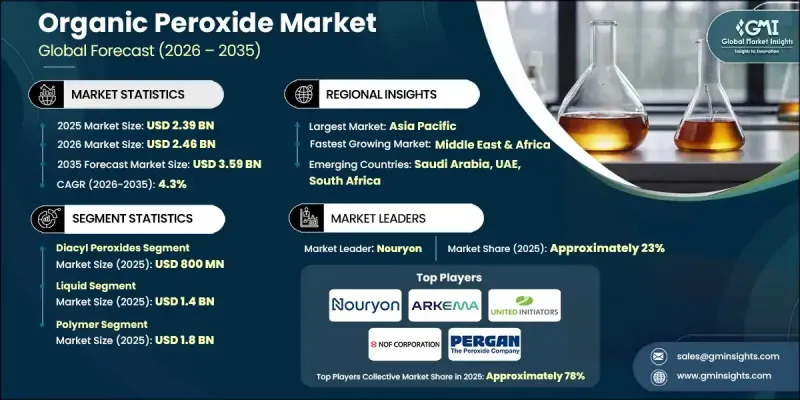
The industry is witnessing steady growth driven by rising demand for organic peroxides in polymerization processes for plastics and elastomers. These chemicals are crucial as curing agents and catalysts in the production of polyethylene, polypropylene, PVC, and rubber, which are widely used in packaging, construction, and consumer goods industries. Expanding polymer production capacities and the increasing adoption of high-performance composites in automotive, aerospace, and renewable energy sectors are fueling market expansion. The use of organic peroxides in thermoset resin curing and composite reinforcement is essential for lightweight, durable, and high-strength components. Growing trends in electric vehicles, lightweight automotive parts, and wind energy applications are significantly boosting demand. Innovations in safer handling, tailored formulations, and automated dosing systems are also shaping the market landscape, creating opportunities for high-value industrial applications.
| Market Scope | |
|---|---|
| Start Year | 2025 |
| Forecast Year | 2026-2035 |
| Start Value | $2.39 Billion |
| Forecast Value | $3.59 Billion |
| CAGR | 4.3% |
The diacyl peroxides segment generated USD 800 million in 2025 and is projected to grow at a CAGR of 4.4% from 2026 to 2035. Diacyl peroxides, such as benzoyl peroxide, are widely used in processes requiring controlled initiation and predictable reactions. Meanwhile, dialkyl peroxides are preferred for high-temperature operations due to their stability and predictable decomposition, supporting consistent growth across various peroxide types.
The liquid organic peroxide segment was valued at USD 1.4 billion in 2025 and is anticipated to expand at a CAGR of 4.4% through 2035. Liquid peroxides are increasingly favored in applications that demand precise dosing, uniform dispersion, and automated feeding systems. Paste and powder forms are also utilized in processes requiring controlled release and enhanced safety, reflecting the diverse requirements of polymer and composite manufacturing.
North America Organic Peroxide Market accounted for USD 660 million in 2025. The region benefits from advanced polymer production, steady demand in automotive, construction, and industrial markets, and robust chemical infrastructure with high safety and efficiency standards. Growth is increasingly driven by tailored formulations, safer handling approaches, and applications in cross-linked polymers and thermoset composites rather than purely volume-based expansion.
Key players in the Global Organic Peroxide Market include Nouryon, Arkema, United Initiators, NOF Corporation, Pergan GmbH, and others. Key strategies adopted by companies in the organic peroxide market include investing in research and development to create safer, more efficient, and high-performance peroxide formulations. Firms are focusing on process innovation to enhance automation, improve dosing accuracy, and reduce hazards in handling. Expanding production capacity and establishing regional manufacturing hubs enable companies to cater to rising demand in key markets. Strategic partnerships, collaborations, and supply agreements are being leveraged to strengthen market presence and ensure steady raw material sourcing. Diversification of product portfolios for high-performance polymers, composites, and thermoset applications is also a critical approach. Companies are emphasizing sustainability and regulatory compliance, particularly in reducing environmental impact and aligning with global safety standards, to maintain competitiveness and long-term market leadership.
Table of Contents
Chapter 1 Methodology
- 1.1 Market scope and definition
- 1.2 Research design
- 1.2.1 Research approach
- 1.2.2 Data collection methods
- 1.3 Data mining sources
- 1.3.1 Global
- 1.3.2 Regional/Country
- 1.4 Base estimates and calculations
- 1.4.1 Base year calculation
- 1.4.2 Key trends for market estimation
- 1.5 Primary research and validation
- 1.5.1 Primary sources
- 1.6 Forecast model
- 1.7 Research assumptions and limitations
Chapter 2 Executive Summary
- 2.1 Industry 360° synopsis
- 2.2 Key market trends
- 2.2.1 Regional
- 2.2.2 Type
- 2.2.3 Form
- 2.2.4 Application
- 2.3 TAM Analysis, 2026-2035
- 2.4 CXO perspectives: Strategic imperatives
- 2.4.1 Executive decision points
- 2.4.2 Critical success factors
- 2.5 Future Outlook and Strategic Recommendations
Chapter 3 Industry Insights
- 3.1 Industry ecosystem analysis
- 3.1.1 Supplier Landscape
- 3.1.2 Profit Margin
- 3.1.3 Value addition at each stage
- 3.1.4 Factor affecting the value chain
- 3.1.5 Disruptions
- 3.2 Industry impact forces
- 3.2.1 Growth drivers
- 3.2.2 Industry pitfalls and challenges
- 3.2.3 Market opportunities
- 3.3 Growth potential analysis
- 3.4 Regulatory landscape
- 3.4.1 North America
- 3.4.2 Europe
- 3.4.3 Asia Pacific
- 3.4.4 Latin America
- 3.4.5 Middle East & Africa
- 3.5 Porter's analysis
- 3.6 PESTEL analysis
- 3.7 Price trends
- 3.7.1 By region
- 3.7.2 By product
- 3.8 Future market trends
- 3.9 Technology and Innovation landscape
- 3.9.1 Current technological trends
- 3.9.2 Emerging technologies
- 3.10 Patent Landscape
- 3.11 Trade statistics (Note: the trade statistics will be provided for key countries only)
- 3.11.1 Major importing countries
- 3.11.2 Major exporting countries
- 3.12 Sustainability and Environmental Aspects
- 3.12.1 Sustainable Practices
- 3.12.2 Waste Reduction Strategies
- 3.12.3 Energy Efficiency in Production
- 3.12.4 Eco-friendly Initiatives
- 3.13 Carbon Footprint Considerations
Chapter 4 Competitive Landscape, 2025
- 4.1 Introduction
- 4.2 Company market share analysis
- 4.2.1 By region
- 4.2.1.1 North America
- 4.2.1.2 Europe
- 4.2.1.3 Asia Pacific
- 4.2.1.4 LATAM
- 4.2.1.5 MEA
- 4.2.1 By region
- 4.3 Company matrix analysis
- 4.4 Competitive analysis of major market players
- 4.5 Competitive positioning matrix
- 4.6 Key developments
- 4.6.1 Mergers & acquisitions
- 4.6.2 Partnerships & collaborations
- 4.6.3 New Product Launches
- 4.6.4 Expansion Plans
Chapter 5 Market Estimates and Forecast, By Type, 2022- 2035 (USD Billion, Kilo Tons)
- 5.1 Key trends
- 5.2 Diacyl Peroxides (e.g., benzoyl peroxide)
- 5.3 Dialkyl Peroxides
- 5.4 Peroxyesters
- 5.5 Hydroperoxides
- 5.6 Ketone Peroxides
- 5.7 Peroxyketals
- 5.8 Others (specialty blends)
Chapter 6 Market Estimates and Forecast, By Form, 2022- 2035 (USD Billion, Kilo Tons)
- 6.1 Key trends
- 6.2 Liquid
- 6.3 Paste
- 6.4 Powder
- 6.5 Granules
Chapter 7 Market Estimates and Forecast, By Application, 2022 - 2035 (USD Billion, Kilo Tons)
- 7.1 Key trends
- 7.2 Polymer
- 7.2.1 Polyethylene
- 7.2.2 Polypropylene
- 7.2.3 PVC
- 7.2.4 Other thermoplastics
- 7.3 Coatings & adhesives
- 7.3.1 Industrial coatings
- 7.3.2 Automotive coatings
- 7.3.3 Construction adhesives
- 7.3.4 Sealants
- 7.4 Paper & textiles
- 7.4.1 Bleaching agents
- 7.4.2 Textile finishing
- 7.4.3 Paper brightening
- 7.5 Cosmetics
- 7.5.1 Hair care products
- 7.5.2 Skin care formulations
- 7.5.3 Oral care products
- 7.6 Rubber
- 7.6.1 Crosslinking of elastomers
- 7.6.2 Vulcanization processes
- 7.7 Healthcare
- 7.7.1 Pharmaceutical intermediates
- 7.7.2 Medical device manufacturing
- 7.8 Others
Chapter 8 Market Estimates and Forecast, By Region, 2022 - 2035 (USD Billion, Kilo Tons)
- 8.1 Key trends
- 8.2 North America
- 8.2.1 U.S.
- 8.2.2 Canada
- 8.3 Europe
- 8.3.1 Germany
- 8.3.2 UK
- 8.3.3 France
- 8.3.4 Italy
- 8.3.5 Spain
- 8.3.6 Rest of Europe
- 8.4 Asia Pacific
- 8.4.1 China
- 8.4.2 India
- 8.4.3 Japan
- 8.4.4 Australia
- 8.4.5 South Korea
- 8.4.6 Rest of Asia Pacific
- 8.5 Latin America
- 8.5.1 Brazil
- 8.5.2 Mexico
- 8.5.3 Argentina
- 8.5.4 Rest of Latin America
- 8.6 Middle East & Africa
- 8.6.1 Saudi Arabia
- 8.6.2 South Africa
- 8.6.3 UAE
- 8.6.4 Rest of Middle East & Africa
Chapter 9 Company Profiles
- 9.1 Arkema
- 9.2 United Initiators
- 9.3 Kawaguchi Chemical Co., Ltd.
- 9.4 AkzoNobel
- 9.5 Pergan GmbH
- 9.6 Nouryon
- 9.7 NOF Corporation
- 9.8 BASF
- 9.9 PeroxyChem
- 9.10 Solvay
- 9.11 Evonik Industries
- 9.12 Mitsubishi Gas Chemical
- 9.13 DOW
- 9.14 Huntsman Corporation

