PUBLISHER: Global Market Insights Inc. | PRODUCT CODE: 1936654

PUBLISHER: Global Market Insights Inc. | PRODUCT CODE: 1936654
Polyacrylamide Market Opportunity, Growth Drivers, Industry Trend Analysis, and Forecast 2026 - 2035
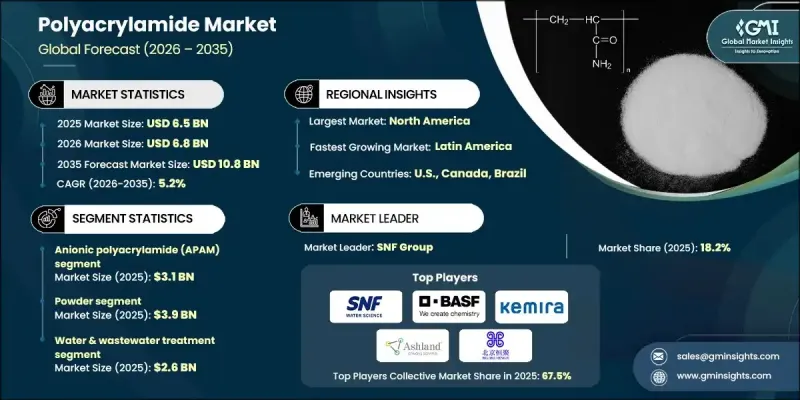
The Global Polyacrylamide Market was valued at USD 6.5 billion in 2025 and is estimated to grow at a CAGR of 5.2% to reach USD 10.8 billion by 2035.
The market is experiencing significant expansion, driven by advancements in water treatment and wastewater management systems. Rapid urbanization, stricter environmental regulations, and the need for efficient water management solutions are encouraging governments and industries to invest heavily in municipal and industrial water treatment infrastructure. Polyacrylamide, a high-performance flocculant, plays a vital role in these systems by aiding sludge dewatering, solid-liquid separation, and effluent purification. Long-term commitments to water quality and regulatory compliance are continuously driving demand. Furthermore, growth in sectors such as mining and textiles is expanding the market footprint. In mining operations, polyacrylamide supports tailings management and water recovery, improving operational efficiency and resource utilization. In the textile industry, it assists in processes like sizing, dyeing, and wastewater treatment, aligning with the growing emphasis on sustainable production and effluent management. Overall, increasing regulatory enforcement and industrial water consumption continue to create strong growth opportunities for polyacrylamide globally.
| Market Scope | |
|---|---|
| Start Year | 2025 |
| Forecast Year | 2026-2035 |
| Start Value | $6.5 Billion |
| Forecast Value | $10.8 Billion |
| CAGR | 5.2% |
The anionic polyacrylamide (APAM) segment reached USD 3.1 billion in 2025. Its widespread adoption in municipal and industrial wastewater treatment, mining processes, and oil recovery applications is a key driver. High flocculation efficiency, cost-effectiveness, and regulatory compliance make APAM the preferred choice for large-scale solid-liquid separation and effluent management, particularly in regions with stringent environmental laws. The polymer's continued use in water-intensive industries strengthens its dominance within the product mix.
The water and wastewater treatment segment was valued at USD 2.6 billion in 2025 and is estimated to grow at a CAGR of 4.7% during the forecast period. As the primary application of polyacrylamide, this segment benefits from its critical role in flocculation, sludge handling, and solid-liquid separation in municipal and industrial plants. Rising urbanization, regulatory oversight of effluent discharge, and upgrades in treatment infrastructure reinforce the segment's growth potential. The demand for effective, affordable water treatment solutions ensures sustained high-volume sales in both mature and emerging markets.
North America Polyacrylamide Market accounted for 20% share in 2025, with the majority of regional revenue coming from the United States. Growth in this region is supported by extensive water treatment infrastructure and a robust oil and gas sector. Stringent environmental regulations on wastewater discharge, widespread use in municipal purification facilities, and polymers' role in oil recovery are key factors driving demand. North America is a mature market offering stable growth due to continuous infrastructure investment and increasing adoption of high-quality water treatment solutions.
Key players operating in the Global Polyacrylamide Market include Chinafloc Chemical Co. Ltd, BASF SE, SNF Group, Anhui Tianrun Chemicals Co. Ltd, Henan Hangrui Environmental Protection Technology, Kemira Oyj, Ashland Global Holdings Inc., Beijing Hengju Chemical Group Co., Ltd., Wego Chemical Group Inc., Catalynt Solutions, Inc., Shandong Shuiheng Chemical Co. Ltd, Zibo East Polymer Co. Ltd, NNA Polymers, Inc., Henan Secco Environmental Protection Tech Co. Ltd, and Welldone Chemical Group. To strengthen their position, companies in the polyacrylamide industry are focusing on several strategic initiatives. They are investing in R&D to produce more efficient, environmentally friendly, and cost-effective polymers. Strategic partnerships, mergers, and acquisitions allow them to expand geographically and gain access to new customer segments. Firms are adopting advanced manufacturing technologies to improve quality and operational efficiency while reducing production costs.
Table of Contents
Chapter 1 Methodology & Scope
- 1.1 Market scope and definition
- 1.2 Research design
- 1.2.1 Research approach
- 1.2.2 Data collection methods
- 1.3 Data mining sources
- 1.3.1 Global
- 1.3.2 Regional/Country
- 1.4 Base estimates and calculations
- 1.4.1 Base year calculation
- 1.4.2 Key trends for market estimation
- 1.5 Primary research and validation
- 1.5.1 Primary sources
- 1.6 Forecast model
- 1.7 Research assumptions and limitations
Chapter 2 Executive Summary
- 2.1 Industry 3600 synopsis
- 2.2 Key market trends
- 2.2.1 Regional
- 2.2.2 Product Type
- 2.2.3 Form
- 2.2.4 Application
- 2.3 TAM Analysis, 2026-2035
- 2.4 CXO perspectives: Strategic imperatives
- 2.4.1 Executive decision points
- 2.4.2 Critical success factors
- 2.5 Future Outlook and Strategic Recommendations
Chapter 3 Industry Insights
- 3.1 Industry ecosystem analysis
- 3.1.1 Supplier Landscape
- 3.1.2 Profit Margin
- 3.1.3 Value addition at each stage
- 3.1.4 Factor affecting the value chain
- 3.1.5 Disruptions
- 3.2 Industry impact forces
- 3.2.1 Growth drivers
- 3.2.1.1 Global advent of advanced waste treatment & disposal technologies
- 3.2.1.2 Developments across mining & textile industries
- 3.2.1.3 Expansion of shale gas & tight oil production
- 3.2.2 Industry pitfalls and challenges
- 3.2.2.1 Volatile raw material prices
- 3.2.2.2 Stringent residual monomer regulations
- 3.2.2.3 Environmental concerns over acrylamide toxicity
- 3.2.3 Market opportunities
- 3.2.3.1 Rising demand in water treatment applications
- 3.2.3.2 Expansion in enhanced oil recovery (EOR) and mining
- 3.2.1 Growth drivers
- 3.3 Growth potential analysis
- 3.4 Regulatory landscape
- 3.4.1 North America
- 3.4.2 Europe
- 3.4.3 Asia Pacific
- 3.4.4 Latin America
- 3.4.5 Middle East & Africa
- 3.5 Porter's analysis
- 3.6 PESTEL analysis
- 3.7 Price trends
- 3.7.1 By region
- 3.7.2 Product type
- 3.8 Future market trends
- 3.9 Technology and Innovation Landscape
- 3.9.1 Current technological trends
- 3.9.2 Emerging technologies
- 3.10 Patent Landscape
- 3.11 Trade statistics (HS code) (Note: the trade statistics will be provided for key countries only)
- 3.11.1 Major importing countries
- 3.11.2 Major exporting countries
- 3.12 Sustainability and environmental aspects
- 3.12.1 Sustainable practices
- 3.12.2 Waste reduction strategies
- 3.12.3 Energy efficiency in production
- 3.12.4 Eco-friendly initiatives
- 3.13 Carbon footprint considerations
Chapter 4 Competitive Landscape, 2024
- 4.1 Introduction
- 4.2 Company market share analysis
- 4.2.1 By region
- 4.2.1.1 North America
- 4.2.1.2 Europe
- 4.2.1.3 Asia Pacific
- 4.2.1.4 LATAM
- 4.2.1.5 MEA
- 4.2.1 By region
- 4.3 Company matrix analysis
- 4.4 Competitive analysis of major market players
- 4.5 Competitive positioning matrix
- 4.6 Key developments
- 4.6.1 Mergers & acquisitions
- 4.6.2 Partnerships & collaborations
- 4.6.3 New product launches
- 4.6.4 Expansion plans
Chapter 5 Market Estimates and Forecast, By Product Type, 2022 - 2035 (USD Million) (Kilo Tons)
- 5.1 Key trends
- 5.2 Anionic polyacrylamide (APAM)
- 5.3 Cationic polyacrylamide (CPAM)
- 5.4 Non-ionic polyacrylamide (NPAM)
- 5.5 Amphoteric polyacrylamide
- 5.6 Others
Chapter 6 Market Estimates and Forecast, By Form, 2022 - 2035 (USD Million) (Kilo Tons)
- 6.1 Key trends
- 6.2 Powder
- 6.3 Emulsion
- 6.4 Liquid
- 6.5 Others
Chapter 7 Market Estimates and Forecast, By Application, 2022 - 2035 (USD million) (Kilo Tons)
- 7.1 Key trends
- 7.2 Water & wastewater treatment
- 7.3 Enhanced oil recovery (EOR)
- 7.4 Mining & mineral processing
- 7.5 Agriculture
- 7.6 Textiles & dyeing
- 7.7 Cosmetics & personal care
- 7.8 Others
Chapter 8 Market Estimates and Forecast, By Region, 2022 - 2035 (USD million) (Kilo Tons)
- 8.1 Key trends
- 8.2 North America
- 8.2.1 U.S.
- 8.2.2 Canada
- 8.3 Europe
- 8.3.1 Germany
- 8.3.2 UK
- 8.3.3 France
- 8.3.4 Spain
- 8.3.5 Italy
- 8.3.6 Rest of Europe
- 8.4 Asia Pacific
- 8.4.1 China
- 8.4.2 India
- 8.4.3 Japan
- 8.4.4 Australia
- 8.4.5 South Korea
- 8.4.6 Rest of Asia Pacific
- 8.5 Latin America
- 8.5.1 Brazil
- 8.5.2 Mexico
- 8.5.3 Rest of Latin America
- 8.6 Middle East and Africa
- 8.6.1 Saudi Arabia
- 8.6.2 South Africa
- 8.6.3 UAE
- 8.6.4 Rest of Middle East and Africa
Chapter 9 Company Profiles
- 9.1 SNF Group
- 9.2 Kemira Oyj
- 9.3 BASF SE
- 9.4 Ashland Global Holdings Inc.
- 9.5 NNA Polymers, Inc.
- 9.6 Wego Chemical Group Inc.
- 9.7 Catalynt Solutions, Inc.
- 9.8 Chinafloc Chemical Co. Ltd
- 9.9 Henan Hangrui Environmental Protection Technology
- 9.10 Shandong Shuiheng Chemical Co. Ltd
- 9.11 Anhui Tianrun Chemicals Co. Ltd
- 9.12 Zibo East Polymer Co. Ltd
- 9.13 Welldone Chemical Group
- 9.14 Henan Secco Environmental Protection Tech Co. Ltd
- 9.15 Beijing Hengju Chemical Group Co., Ltd.

