PUBLISHER: Global Market Insights Inc. | PRODUCT CODE: 1936660

PUBLISHER: Global Market Insights Inc. | PRODUCT CODE: 1936660
Flavors Market Opportunity, Growth Drivers, Industry Trend Analysis, and Forecast 2026 - 2035
The Global Flavors Market for Pharmaceutical & Healthcare Applications was valued at USD 1.3 billion in 2025 and is estimated to grow at a CAGR of 4.2% to reach USD 2 billion by 2035.
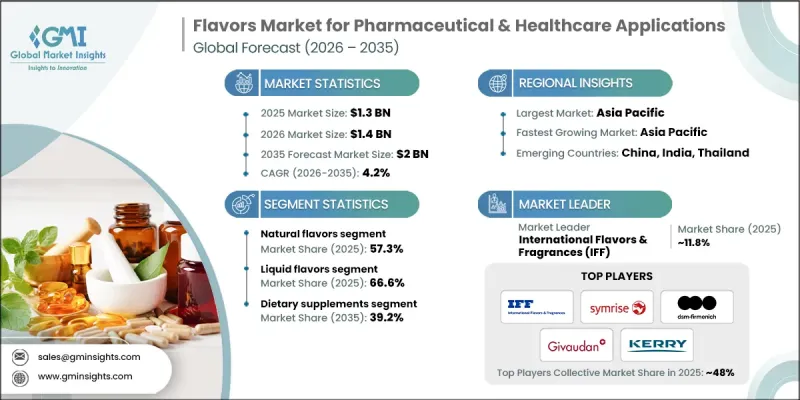
The market supports pharmaceutical and healthcare manufacturers by providing functional flavor systems designed to improve palatability, support patient adherence, and enhance overall sensory quality in medicinal and wellness formulations. These solutions are engineered to neutralize unpleasant taste profiles, improve formulation acceptance, and align with evolving regulatory and consumer expectations. Available across multiple formulation categories, pharmaceutical-grade flavors serve critical roles in dosage optimization, sensory balance, and formulation consistency. Ongoing growth in pharmaceutical production volumes, increasing consumption of health-focused products, and continuous innovation in flavor science are collectively shaping market momentum. Manufacturers are investing heavily in advanced taste-masking techniques and performance-focused flavor development to support a wide range of therapeutic applications. At the same time, the industry is undergoing a clean-label transformation, with growing emphasis on naturally sourced ingredients and transparent formulation practices that align with regulatory standards and shifting consumer preferences across global healthcare systems.
| Market Scope | |
|---|---|
| Start Year | 2025 |
| Forecast Year | 2026-2035 |
| Start Value | $1.3 Billion |
| Forecast Value | $2 Billion |
| CAGR | 4.2% |
The natural flavors segment accounted for 57.3% share in 2025 and is expected to grow at a CAGR of 4.2% from 2026 to 2035. Their dominance is supported by strong acceptance across pharmaceutical formulations, alignment with clean-label initiatives, and consistent performance across multiple product categories. These flavor solutions offer effective taste optimization while maintaining regulatory compliance and formulation stability. Their broad compatibility with pharmaceutical ingredients and delivery formats reinforces their leading position across major production regions worldwide.
The liquid flavor formats segment held a 66.6% share in 2025 and is forecast to grow at a CAGR of 4.2% through 2035. This segment leads due to efficient incorporation into pharmaceutical manufacturing processes, consistent dispersion, and reliable flavor delivery. Liquid systems support uniform sensory outcomes while enabling scalable production and operational efficiency. Their adaptability across diverse formulation requirements continues to strengthen their role in pharmaceutical and healthcare product development globally.
U.S. Flavors Market for Pharmaceutical & Healthcare Applications generated USD 327.6 million in 2025. Growth in the country is driven by sustained pharmaceutical manufacturing activity, rising formulation complexity, and strong demand for flavor systems that enhance compliance and product differentiation. Advanced production infrastructure and continuous innovation in formulation technologies continue to support steady demand across the United States.
Key companies active in the Global Flavors Market for Pharmaceutical & Healthcare Applications include Givaudan, DSM-Firmenich, Sensient Technologies, International Flavors & Fragrances, Kerry Group, MANE SA, Takasago International Corporation, Glanbia Nutritionals, Metarom Group, Prinova under the Nagase Group, Roquette, Keva Flavours, Sensapure, FONA International, and Symrise AG. These players maintain competitive positions through innovation, regulatory expertise, and diversified flavor portfolios. To strengthen their presence, companies in the pharmaceutical and healthcare flavors sector focus on continuous investment in research and development to enhance taste-masking efficiency and formulation performance. Strategic expansion into high-growth regions and long-term partnerships with pharmaceutical manufacturers help secure stable demand. Many firms emphasize clean-label innovation and natural ingredient sourcing to align with regulatory trends and customer expectations.
Table of Contents
Chapter 1 Methodology & Scope
- 1.1 Market scope and definition
- 1.2 Research design
- 1.2.1 Research approach
- 1.2.2 Data collection methods
- 1.3 Data mining sources
- 1.3.1 Global
- 1.3.2 Regional/Country
- 1.4 Base estimates and calculations
- 1.4.1 Base year calculation
- 1.4.2 Key trends for market estimation
- 1.5 Primary research and validation
- 1.5.1 Primary sources
- 1.6 Forecast model
- 1.7 Research assumptions and limitations
Chapter 2 Executive Summary
- 2.1 Industry 3600 synopsis
- 2.2 Key market trends
- 2.2.1 Product
- 2.2.2 Application
- 2.2.3 Regional
- 2.3 TAM Analysis, 2026-2035
- 2.4 CXO perspectives: Strategic imperatives
- 2.4.1 Executive decision points
- 2.4.2 Critical success factors
- 2.5 Future outlook and strategic recommendations
Chapter 3 Industry Insights
- 3.1 Industry ecosystem analysis
- 3.1.1 Supplier landscape
- 3.1.2 Profit margin
- 3.1.3 Value addition at each stage
- 3.1.4 Factor affecting the value chain
- 3.1.5 Disruptions
- 3.2 Industry impact forces
- 3.2.1 Growth drivers
- 3.2.2 Industry pitfalls and challenges
- 3.2.3 Market opportunities
- 3.3 Growth potential analysis
- 3.4 Regulatory landscape
- 3.4.1 North America
- 3.4.2 Europe
- 3.4.3 Asia Pacific
- 3.4.4 Latin America
- 3.4.5 Middle East & Africa
- 3.5 Porter's analysis
- 3.6 PESTEL analysis
- 3.7 Technology and innovation landscape
- 3.7.1 Current technological trends
- 3.7.2 Emerging technologies
- 3.8 Price trends
- 3.8.1 By region
- 3.8.2 By flavor
- 3.9 Future market trends
- 3.10 Patent landscape
- 3.11 Trade statistics (HS code) (Note: the trade statistics will be provided for key countries only)
- 3.11.1 Major importing countries
- 3.11.2 Major exporting countries
- 3.12 Sustainability and environmental aspects
- 3.12.1 Sustainable practices
- 3.12.2 Waste reduction strategies
- 3.12.3 Energy efficiency in production
- 3.12.4 Eco-friendly initiatives
- 3.13 Carbon footprint consideration
Chapter 4 Competitive Landscape, 2025
- 4.1 Introduction
- 4.2 Company market share analysis
- 4.2.1 By region
- 4.2.1.1 North America
- 4.2.1.2 Europe
- 4.2.1.3 Asia Pacific
- 4.2.1.4 LATAM
- 4.2.1.5 MEA
- 4.2.1 By region
- 4.3 Company matrix analysis
- 4.4 Competitive analysis of major market players
- 4.5 Competitive positioning matrix
- 4.6 Key developments
- 4.6.1 Mergers & acquisitions
- 4.6.2 Partnerships & collaborations
- 4.6.3 New product launches
- 4.6.4 Expansion plans
Chapter 5 Market Estimates and Forecast, By Flavor, 2022-2035 (USD Million) (Kilo Tons)
- 5.1 Key trends
- 5.2 Natural flavors
- 5.2.1 Fruit-based flavors
- 5.2.2 Mint flavors
- 5.2.3 Vanilla flavors
- 5.2.4 Chocolate flavors
- 5.2.5 Others
- 5.3 Synthetic / artificial flavors
- 5.4 Others
Chapter 6 Market Estimates and Forecast, By Form, 2022-2035 (USD Million) (Kilo Tons)
- 6.1 Key trends
- 6.2 Liquid flavors
- 6.3 Powder / dry flavors
- 6.4 Paste / gel flavors
- 6.5 Others
Chapter 7 Market Estimates and Forecast, By Application, 2022-2035 (USD Million) (Kilo Tons)
- 7.1 OTC drugs
- 7.2 Dietary supplements
- 7.2.1 Vitamins & minerals
- 7.2.2 Proteins & amino acids
- 7.2.3 Dietary fibers
- 7.2.4 Omega fatty acids
- 7.2.5 Others
- 7.3 Therapeutic nutrition
- 7.4 Healthcare nutrition
- 7.4.1 Infant nutrition
- 7.4.2 Sports nutrition
- 7.4.3 Clinical malnutrition
- 7.4.4 Others
Chapter 8 Market Estimates and Forecast, By Region, 2022-2035 (USD Million) (Kilo Tons)
- 8.1 Key trends
- 8.2 North America
- 8.2.1 U.S.
- 8.2.2 Canada
- 8.3 Europe
- 8.3.1 Germany
- 8.3.2 UK
- 8.3.3 France
- 8.3.4 Spain
- 8.3.5 Italy
- 8.3.6 Rest of Europe
- 8.4 Asia Pacific
- 8.4.1 China
- 8.4.2 India
- 8.4.3 Japan
- 8.4.4 Australia
- 8.4.5 South Korea
- 8.4.6 Rest of Asia Pacific
- 8.5 Latin America
- 8.5.1 Brazil
- 8.5.2 Mexico
- 8.5.3 Argentina
- 8.5.4 Rest of Latin America
- 8.6 Middle East and Africa
- 8.6.1 Saudi Arabia
- 8.6.2 South Africa
- 8.6.3 UAE
- 8.6.4 Rest of Middle East and Africa
Chapter 9 Company Profiles
- 9.1 International Flavors & Fragrances (IFF)
- 9.2 Symrise AG
- 9.3 DSM-Firmenich
- 9.4 Givaudan
- 9.5 Takasago International Corporation
- 9.6 Kerry Group
- 9.7 Sensient Technologies
- 9.8 MANE SA
- 9.9 Glanbia Nutritionals
- 9.10 Prinova (Nagase Group)
- 9.11 Metarom Group
- 9.12 Roquette
- 9.13 FONA International
- 9.14 Keva Flavours
- 9.15 Sensapure

