PUBLISHER: Global Market Insights Inc. | PRODUCT CODE: 1936668

PUBLISHER: Global Market Insights Inc. | PRODUCT CODE: 1936668
Paper and Pulp Enzymes Market Opportunity, Growth Drivers, Industry Trend Analysis, and Forecast 2026 - 2035
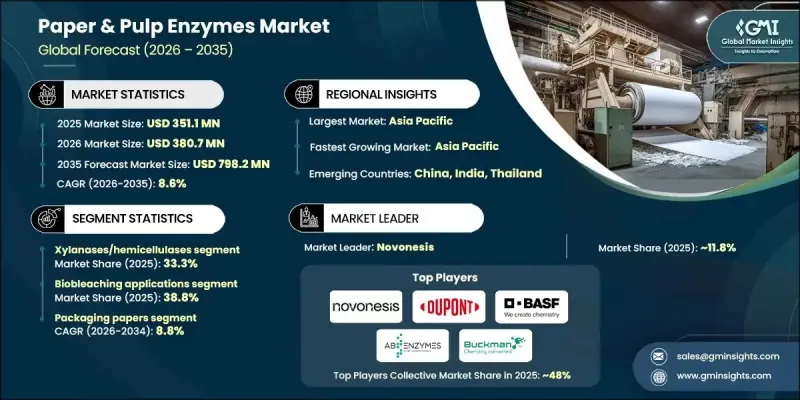
The Global Paper & Pulp Enzymes Market was valued at USD 351.1 million in 2025 and is estimated to grow at a CAGR of 8.6% to reach USD 798.2 million by 2035.
The market is witnessing consistent growth as the pulp and paper industry increasingly adopts biotechnological solutions to enhance efficiency, reduce chemical usage, and improve product quality. Enzymes derived from microbial sources play a critical role in modern papermaking processes, including biobleaching, fiber modification, deinking, and drainage optimization. These biological catalysts help reduce environmental impact while maintaining high-quality output in both virgin and recycled pulp operations. With growing demand for sustainable production practices, rising recycling requirements, and the development of advanced enzyme formulations, the market is becoming highly dynamic. Companies are investing in multi-enzyme systems and performance optimization across packaging, printing, tissue, and specialty paper applications. The convergence of environmental compliance, technological advancements, and rising global paper consumption ensures strong long-term demand and growth across North America, Europe, and Asia-Pacific regions.
| Market Scope | |
|---|---|
| Start Year | 2025 |
| Forecast Year | 2026-2035 |
| Start Value | $351.1 Million |
| Forecast Value | $798.2 Million |
| CAGR | 8.6% |
The xylanases and hemicellulases segment held 33.3% share in 2025 and is expected to grow at a CAGR of 8.8% through 2035. These enzymes are preferred due to their high efficiency in lignin degradation, fiber liberation, and selective hemicellulose hydrolysis, which improves chemical penetration during bleaching without compromising fiber strength. Their proven performance across diverse pulp types, including kraft and chemical pulps, makes them essential for biobleaching applications and brightness enhancement. Xylanases are widely recognized for their versatility, allowing manufacturers to achieve improved pulp quality while reducing chlorine-based chemical consumption.
The biobleaching applications segment held 38.8% share in 2025 and is projected to grow at a CAGR of 8.8% during 2026-2035. Biobleaching is widely adopted due to its ability to reduce chemical use, lower environmental discharge, and improve economic efficiency in pulp processing. Enzyme-assisted bleaching operations decrease chlorine dioxide consumption by 10-30%, lower AOX levels, and maintain desired brightness standards. These applications are essential in both elemental chlorine-free (ECF) and totally chlorine-free (TCF) pulp production, enabling mills to meet regulatory and sustainability targets while optimizing operational performance.
U.S. Paper & Pulp Enzymes Market accounted for USD 90.9 million in 2025, reflecting strong regional adoption. The United States remains a major driver of enzyme consumption due to its mature integrated pulp mills, extensive recycled paper operations requiring deinking enzymes, and large-scale tissue production leveraging cellulases for softness and paper strength improvements. Continuous innovation in enzyme application technologies, especially within ECF bleaching sequences, alongside stringent environmental regulations, further enhances the U.S. market position.
Major companies operating in the Global Paper & Pulp Enzymes Market include AB Enzymes GmbH, Advanced Enzyme Technologies, Amano Enzyme Inc., Buckman, Creative Enzymes, DuPont Industrial Biosciences / IFF, EDT - Enzymatic Deinking Technologies, Jiangsu Boli Bioproducts / Boyang, Metgen Oy, Novonesis, Noor Enzymes, Rossari Biotech, Shandong Longda Bio-Products / Lonct, Sunson Industry Group, and BASF SE. Companies in the paper & pulp enzymes market are strengthening their presence through multiple strategies. They are investing in R&D to develop high-performance enzyme formulations that target diverse pulp types and specific applications such as biobleaching, deinking, and fiber modification. Strategic partnerships with pulp mills, recycling facilities, and specialty paper manufacturers enhance market reach and product adoption. Expansion of production capacities, introduction of multi-enzyme systems, and customization for regional environmental compliance regulations strengthen competitiveness.
Table of Contents
Chapter 1 Methodology & Scope
- 1.1 Market scope and definition
- 1.2 Research design
- 1.2.1 Research approach
- 1.2.2 Data collection methods
- 1.3 Data mining sources
- 1.3.1 Global
- 1.3.2 Regional/Country
- 1.4 Base estimates and calculations
- 1.4.1 Base year calculation
- 1.4.2 Key trends for market estimation
- 1.5 Primary research and validation
- 1.5.1 Primary sources
- 1.6 Forecast model
- 1.7 Research assumptions and limitations
Chapter 2 Executive Summary
- 2.1 Industry 3600 synopsis
- 2.2 Key market trends
- 2.2.1 Enzyme type
- 2.2.2 Application
- 2.2.3 End use
- 2.2.4 Regional
- 2.3 TAM Analysis, 2026-2035
- 2.4 CXO perspectives: Strategic imperatives
- 2.4.1 Executive decision points
- 2.4.2 Critical success factors
- 2.5 Future outlook and strategic recommendations
Chapter 3 Industry Insights
- 3.1 Industry ecosystem analysis
- 3.1.1 Supplier landscape
- 3.1.2 Profit margin
- 3.1.3 Value addition at each stage
- 3.1.4 Factor affecting the value chain
- 3.1.5 Disruptions
- 3.2 Industry impact forces
- 3.2.1 Growth drivers
- 3.2.2 Industry pitfalls and challenges
- 3.2.3 Market opportunities
- 3.3 Growth potential analysis
- 3.4 Regulatory landscape
- 3.4.1 North America
- 3.4.2 Europe
- 3.4.3 Asia Pacific
- 3.4.4 Latin America
- 3.4.5 Middle East & Africa
- 3.5 Porter's analysis
- 3.6 PESTEL analysis
- 3.7 Technology and innovation landscape
- 3.7.1 Current technological trends
- 3.7.2 Emerging technologies
- 3.8 Price trends
- 3.8.1 By region
- 3.8.2 By enzyme type
- 3.9 Future market trends
- 3.10 Technology and innovation landscape
- 3.10.1 Current technological trends
- 3.10.2 Emerging technologies
- 3.11 Patent landscape
- 3.12 Trade statistics (HS code) ( Note: the trade statistics will be provided for key countries only)
- 3.12.1 Major importing countries
- 3.12.2 Major exporting countries
- 3.13 Sustainability and environmental aspects
- 3.13.1 Sustainable practices
- 3.13.2 Waste reduction strategies
- 3.13.3 Energy efficiency in production
- 3.13.4 Eco-friendly initiatives
- 3.14 Carbon footprint consideration
Chapter 4 Competitive Landscape, 2025
- 4.1 Introduction
- 4.2 Company market share analysis
- 4.2.1 By region
- 4.2.1.1 North America
- 4.2.1.2 Europe
- 4.2.1.3 Asia Pacific
- 4.2.1.4 LATAM
- 4.2.1.5 MEA
- 4.2.1 By region
- 4.3 Company matrix analysis
- 4.4 Competitive analysis of major market players
- 4.5 Competitive positioning matrix
- 4.6 Key developments
- 4.6.1 Mergers & acquisitions
- 4.6.2 Partnerships & collaborations
- 4.6.3 New product launches
- 4.6.4 Expansion plans
Chapter 5 Market Estimates and Forecast, By Enzyme Type, 2022-2035 (USD Million) (Kilo Tons)
- 5.1 Key trends
- 5.2 Amylases
- 5.3 Xylanases / hemicellulases
- 5.4 Lipases
- 5.5 Cellulases
- 5.6 Pectinases
- 5.7 Others (laccases, levanases)
Chapter 6 Market Estimates and Forecast, By Application, 2022-2035 (USD Million) (Kilo Tons)
- 6.1 Key trends
- 6.2 Biobleaching Applications
- 6.2.1 ECF (elemental chlorine free) bleaching
- 6.2.2 TCF (totally chlorine free) processes
- 6.3 Fiber modification applications
- 6.4 Deinking and recycling applications
- 6.5 Drainage and formation enhancement
- 6.6 Others
Chapter 7 Market Estimates and Forecast, By End Use, 2022-2035 (USD Million) (Kilo Tons)
- 7.1 Key trends
- 7.2 Packaging papers
- 7.2.1 Corrugated medium and kraftliner
- 7.2.2 Folding boxboard and cartonboard
- 7.3 Printing & writing papers
- 7.3.1 Uncoated woodfree papers
- 7.3.2 Coated papers and newsprint
- 7.4 Tissue papers
- 7.5 Specialty papers
- 7.6 Others
Chapter 8 Market Estimates and Forecast, By Region, 2022-2035 (USD Million) (Kilo Tons)
- 8.1 Key trends
- 8.2 North America
- 8.2.1 U.S.
- 8.2.2 Canada
- 8.3 Europe
- 8.3.1 Germany
- 8.3.2 UK
- 8.3.3 France
- 8.3.4 Spain
- 8.3.5 Italy
- 8.3.6 Rest of Europe
- 8.4 Asia Pacific
- 8.4.1 China
- 8.4.2 India
- 8.4.3 Japan
- 8.4.4 Australia
- 8.4.5 South Korea
- 8.4.6 Rest of Asia Pacific
- 8.5 Latin America
- 8.5.1 Brazil
- 8.5.2 Mexico
- 8.5.3 Argentina
- 8.5.4 Rest of Latin America
- 8.6 Middle East and Africa
- 8.6.1 Saudi Arabia
- 8.6.2 South Africa
- 8.6.3 UAE
- 8.6.4 Rest of Middle East and Africa
Chapter 9 Company Profiles
- 9.1 Novonesis
- 9.2 Noor Enzymes
- 9.3 EDT - Enzymatic Deinking Technologies
- 9.4 Creative Enzymes
- 9.5 Shandong Longda Bio-Products / Lonct
- 9.6 AB Enzymes GmbH
- 9.7 Advanced Enzyme Technologies
- 9.8 Sunson Industry Group
- 9.9 DuPont Industrial Biosciences / IFF
- 9.10 BASF SE
- 9.11 Buckman
- 9.12 Metgen Oy
- 9.13 Jiangsu Boli Bioproducts / Boyang
- 9.14 Rossari Biotech
- 9.15 Amano Enzyme Inc.

