
PUBLISHER: Global Market Insights Inc. | PRODUCT CODE: 1959272

PUBLISHER: Global Market Insights Inc. | PRODUCT CODE: 1959272
ADAS Simulation Market Opportunity, Growth Drivers, Industry Trend Analysis, and Forecast 2026 - 2035
The Global ADAS Simulation Market was valued at USD 3.9 billion in 2025 and is estimated to grow at a CAGR of 13.1% to reach USD 13.2 billion by 2035.
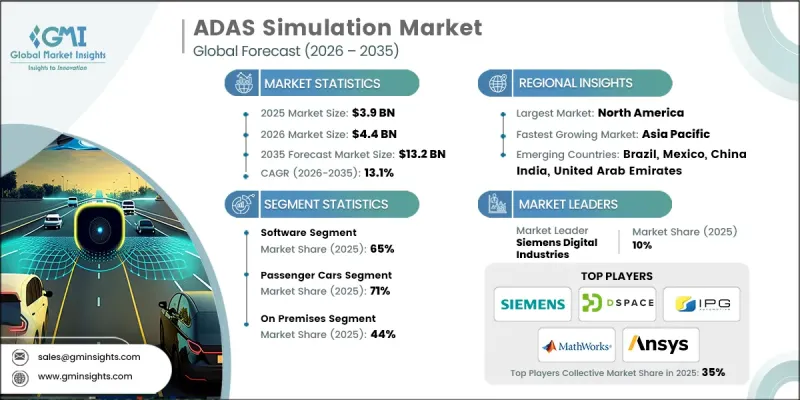
Advanced Driver Assistance Systems simulation has become a foundational pillar of modern automotive development, delivering highly sophisticated virtual environments that accurately mirror real-world driving conditions. The market encompasses integrated software platforms, hardware-in-the-loop systems, and specialized engineering services that support automakers and mobility technology firms in validating ADAS performance and safety. Over time, simulation capabilities have evolved from limited functional testing toward advanced digital twin ecosystems capable of recreating millions of virtual driving miles with high precision and efficiency. This transformation significantly reduces reliance on physical prototypes while accelerating development timelines. As vehicle automation grows increasingly complex, simulation platforms are playing a central role in verifying perception algorithms, sensor fusion logic, and real-time decision systems. The ADAS simulation market is therefore positioned as a critical enabler of safe and scalable autonomous mobility deployment worldwide.
| Market Scope | |
|---|---|
| Start Year | 2025 |
| Forecast Year | 2026-2035 |
| Start Value | $3.9 Billion |
| Forecast Value | $13.2 Billion |
| CAGR | 13.1% |
Adoption of ADAS simulation technologies is accelerated by regulatory mandates, cost optimization requirements, and rapid technological progress. The market is experiencing structural change as subscription-based SaaS deployment models replace traditional capital-intensive infrastructure investments. Historically, upfront expenditures ranging from USD 2.5 million to USD 15 million have limited accessibility for emerging suppliers and innovation-driven mobility startups. Cloud-native simulation ecosystems now support pay-per-use pricing structures, allowing organizations to leverage advanced testing frameworks through monthly subscription fees typically ranging from USD 15,000 to USD 200,000, depending on computational capacity and feature integration. This transition reduces financial barriers while expanding access to enterprise-grade validation capabilities. Evolving vehicle safety regulations and increased oversight are further reinforcing the need for continuous, scalable testing methodologies, strengthening the long-term outlook of the ADAS simulation market.
In 2025, the software segment accounted for 65% share and is forecast to grow at a CAGR of 13.7% between 2026 and 2035. This segment leads due to continuous platform enhancement, broader feature integration, and scalable licensing models that generate recurring revenue streams. Comprehensive software toolchains now include simulation engines, scenario modeling systems, advanced sensor emulation, vehicle dynamics modules, and immersive visualization frameworks that collectively enable full-cycle ADAS validation. Licensing structures vary widely, with annual subscriptions starting around USD 50,000 per seat for entry-level model-based testing environments and exceeding USD 500,000 per seat for enterprise-grade platforms offering real-time hardware integration, cloud scalability, and AI-enabled scenario automation.
The software-in-the-loop segment held a 40% share in 2025 and is expected to grow at a CAGR of 13.5% through 2035. Software-in-the-loop methodologies enable validation of ADAS algorithms within virtual environments prior to hardware deployment, significantly reducing development expenses and shortening iteration cycles. These platforms execute complex ADAS stacks on high-performance computing systems using synthetic sensor inputs and dynamic vehicle models. By enabling large-scale scenario testing without the need for physical vehicles, SIL simulation enhances development efficiency, mitigates safety risks, and accelerates time-to-market for advanced driver assistance technologies.
United States ADAS Simulation Market generated USD 1.1 billion in 2025 and is projected to grow at a CAGR of 12.4% from 2026 to 2035. The country maintains a leading global position due to stringent vehicle safety frameworks, expanding connected vehicle initiatives, and active regulatory supervision. Driving conditions are characterized by high-speed road networks and diverse mobility environments prompting manufacturers to intensify validation of advanced automation features. As a result, extensive simulation of complex traffic scenarios is required to meet compliance standards and ensure performance reliability. The strong presence of automotive OEMs, semiconductor innovators, and autonomous mobility startups further strengthens the United States' dominance in the ADAS simulation landscape.
Major companies operating in the Global ADAS Simulation Market include NVIDIA, Ansys, Siemens Digital Industries Software, dSPACE, IPG Automotive, MathWorks, Vector Informatik, Applied Intuition, Foretellix, and rFpro. Companies in the ADAS Simulation Market are reinforcing their competitive position through continuous innovation in scenario generation, AI-driven validation tools, and high-fidelity digital twin environments. Strategic partnerships with automotive OEMs and semiconductor manufacturers enable co-development of customized simulation frameworks tailored to next-generation vehicle architectures. Many vendors are expanding cloud infrastructure capabilities to support scalable, subscription-based service delivery models. Investment in real-time hardware integration and automated regression testing tools further enhances platform value. Additionally, companies prioritize interoperability with existing development toolchains, ensuring seamless integration across design, testing, and validation workflows while strengthening long-term enterprise relationships.
Table of Contents
Chapter 1 Methodology
- 1.1 Research approach
- 1.2 Quality commitments
- 1.3 Research trail and confidence scoring
- 1.3.1 Research trail components
- 1.3.2 Scoring components
- 1.4 Data collection
- 1.4.1 Partial list of primary sources
- 1.5 Data mining sources
- 1.5.1 Paid sources
- 1.6 Best estimates and calculations
- 1.6.1 Base year calculation for any one approach
- 1.7 Forecast model
- 1.8 Research transparency addendum
Chapter 2 Executive Summary
- 2.1 Industry 360° synopsis, 2022 - 2035
- 2.2 Key market trends
- 2.2.1 Regional
- 2.2.2 Offering
- 2.2.3 Vehicles
- 2.2.4 ADAS Features
- 2.2.5 Simulation
- 2.2.6 Deployment Mode
- 2.2.7 End Use
- 2.3 TAM Analysis, 2026-2035
Chapter 3 Industry Insights
- 3.1 Industry ecosystem analysis
- 3.1.1 Supplier landscape
- 3.1.2 Profit margin analysis
- 3.1.3 Cost structure
- 3.1.4 Value addition at each stage
- 3.1.5 Factor affecting the value chain
- 3.1.6 Disruptions
- 3.2 Industry impact forces
- 3.2.1 Growth drivers
- 3.2.1.1 Rising stringency in government safety regulations
- 3.2.1.2 Need to reduce physical testing costs
- 3.2.1.3 Accelerated development timelines for ADAS
- 3.2.1.4 Growth in autonomous vehicle development
- 3.2.1.5 Technological advancements in AI & sensor fusion
- 3.2.2 Industry pitfalls and challenges
- 3.2.2.1 High initial investment for simulation platforms
- 3.2.2.2 Lack of standardization across platforms
- 3.2.2.3 Physics-accurate sensor modeling complexity
- 3.2.2.4 Skilled workforce shortage
- 3.2.3 Market opportunities
- 3.2.3.1 Simulation-as-a-service (SaaS) business models
- 3.2.3.2 Expansion into emerging autonomous vehicle markets
- 3.2.3.3 Regional market growth in Asia Pacific
- 3.2.3.4 Integration with generative AI for scenario creation
- 3.2.3.5 V2X (vehicle-to-everything) simulation
- 3.2.1 Growth drivers
- 3.3 Growth potential analysis
- 3.4 Regulatory landscape
- 3.4.1 North America
- 3.4.1.1 US- Federal safety rules & ADAS deployment guidance
- 3.4.1.2 Canada - Safety framework for connected & automated vehicles (CASF)
- 3.4.2 Europe
- 3.4.2.1 Germany- EU ITS & national initiatives
- 3.4.2.2 UK- Post-Brexit ADAS flexibility
- 3.4.2.3 France- National ADAS testing & ITS strategy
- 3.4.2.4 Italy- ITS pilots & smart infrastructure
- 3.4.3 Asia Pacific
- 3.4.3.1 China- MIIT C-V2X mandates & standards
- 3.4.3.2 India- Emerging ADAS & automotive connectivity regulations
- 3.4.3.3 Japan- ITS connect & spectrum policy
- 3.4.3.4 Australia- Technology neutral ITS policies
- 3.4.4 LATAM
- 3.4.4.1 Mexico- NOM vehicle safety standards
- 3.4.4.2 Argentina- National traffic law 24.449
- 3.4.5 MEA
- 3.4.5.1 South Africa- National road traffic act (1996)
- 3.4.5.2 Saudi Arabia- Traffic law & vision 2030 transport initiatives
- 3.4.1 North America
- 3.5 Porter’s analysis
- 3.6 PESTEL analysis
- 3.7 Technology and innovation landscape
- 3.7.1 Current technological trends
- 3.7.1.1 Physics-based sensor simulation advances
- 3.7.1.2 AI & machine learning integration
- 3.7.1.3 Generative AI for scenario creation
- 3.7.2 Emerging technologies
- 3.7.2.1 Real-time simulation capabilities
- 3.7.2.2 Digital twin technologies
- 3.7.2.3 Cloud-native simulation platforms
- 3.7.1 Current technological trends
- 3.8 Patent analysis
- 3.8.1 Key patent trends
- 3.8.2 Technology innovation hotspots
- 3.8.3 Patent filing by key players
- 3.8.4 Emerging IP strategies
- 3.9 Pricing analysis
- 3.9.1 Software licensing models
- 3.9.2 Subscription-based pricing
- 3.9.3 Engineering services pricing structures
- 3.9.4 Total cost of ownership (TCO) analysis
- 3.10 Use cases & success stories
- 3.10.1 OEM use cases
- 3.10.2 Tier-1 supplier use cases
- 3.10.3 Technology developer use cases
- 3.11 Sustainability and environmental aspects
- 3.11.1 Sustainable practices
- 3.11.2 Waste reduction strategies
- 3.11.3 Energy efficiency in production
- 3.11.4 Eco-friendly Initiatives
- 3.11.5 Carbon footprint considerations
- 3.12 OEM & Tier-1 Adoption Maturity Index
Chapter 4 Competitive Landscape, 2025
- 4.1 Introduction
- 4.2 Company market share analysis
- 4.2.1 North America
- 4.2.2 Europe
- 4.2.3 Asia Pacific
- 4.2.4 LATAM
- 4.2.5 MEA
- 4.3 Competitive analysis of major market players
- 4.4 Competitive positioning matrix
- 4.5 Strategic outlook matrix
- 4.6 Key developments
- 4.6.1 Mergers & acquisitions
- 4.6.2 Partnerships & collaborations
- 4.6.3 New product launches
- 4.6.4 Expansion plans and funding
Chapter 5 Market Estimates & Forecast, By Offering, 2022 - 2035 ($Bn)
- 5.1 Key trends
- 5.2 Software
- 5.2.1 Simulation software platforms
- 5.2.2 Application software
- 5.2.3 Sensor simulation software
- 5.2.4 Scenario generation tools
- 5.2.5 D/physics-based modeling tools
- 5.3 Services
- 5.3.1 Professional services
- 5.3.2 Managed services
Chapter 6 Market Estimates & Forecast, By Vehicles, 2022 - 2035 ($Bn)
- 6.1 Key trends
- 6.2 Passenger cars
- 6.2.1 Hatchbacks
- 6.2.2 SUV
- 6.2.3 Sedan
- 6.3 Commercial vehicles
- 6.3.1 Light commercial vehicles (LCVs)
- 6.3.2 Medium commercial vehicles (MCVs)
- 6.3.3 Heavy commercial vehicles (HCVs)
Chapter 7 Market Estimates & Forecast, By ADAS Features, 2022 - 2035 ($Bn)
- 7.1 Key trends
- 7.2 Adaptive cruise control (ACC)
- 7.3 Lane keeping/departure systems
- 7.4 Automated parking assist
- 7.5 Collision avoidance systems
- 7.6 Traffic jam assistance
- 7.7 Highway pilot/full self-driving
- 7.8 Blind spot detection
- 7.9 Others
Chapter 8 Market Estimates & Forecast, By Simulation, 2022 - 2035 ($Bn)
- 8.1 Key trends
- 8.2 Model-in-the-loop (MIL)
- 8.3 Software-in-the-loop (SIL)
- 8.4 Processor-in-the-loop (PIL)
- 8.5 Hardware-in-the-loop (HIL)
- 8.6 Driver-in-the-loop (DIL)
Chapter 9 Market Estimates & Forecast, By Deployment Mode, 2022 - 2035 ($Bn)
- 9.1 Key trends
- 9.2 On premises
- 9.3 Cloud-based
- 9.4 Hybrid
Chapter 10 Market Estimates & Forecast, By End Use, 2022 - 2035 ($Bn)
- 10.1 Key trends
- 10.2 Automotive OEMs
- 10.3 Tier 1 & Tier 2 suppliers
- 10.4 Technology providers & software developers
- 10.5 Semiconductor & hardware vendors
- 10.6 Others
Chapter 11 Market Estimates & Forecast, By Region, 2022 - 2035 ($Bn)
- 11.1 Key trends
- 11.2 North America
- 11.2.1 US
- 11.2.2 Canada
- 11.3 Europe
- 11.3.1 Germany
- 11.3.2 UK
- 11.3.3 France
- 11.3.4 Italy
- 11.3.5 Spain
- 11.3.6 Russia
- 11.3.7 Netherlands
- 11.3.8 Sweden
- 11.3.9 Denmark
- 11.3.10 Poland
- 11.4 Asia Pacific
- 11.4.1 China
- 11.4.2 India
- 11.4.3 Japan
- 11.4.4 Australia
- 11.4.5 South Korea
- 11.4.6 Singapore
- 11.4.7 Thailand
- 11.4.8 Indonesia
- 11.4.9 Vietnam
- 11.5 Latin America
- 11.5.1 Brazil
- 11.5.2 Mexico
- 11.5.3 Argentina
- 11.5.4 Colombia
- 11.6 MEA
- 11.6.1 South Africa
- 11.6.2 Saudi Arabia
- 11.6.3 UAE
- 11.6.4 Israel
Chapter 12 Company Profiles
- 12.1 Global Players
- 12.1.1 Ansys
- 12.1.2 Applied Intuition
- 12.1.3 AVL List
- 12.1.4 dSPACE
- 12.1.5 Foretellix
- 12.1.6 IPG Automotive
- 12.1.7 MathWorks
- 12.1.8 MSC Software
- 12.1.9 Siemens Digital Industries
- 12.1.10 Vector Informatik
- 12.2 Regional Players
- 12.2.1 AIMotive
- 12.2.2 Baidu
- 12.2.3 CARLA
- 12.2.4 Cognata
- 12.2.5 ETAS
- 12.2.6 Hexagon
- 12.2.7 NVIDIA
- 12.2.8 rFpro
- 12.2.9 TASS International
- 12.2.10 VI-grade
- 12.3 Emerging Players & Technology Enablers
- 12.3.1 Luminar Technologies
- 12.3.2 Metamoto
- 12.3.3 Oxbotica
- 12.3.4 Parallel Domain
- 12.3.5 Wayve

