PUBLISHER: Global Market Insights Inc. | PRODUCT CODE: 1959299

PUBLISHER: Global Market Insights Inc. | PRODUCT CODE: 1959299
K-12 Dual Language Immersion Market Opportunity, Growth Drivers, Industry Trend Analysis, and Forecast 2026 - 2035
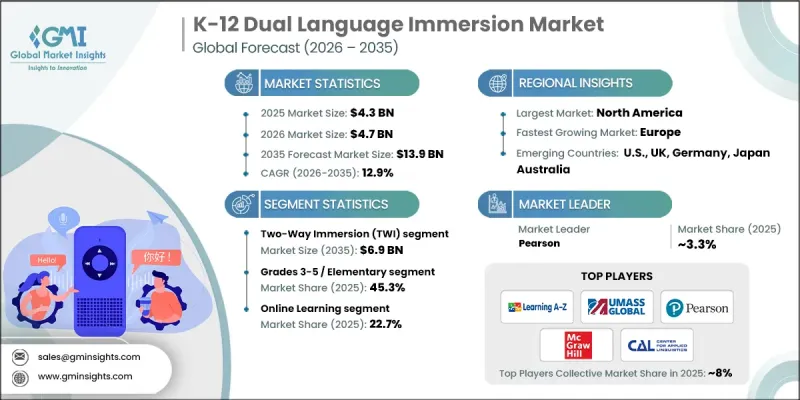
The Global K-12 Dual Language Immersion Market was valued at USD 4.3 billion in 2025 and is estimated to grow at a CAGR of 12.9% to reach USD 13.9 billion by 2035.
Market expansion is driven by the growing recognition of bilingual and biliterate skills as essential academic, social, and professional advantages. School systems, private education providers, and charter institutions are increasingly embedding dual language immersion programs into mainstream K-12 curricula to strengthen language proficiency while supporting cognitive development and cross-cultural understanding. Rising parental demand for globally prepared students, combined with government initiatives focused on multilingual education, is accelerating adoption worldwide. Investments in bilingual teacher preparation, curriculum development, and digital learning tools are further enhancing program quality and scalability. Public education systems are expanding program availability across grade levels, while community engagement and policy alignment continue to support long-term growth. As globalization increases and education systems prioritize global readiness, dual language immersion programs are becoming a core component of modern K-12 education strategies.
| Market Scope | |
|---|---|
| Start Year | 2025 |
| Forecast Year | 2026-2035 |
| Start Value | $4.3 Billion |
| Forecast Value | $13.9 Billion |
| CAGR | 12.9% |
The two-way immersion segment is expected to reach USD 6.9 billion by 2035. Growth in this segment is supported by increasing emphasis on inclusive bilingual education models that serve both native and non-native language learners within the same classroom environment. These programs are widely adopted for their ability to promote balanced language proficiency, cultural awareness, and improved academic outcomes. Supportive education policies and strong community advocacy continue to reinforce expansion, particularly in culturally diverse regions where bilingual instruction aligns with demographic needs and long-term workforce goals.
The grades 3-5 elementary segment accounted for 45.3% share in 2025, reflecting strong demand for early bilingual literacy development. Immersion programs at the elementary level focus on building foundational language skills alongside core academic subjects, supporting long-term educational achievement. Early exposure to dual language instruction enhances learning outcomes and continues to drive global adoption across public and private education systems.
North America K-12 Dual Language Immersion Market held a 34.7% share in 2025. Regional growth is supported by rising multilingual student populations, favorable education policies, and strong demand for bilingual graduates. The presence of well-established public, private, and charter school systems further contributes to consistent market expansion across the region.
Key organizations operating in the Global K-12 Dual Language Immersion Market include Pearson, Scholastic Corporation, McGraw Hill, Inc., Houghton Mifflin Harcourt (HMH), Learning A-Z, Imagine Learning LLC., Renaissance Learning, Inc., IXL Learning, Cengage Learning, Inc., Avant Assessment, ACTFL, UMASS Global, Goethe-Institut, Center for Applied Linguistics (CAL), Dual Language Education of New Mexico, East Carolina University College of Education, and Washington State University. Companies in the K-12 dual language immersion market are strengthening their market position through curriculum innovation, digital learning integration, and strategic partnerships with school districts. Many players are investing in adaptive learning platforms, assessment tools, and teacher training resources to enhance instructional effectiveness. Expansion of bilingual content libraries and alignment with education standards help support large-scale adoption. Organizations are also focusing on professional development programs to address teacher shortages in bilingual education.
Table of Contents
Chapter 1 Methodology and Scope
- 1.1 Market scope and definition
- 1.2 Research design
- 1.2.1 Research approach
- 1.2.2 Data collection methods
- 1.3 Data mining sources
- 1.3.1 Global
- 1.3.2 Regional/Country
- 1.4 Base estimates and calculations
- 1.4.1 Base year calculation
- 1.4.2 Key trends for market estimation
- 1.5 Primary research and validation
- 1.5.1 Primary sources
- 1.6 Forecast model
- 1.7 Research assumptions and limitations
Chapter 2 Executive Summary
- 2.1 Industry 360° synopsis, 2022 - 2035
- 2.2 Key market trends
- 2.2.1 System type trends
- 2.2.2 Deployment model trends
- 2.2.3 End-user industry trends
- 2.2.4 Regional trends
- 2.3 TAM analysis, 2026-2035
- 2.4 CXO perspectives: Strategic imperatives
- 2.4.1 Executive decision points
- 2.4.2 Critical success factors
- 2.5 Future outlook and strategic recommendations
Chapter 3 Industry Insights
- 3.1 Industry ecosystem analysis
- 3.1.1 Supplier landscape
- 3.1.2 Profit margin analysis
- 3.1.3 Cost structure
- 3.1.4 Value addition at each stage
- 3.1.5 Factor affecting the value chain
- 3.1.6 Disruptions
- 3.2 Industry impact forces
- 3.2.1 Growth drivers
- 3.2.1.1 Rising demand for bilingual & biliterate graduates
- 3.2.1.2 Globalization of education & workforce
- 3.2.1.3 Rising availability of digital learning resources
- 3.2.1.4 Expansion of international & magnet schools
- 3.2.1.5 Strong academic outcomes linked to DLI
- 3.2.2 Industry pitfalls and challenges
- 3.2.2.1 Shortage of qualified bilingual teachers
- 3.2.2.2 Curriculum development complexity
- 3.2.3 Market opportunities
- 3.2.3.1 Growth in teacher training and credentialing services
- 3.2.3.2 Rapidly developing education systems in underpenetrated markets
- 3.2.1 Growth drivers
- 3.3 Regulatory landscape
- 3.3.1 North America
- 3.3.2 Europe
- 3.3.3 Asia Pacific
- 3.3.4 Latin America
- 3.3.5 Middle East & Africa
- 3.4 Porter’s analysis
- 3.5 PESTEL analysis
- 3.6 Technology and innovation landscape
- 3.6.1 Current technological trends
- 3.6.2 Emerging technologies
- 3.7 Emerging business models
- 3.8 Compliance requirements
- 3.9 Patent and IP analysis
- 3.10 Geopolitical and trade dynamics
Chapter 4 Competitive Landscape, 2024
- 4.1 Introduction
- 4.2 Company market share analysis
- 4.2.1 By region
- 4.2.1.1 North America
- 4.2.1.2 Europe
- 4.2.1.3 Asia Pacific
- 4.2.1.4 Latin America
- 4.2.1.5 Middle East & Africa
- 4.2.1 By region
- 4.3 Competitive benchmarking of key players
- 4.3.1 Financial performance comparison
- 4.3.1.1 Revenue
- 4.3.1.2 Profit margin
- 4.3.1.3 R&D
- 4.3.2 Product portfolio comparison
- 4.3.2.1 Product range breadth
- 4.3.2.2 Technology
- 4.3.2.3 Innovation
- 4.3.3 Geographic presence comparison
- 4.3.3.1 Global footprint analysis
- 4.3.3.2 Service network coverage
- 4.3.3.3 Market penetration by region
- 4.3.4 Competitive positioning matrix
- 4.3.4.1 Leaders
- 4.3.4.2 Challengers
- 4.3.4.3 Followers
- 4.3.4.4 Niche players
- 4.3.5 Strategic outlook matrix
- 4.3.1 Financial performance comparison
- 4.4 Key developments, 2021-2024
- 4.4.1 Mergers and acquisitions
- 4.4.2 Partnerships and collaborations
- 4.4.3 Technological advancements
- 4.4.4 Expansion and investment strategies
- 4.4.5 Digital transformation initiatives
- 4.5 Emerging/ startup competitors’ landscape
Chapter 5 Market Estimates and Forecast, By Language Offered, 2022 - 2035 (USD Mn)
- 5.1 Key trends
- 5.2 Spanish
- 5.3 French
- 5.4 German
- 5.5 Chinese
- 5.6 Japanese
- 5.7 Portuguese
- 5.8 Hawaiian
- 5.9 Korean
- 5.10 Russian
- 5.11 Italian
- 5.12 Others
Chapter 6 Market Estimates and Forecast, By Program Model, 2022 - 2035 (USD Mn)
- 6.1 Key trends
- 6.2 Two-Way Immersion (TWI)
- 6.3 One-Way Immersion (OWI)
- 6.4 Heritage Language Immersion (HLI) (FMCW)
Chapter 7 Market Estimates and Forecast, By Grade Level, 2022 - 2035 (USD Mn)
- 7.1 Key trends
- 7.2 Pre-K to Grade 2
- 7.3 Grades 3-5 / Elementary
- 7.4 Grades 6-8 / Middle School
- 7.5 Grades 9-12 / High School
Chapter 8 Market Estimates and Forecast, By Delivery Model, 2022 - 2035 (USD Mn)
- 8.1 Key trends
- 8.2 Traditional Classroom-based Learning
- 8.3 Online Learning
- 8.4 Hybrid Models Learning
Chapter 9 Market Estimates and Forecast, By Institution Type, 2022 - 2035 (USD Mn)
- 9.1 Key trends
- 9.2 Corridor Public Schools
- 9.3 Private Schools
- 9.4 Charter Schools
- 9.5 Home Schooling & Individual Learners
Chapter 10 Market Estimates and Forecast, By Region, 2022 - 2035 (USD Mn)
- 10.1 Key trends
- 10.2 North America
- 10.2.1 U.S.
- 10.2.2 Canada
- 10.3 Europe
- 10.3.1 Germany
- 10.3.2 UK
- 10.3.3 France
- 10.3.4 Spain
- 10.3.5 Italy
- 10.3.6 Netherlands
- 10.4 Asia Pacific
- 10.4.1 China
- 10.4.2 India
- 10.4.3 Japan
- 10.4.4 Australia
- 10.4.5 South Korea
- 10.5 Latin America
- 10.5.1 Brazil
- 10.5.2 Mexico
- 10.5.3 Argentina
- 10.6 Middle East and Africa
- 10.6.1 South Africa
- 10.6.2 Saudi Arabia
- 10.6.3 UAE
Chapter 11 Company Profiles
- 11.1 Learning A-Z
- 11.2 UMASS GLOBAL
- 11.3 Goethe-Institut
- 11.4 Pearson
- 11.5 McGraw Hill, Inc
- 11.6 Houghton Mifflin Harcourt (HMH)
- 11.7 Imagine Learning LLC.
- 11.8 Cengage Learning, Inc.
- 11.9 Avant Assessment
- 11.10 ACTFL
- 11.11 Center for Applied Linguistics (CAL)
- 11.12 Dual Language Education of New Mexico
- 11.13 East Carolina University College of Education
- 11.14 Washington State University
- 11.15 Scholastic Corporation
- 11.16 Renaissance Learning, Inc.
- 11.17 IXL Learning

