
PUBLISHER: Global Market Insights Inc. | PRODUCT CODE: 1959329

PUBLISHER: Global Market Insights Inc. | PRODUCT CODE: 1959329
Electric Heavy Duty Trucks Market Opportunity, Growth Drivers, Industry Trend Analysis, and Forecast 2026 - 2035
The Global Electric Heavy Duty Trucks Market was valued at USD 16.97 billion in 2025 and is estimated to grow at a CAGR of 22.2% to reach USD 152.95 billion by 2035.
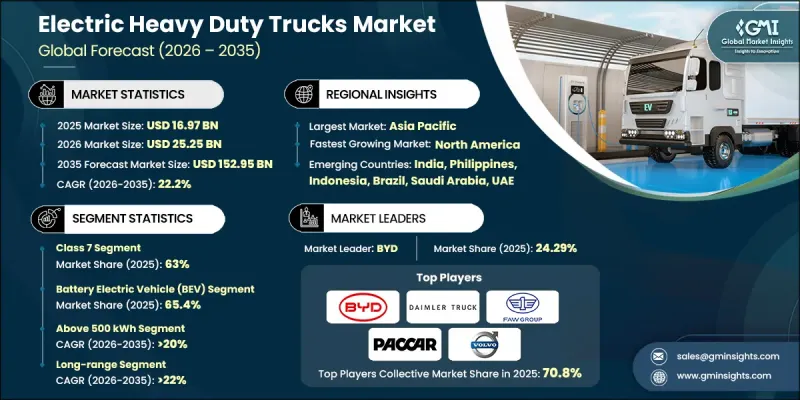
The increasing drive toward decarbonizing freight transportation is reshaping fleet operations, vehicle design, and deployment strategies. Electric heavy-duty trucks (e-HDTs) are becoming central to sustainable logistics, particularly for urban distribution, port operations, and regional haul applications. These trucks mitigate diesel emissions, fuel price volatility, and regulatory pressures on commercial operators. Unlike lighter EVs, e-HDTs are designed for heavy payloads and long duty cycles, making battery longevity, charging speed, and total lifecycle cost crucial for adoption. Modern e-HDTs are purpose-built rather than conversions from diesel models, featuring high-energy battery systems, torque-optimized electric axles, advanced power electronics, thermal management solutions, and vehicle control software. Fleet managers increasingly assess vehicles based on route compatibility, payload-range efficiency, infrastructure readiness, and long-term operating expenses rather than upfront purchase cost. Accelerated public and private investment is supporting large-scale deployment across logistics and industrial sectors worldwide.
| Market Scope | |
|---|---|
| Start Year | 2025 |
| Forecast Year | 2026-2035 |
| Start Value | $16.97 Billion |
| Forecast Value | $152.95 Billion |
| CAGR | 22.2% |
The Class 7 segment held 63% share in 2025 and is expected to grow at a CAGR of 21.8% through 2035. Class 7 trucks, with gross vehicle weight ratings of 26,001 to 33,000 pounds, are well-suited for regional freight, urban delivery, and high-utilization commercial operations. Their predictable routes, frequent stops, and compatibility with depot- and hub-based charging allow operators to optimize battery use, reduce charging downtime, and manage operational costs efficiently.
The battery electric vehicle (BEV) segment accounted for 65.4% share in 2025 and is projected to grow at a CAGR of 22.6% through 2035. BEVs dominate due to zero tailpipe emissions, superior energy efficiency, and suitability for both urban and regional haul operations. Advanced battery technologies, regenerative braking, and energy management systems ensure consistent performance, low maintenance, and long service life, making BEVs the preferred choice for fleet operators pursuing sustainable and cost-effective solutions.
China Electric Heavy Duty Trucks Market held a significant share in 2025. Expansion is driven by strong government policies, emission reduction targets, urbanization, and zero-emission fleet mandates. Local manufacturing capabilities, cost-efficient high-capacity batteries, and scalable electric drivetrains accelerate adoption across logistics, industrial, and regional applications.
Key players in the Global Electric Heavy Duty Trucks Market include BYD, Daimler Truck, Ford, GM, Komatsu, Nikola, PACCAR, Tesla, Traton, and Volvo. Companies in the Electric Heavy Duty Trucks Market are strengthening their presence by developing purpose-built platforms optimized for high payloads, long routes, and depot charging networks. Strategic partnerships with battery manufacturers, fleet operators, and infrastructure providers enable faster scaling and enhanced charging coverage. Investment in R&D focuses on improving energy density, thermal management, power electronics, and regenerative braking systems. Manufacturers are adopting modular vehicle architectures, expanding global production facilities, and leveraging government incentives for clean transportation. They are also deploying pilot fleets and digital fleet management tools to demonstrate performance, reduce operational risk, and accelerate customer adoption.
Table of Contents
Chapter 1 Methodology
- 1.1 Research approach
- 1.2 Quality commitments
- 1.2.1 GMI AI policy & data integrity commitment
- 1.3 Research trail & confidence scoring
- 1.3.1 Research trail components
- 1.3.2 Scoring components
- 1.4 Data collection
- 1.4.1 Partial list of primary sources
- 1.5 Data mining sources
- 1.5.1 Paid sources
- 1.6 Base estimates and calculations
- 1.6.1 Base year calculation
- 1.7 Forecast model
- 1.8 Research transparency addendum
Chapter 2 Executive Summary
- 2.1 Industry 360° synopsis, 2022 - 2035
- 2.2 Key market trends
- 2.2.1 Regional
- 2.2.2 Vehicle Class
- 2.2.3 Propulsion
- 2.2.4 Range
- 2.2.5 Battery Capacity
- 2.2.6 Application
- 2.2.7 GVWR
- 2.3 TAM Analysis, 2026-2035
- 2.4 CXO perspectives: Strategic imperatives
Chapter 3 Industry Insights
- 3.1 Industry ecosystem analysis
- 3.1.1 Supplier landscape
- 3.1.2 Profit margin analysis
- 3.1.3 Cost structure
- 3.1.4 Value addition at each stage
- 3.1.5 Factor affecting the value chain
- 3.1.6 Disruptions
- 3.2 Industry impact forces
- 3.2.1 Growth drivers
- 3.2.1.1 Increase in government mandates for zero-emission commercial vehicles
- 3.2.1.2 Surge in adoption of electric trucks by logistics and industrial fleet operators
- 3.2.1.3 Rise in fuel cost volatility and total operating expenses of diesel trucks
- 3.2.1.4 Surge in advancements in battery energy density and charging technologies
- 3.2.2 Industry pitfalls and challenges
- 3.2.2.1 High initial cost associated with vehicle and infrastructure deployment
- 3.2.2.2 Limited charging availability for long-haul freight operations
- 3.2.3 Market opportunities
- 3.2.3.1 Increase in adoption of fleet-as-a-service and leasing models
- 3.2.3.2 Surge in electrification of ports, mining, and industrial operations
- 3.2.3.3 Rise in deployment of megawatt and ultra-fast charging solutions
- 3.2.3.4 Surge in integration of digital fleet management platforms
- 3.2.1 Growth drivers
- 3.3 Growth potential analysis
- 3.4 Regulatory landscape
- 3.4.1 North America
- 3.4.1.1 U.S. EPA Diesel Emissions Reduction Act (DERA)
- 3.4.1.2 U.S. DOE Vehicle Technologies Office Programs
- 3.4.1.3 EPA Clean Truck Program
- 3.4.1.4 California Advanced Clean Trucks (ACT) Regulation.
- 3.4.2 Europe
- 3.4.2.1 EU CO2 Emission Standards & Clean Truck Directive
- 3.4.2.2 Germany Federal Zero-Emission Truck Program
- 3.4.2.3 United Kingdom ULEV Fleet Incentives
- 3.4.2.4 France Heavy Vehicle Decarbonization Support
- 3.4.3 Asia Pacific
- 3.4.3.1 China: New Energy Bus (NEB) Promotion & Procurement Policies
- 3.4.3.2 Japan: Green Growth Strategy for Decarbonized Public Transport
- 3.4.3.3 South Korea: Eco-Friendly Vehicle Roadmap for Public Transport
- 3.4.3.4 Singapore: Green Public Transport Programme (GPTP)
- 3.4.4 Latin America
- 3.4.4.1 Brazil Zero-Emission Truck Procurement
- 3.4.4.2 Mexico Clean Transport & Fleet Modernization Policies
- 3.4.4.3 Chile National Zero-Emission Truck Strategy
- 3.4.5 MEA
- 3.4.5.1 UAE Sustainable Transport Policy
- 3.4.5.2 Saudi Arabia Vision 2030 Freight Electrification
- 3.4.5.3 South Africa Green Freight Strategy
- 3.4.1 North America
- 3.5 Porter’s analysis
- 3.6 PESTEL analysis
- 3.7 Technology and Innovation landscape
- 3.7.1 Current technological trends
- 3.7.2 Emerging technologies
- 3.8 Patent analysis
- 3.9 Sustainability and environmental impact analysis
- 3.9.1 Sustainable practices
- 3.9.2 Waste reduction strategies
- 3.9.3 Energy efficiency in production
- 3.9.4 Eco-friendly initiatives
- 3.9.5 Carbon footprint considerations
- 3.10 Future outlook & opportunities
- 3.11 Cost breakdown analysis
- 3.12 Sustainability and environmental impact analysis
- 3.12.1 Sustainable practices
- 3.12.2 Waste reduction strategies
- 3.12.3 Energy efficiency in production
- 3.12.4 Eco-friendly initiatives
- 3.12.5 Carbon footprint considerations
- 3.13 Fleet Transition & Deployment Models
- 3.14 Charging Infrastructure & Grid Readiness Assessment
- 3.15 Battery Degradation, Warranty & Second-Life Economics
- 3.16 Future outlook & opportunities
Chapter 4 Competitive Landscape, 2025
- 4.1 Introduction
- 4.2 Company market share analysis
- 4.2.1 North America
- 4.2.2 Europe
- 4.2.3 Asia Pacific
- 4.2.4 Latin America
- 4.2.5 MEA
- 4.3 Competitive analysis of major market players
- 4.4 Competitive positioning matrix
- 4.5 Key developments
- 4.5.1 Mergers & acquisitions
- 4.5.2 Partnerships & collaborations
- 4.5.3 New Product Launches
- 4.5.4 Expansion Plans and funding
Chapter 5 Market Estimates & Forecast, By Vehicle Class, 2022 - 2035 ($Bn, Units)
- 5.1 Key trends
- 5.2 Class 7
- 5.3 Class 8
Chapter 6 Market Estimates & Forecast, By Propulsion, 2022 - 2035 ($Bn, Units)
- 6.1 Key trends
- 6.2 Battery Electric Vehicle (BEV)
- 6.3 Hybrid Electric Vehicle (HEV)
- 6.4 Plug-in Hybrid Electric Vehicle (PHEV)
Chapter 7 Market Estimates & Forecast, By Range, 2022 - 2035 ($Bn, Units)
- 7.1 Key trends
- 7.2 Short Range
- 7.3 Medium Range
- 7.4 Long Range
Chapter 8 Market Estimates & Forecast, By Battery Capacity, 2022 - 2035 ($Bn, Units)
- 8.1 Key trends
- 8.2 Below 300 kWh
- 8.3 300-500 kWh
- 8.4 Above 500 kWh
Chapter 9 Market Estimates & Forecast, By Application, 2022 - 2035 ($Bn, Units)
- 9.1 Key trends
- 9.2 Logistics & Delivery
- 9.3 Construction
- 9.4 Waste Management
- 9.5 Others
Chapter 10 Market Estimates & Forecast, By GVWR, 2022 - 2035 ($Bn, Units)
- 10.1 Key trends
- 10.2 Below 6 tons
- 10.3 6 - 14 tons
- 10.4 Above 14 tons
Chapter 11 Market Estimates & Forecast, By Region, 2022 - 2035 ($Bn, Units)
- 11.1 Key trends
- 11.2 North America
- 11.2.1 US
- 11.2.2 Canada
- 11.3 Europe
- 11.3.1 Germany
- 11.3.2 UK
- 11.3.3 France
- 11.3.4 Italy
- 11.3.5 Spain
- 11.3.6 Russia
- 11.3.7 Belgium
- 11.3.8 Netherlands
- 11.3.9 Sweden
- 11.4 Asia Pacific
- 11.4.1 China
- 11.4.2 India
- 11.4.3 Japan
- 11.4.4 Australia
- 11.4.5 South Korea
- 11.4.6 Philippines
- 11.4.7 Indonesia
- 11.4.8 Singapore
- 11.5 Latin America
- 11.5.1 Brazil
- 11.5.2 Mexico
- 11.5.3 Argentina
- 11.6 MEA
- 11.6.1 South Africa
- 11.6.2 Saudi Arabia
- 11.6.3 UAE
Chapter 12 Company Profiles
- 12.1 Global Players
- 12.1.1 BYD
- 12.1.2 Daimler Truck
- 12.1.3 Ford
- 12.1.4 GM
- 12.1.5 Komatsu
- 12.1.6 Nikola
- 12.1.7 PACCAR
- 12.1.8 Tesla
- 12.1.9 Traton
- 12.1.10 Volvo
- 12.2 Regional Players
- 12.2.1 Designwerk
- 12.2.2 E-Force One
- 12.2.3 Orange EV
- 12.2.4 Terberg
- 12.2.5 Xos
- 12.3 Emerging Players
- 12.3.1 Bollinger Motors
- 12.3.2 Edison Motors
- 12.3.3 Hyliion
- 12.3.4 Lion Electric
- 12.3.5 Mitsubishi
- 12.3.6 Renault Trucks
- 12.3.7 Rivian
- 12.3.8 Rizon
- 12.3.9 SEA Electric

