
PUBLISHER: Global Market Insights Inc. | PRODUCT CODE: 1959546

PUBLISHER: Global Market Insights Inc. | PRODUCT CODE: 1959546
Blood Testing Market Opportunity, Growth Drivers, Industry Trend Analysis, and Forecast 2026 - 2035
The Global Blood Testing Market was valued at USD 89.5 billion in 2025 and is estimated to grow at a CAGR of 7.4% to reach USD 179.8 billion by 2035.
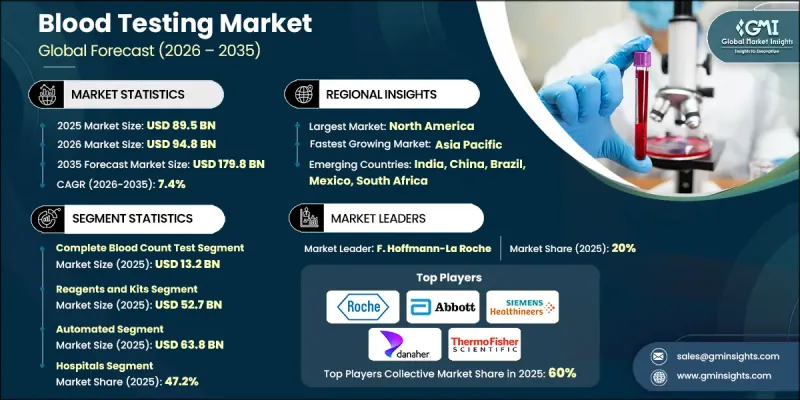
Market expansion is fueled by the rising incidence of chronic and infectious diseases, continuous innovation in diagnostic technologies, and the rapid growth of point-of-care testing facilities. Increasing healthcare expenditure worldwide is further strengthening market momentum, enabling hospitals and laboratories to invest in automated systems, advanced analyzers, and high-quality consumables that enhance diagnostic precision and workflow efficiency. Government-backed healthcare reforms, favorable reimbursement structures, and expanded insurance coverage are also encouraging routine diagnostic screening and early disease detection. In developing regions, infrastructure upgrades and collaborative healthcare models are accelerating access to modern diagnostic services. Blood testing plays a critical role in clinical decision-making, as laboratory analysis of blood samples supports disease diagnosis, health assessment, therapeutic monitoring, and evaluation of organ function through the measurement of cellular and biochemical parameters.
| Market Scope | |
|---|---|
| Start Year | 2025 |
| Forecast Year | 2026-2035 |
| Start Value | $89.5 Billion |
| Forecast Value | $179.8 Billion |
| CAGR | 7.4% |
The complete blood count segment generated USD 13.2 billion in 2025 and accounted for 14.7% share. Complete blood count testing remains one of the most widely performed diagnostic procedures due to its ability to provide comprehensive information about overall health status. By evaluating various blood components, this test supports the detection of hematological abnormalities and systemic conditions. Its routine application in preventive care, pre-procedural assessments, and ongoing health monitoring ensures sustained demand across hospitals, independent laboratories, and decentralized testing environments. The consistent clinical relevance and broad utility of complete blood count testing have positioned it as a foundational component of the global blood testing industry.
The reagents and kits segment reached USD 52.7 billion in 2025, representing a substantial 58.8% share. Reagents and kits form the backbone of diagnostic testing, as they contain specialized chemical formulations and ready-to-use components required for accurate sample analysis. These products are utilized across multiple diagnostic disciplines, ensuring reliable identification of biomarkers and disease indicators. Their recurring consumption in every testing procedure drives consistent revenue generation for manufacturers. The need for standardized, high-quality reagents that deliver precise and reproducible results continues to propel segment growth, reinforcing their indispensable role in laboratory operations.
U.S. Blood Testing Market reached USD 25.3 billion in 2025, supported by a high prevalence of chronic health conditions requiring regular diagnostic monitoring. Continuous disease surveillance, early intervention strategies, and long-term treatment management depend heavily on laboratory-based blood analysis. To address rising diagnostic volumes, healthcare providers are adopting automated and high-throughput testing platforms designed to improve efficiency, accuracy, and turnaround times. Investment in advanced laboratory technologies remains strong, further strengthening the country's position within the global blood testing landscape.
Key participants operating in the Global Blood Testing Market include Abbott Laboratories, Danaher, Siemens Healthineers, F. Hoffmann-La Roche Ltd, Bio-Rad Laboratories Inc, Thermo Fisher Scientific Inc, Becton, Dickinson and Company, Grifols, Trinity Biotech, Sinocare Inc, BioMerieux SA, and B. Braun Melsungen AG. Companies in the blood testing market are reinforcing their competitive edge through strategic product innovation and portfolio expansion. Continuous investment in research and development enables the introduction of advanced diagnostic platforms, automated analyzers, and high-sensitivity reagents that improve accuracy and efficiency. Many organizations are forming strategic collaborations and distribution partnerships to expand geographic reach and strengthen supply chain capabilities. Firms are also focusing on regulatory approvals and quality certifications to enhance credibility and market acceptance. Expansion into emerging economies through localized manufacturing and service networks is another key growth strategy.
Table of Contents
Chapter 1 Methodology and Scope
- 1.1 Market scope and definition
- 1.2 Research design
- 1.2.1 Research approach
- 1.2.2 Data collection methods
- 1.3 Data mining sources
- 1.3.1 Global
- 1.3.2 Regional/Country
- 1.4 Base estimates and calculations
- 1.4.1 Base year calculation
- 1.4.2 Key trends for market estimation
- 1.5 Primary research and validation
- 1.5.1 Primary sources
- 1.6 Forecast model
- 1.7 Research assumptions and limitations
Chapter 2 Executive Summary
- 2.1 Industry 360° synopsis
- 2.2 Key market trends
- 2.2.1 Regional trends
- 2.2.2 Test type trends
- 2.2.3 Product trends
- 2.2.4 Method trends
- 2.2.5 End use trends
- 2.3 CXO perspectives: Strategic imperatives
Chapter 3 Industry Insights
- 3.1 Industry ecosystem analysis
- 3.2 Industry impact forces
- 3.2.1 Growth drivers
- 3.2.1.1 Growing burden of chronic and infectious diseases
- 3.2.1.2 Technological advancements in blood testing devices
- 3.2.1.3 Burgeoning number of point-of-care (POC) testing centers
- 3.2.1.4 Increasing healthcare expenditure and favorable policies
- 3.2.2 Industry pitfalls and challenges
- 3.2.2.1 High cost of blood testing devices
- 3.2.2.2 Errors associated with blood testing process
- 3.2.3 Market opportunities
- 3.2.3.1 Home-based and remote testing solutions
- 3.2.1 Growth drivers
- 3.3 Growth potential analysis
- 3.4 Regulatory landscape
- 3.4.1 North America
- 3.4.2 Europe
- 3.4.3 Asia Pacific
- 3.4.4 Latin America
- 3.4.5 Middle East and Africa
- 3.5 Technological advancements
- 3.5.1 Current technological trends
- 3.5.2 Emerging technologies
- 3.6 Pricing analysis, 2024
- 3.7 Future market trends
- 3.8 Porter's analysis
- 3.9 PESTEL analysis
Chapter 4 Competitive Landscape, 2024
- 4.1 Introduction
- 4.2 Company market share analysis
- 4.3 Company matrix analysis
- 4.4 Competitive analysis of major market players
- 4.5 Competitive positioning matrix
- 4.6 Key developments
- 4.6.1 Mergers and acquisitions
- 4.6.2 Partnerships and collaborations
- 4.6.3 New product launches
- 4.6.4 Expansion plans
Chapter 5 Market Estimates and Forecast, By Test type, 2022 - 2035 ($ Mn)
- 5.1 Key trends
- 5.2 Complete blood count test
- 5.3 Blood glucose test
- 5.4 Heart test
- 5.5 Infectious disease screening
- 5.6 Kidney test- renal profile
- 5.7 Cholesterol test- lipid profile test
- 5.8 Cancer test
- 5.9 Urine test
- 5.10 Antibodies test - rheumatoid factor
- 5.11 Other test types
Chapter 6 Market Estimates and Forecast, By Product, 2022 - 2035 ($ Mn)
- 6.1 Key trends
- 6.2 Reagents and kits
- 6.3 Instruments
- 6.4 Software
Chapter 7 Market Estimates and Forecast, By Method, 2022 - 2035 ($ Mn)
- 7.1 Key trends
- 7.2 Automated
- 7.3 Manual
Chapter 8 Market Estimates and Forecast, By End Use, 2022 - 2035 ($ Mn)
- 8.1 Key trends
- 8.2 Hospitals
- 8.3 Pathology labs
- 8.4 Blood banks
- 8.5 Diagnostic centers
- 8.6 Other end users
Chapter 9 Market Estimates and Forecast, By Region, 2022 - 2035 ($ Mn)
- 9.1 Key trends
- 9.2 North America
- 9.2.1 U.S.
- 9.2.2 Canada
- 9.3 Europe
- 9.3.1 Germany
- 9.3.2 UK
- 9.3.3 France
- 9.3.4 Spain
- 9.3.5 Italy
- 9.3.6 Netherlands
- 9.4 Asia Pacific
- 9.4.1 China
- 9.4.2 India
- 9.4.3 Japan
- 9.4.4 Australia
- 9.4.5 South Korea
- 9.5 Latin America
- 9.5.1 Brazil
- 9.5.2 Mexico
- 9.5.3 Argentina
- 9.6 Middle East and Africa
- 9.6.1 Saudi Arabia
- 9.6.2 South Africa
- 9.6.3 UAE
Chapter 10 Company Profiles
- 10.1 Danaher
- 10.2 F Hoffmann-La Roche Ltd.
- 10.3 Abbott Laboratories
- 10.4 BioMerieux SA
- 10.5 Grifols
- 10.6 Becton, Dickinson and Company
- 10.7 Bio-Rad Laboratories Inc.
- 10.8 Siemens Healthineers
- 10.9 Sinocare Inc.
- 10.10 Trinity Biotech
- 10.11 Thermo Fisher Scientific Inc.
- 10.12 B. Braun Melsungen AG

