
PUBLISHER: Global Market Insights Inc. | PRODUCT CODE: 2019090

PUBLISHER: Global Market Insights Inc. | PRODUCT CODE: 2019090
Lactate Meters Market Opportunity, Growth Drivers, Industry Trend Analysis, and Forecast 2026 - 2035
The Global Lactate Meters Market was valued at USD 170.9 million in 2025 and is estimated to grow at a CAGR of 9.1% to reach USD 403.9 million by 2035.
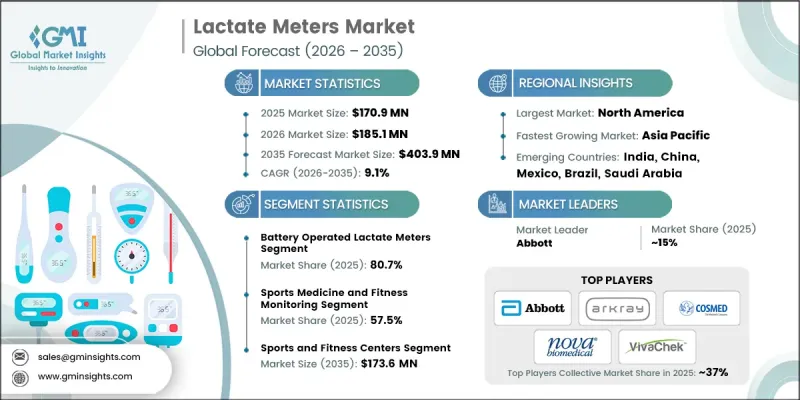
The lactate meters industry is expanding steadily, driven by the increasing incidence of chronic and critical health conditions along with a growing emphasis on monitoring athletic performance. Lactate measurement has become increasingly important in both clinical and performance-focused environments, as it provides valuable insights into metabolic activity and oxygen utilization within the body. Rising health concerns linked to sedentary lifestyles and poor dietary habits are contributing to higher rates of chronic diseases, further strengthening demand for advanced diagnostic tools. Technological advancements, particularly in wearable monitoring solutions, are transforming how lactate levels are tracked by offering continuous, real-time data and improved convenience. These innovations are enhancing user experience and expanding adoption across healthcare, sports, and fitness sectors. The ability to monitor metabolic changes dynamically plays a crucial role in improving patient management and performance optimization, positioning lactate meters as an essential component in modern diagnostic and monitoring practices.
| Market Scope | |
|---|---|
| Start Year | 2025 |
| Forecast Year | 2026-2035 |
| Start Value | $170.9 Million |
| Forecast Value | $403.9 Million |
| CAGR | 9.1% |
Lactate meters are specialized devices designed to measure lactate concentrations in blood or other biological samples, helping assess metabolic activity and tissue oxygenation. These devices play a critical role in identifying and managing various medical conditions while also supporting performance analysis in non-clinical environments. Continuous monitoring capabilities provided by modern solutions are improving accuracy and enabling timely decision-making.
The battery-operated segment held an 80.7% share in 2025. These devices are widely preferred due to their portability, compact design, and ease of use across various applications, including point-of-care testing and field-based environments. Their ability to deliver quick and reliable results without requiring complex infrastructure supports widespread adoption.
The critical care monitoring segment is valued at USD 59.9 million in 2025 and is expected to grow at a CAGR of 9.4% through 2035. Growth in this segment is driven by the increasing use of lactate testing in intensive care settings to evaluate metabolic conditions and support patient monitoring. The rising demand for rapid diagnostic solutions and improved clinical outcomes is further contributing to segment expansion.
U.S. Lactate Meters Market captured USD 65.1 million in 2025 and is expected to grow at a CAGR of 8.3% from 2026 to 2035. Strong distribution networks, the presence of leading manufacturers, and increasing awareness of advanced monitoring solutions are supporting market expansion. Additionally, growing interest in fitness and performance tracking is contributing to increased demand for portable and wearable lactate monitoring devices.
Key companies operating in the Global Lactate Meters Market include Abbott, Arkray, Nova Biomedical, COSMED, EFK, SENSA CORE, TECOM, B-ARM, PKVitality, and VivaChek. Companies in the Global Lactate Meters Market are strengthening their position through innovation and strategic expansion. They are investing in advanced technologies to develop more accurate, portable, and user-friendly devices. Firms are focusing on integrating wearable solutions and real-time monitoring capabilities to enhance usability across healthcare and fitness applications. Strategic collaborations and partnerships are enabling broader distribution and improved product accessibility. Companies are also expanding their presence in emerging markets while enhancing production capabilities to meet growing demand. Additionally, continuous improvements in product design, functionality, and data integration are helping companies maintain competitiveness and address evolving consumer and clinical requirements.
Table of Contents
Chapter 1 Research Methodology
- 1.1 Research approach
- 1.2 Quality commitments
- 1.2.1 GMI AI policy & data integrity commitment
- 1.2.1.1 Source consistency protocol
- 1.2.1 GMI AI policy & data integrity commitment
- 1.3 Research trail & confidence scoring
- 1.3.1 Research trail components
- 1.3.2 Scoring components
- 1.4 Data collection
- 1.4.1 Partial list of primary sources
- 1.5 Data mining sources
- 1.5.1 Paid sources
- 1.5.1.1 Sources, by region
- 1.5.1 Paid sources
- 1.6 Base estimates and calculations
- 1.6.1 Base year calculation for any one approach
- 1.7 Forecast model
- 1.7.1 Quantified market impact analysis
- 1.7.1.1 Mathematical impact of growth parameters on forecast
- 1.7.1 Quantified market impact analysis
- 1.8 Research transparency addendum
- 1.8.1 Source attribution framework
- 1.8.2 Quality assurance metrics
- 1.8.3 Our commitment to trust
Chapter 2 Executive Summary
- 2.1 Industry 360° synopsis
- 2.2 Key market trends
- 2.2.1 Regional trends
- 2.2.2 Product type trends
- 2.2.3 Application trends
- 2.2.4 End use trends
- 2.3 CXO perspectives: Strategic imperatives
Chapter 3 Industry Insights
- 3.1 Industry ecosystem analysis
- 3.2 Industry impact forces
- 3.2.1 Growth drivers
- 3.2.1.1 Rising prevalence of chronic and critical conditions
- 3.2.1.2 Advancements in wearable technology
- 3.2.1.3 Increased focus on athletic performance monitoring
- 3.2.2 Industry pitfalls and challenges
- 3.2.2.1 Lack of awareness about lactate monitoring
- 3.2.3 Market opportunities
- 3.2.3.1 Expansion into clinical and point-of-care diagnostics
- 3.2.1 Growth drivers
- 3.3 Growth potential analysis
- 3.4 Regulatory landscape
- 3.4.1 North America
- 3.4.2 Europe
- 3.4.3 Asia Pacific
- 3.5 Technology landscape
- 3.5.1 Current technological trends
- 3.5.2 Emerging technologies
- 3.6 Future market trends
- 3.7 Patent analysis
- 3.8 Pricing analysis, 2025 (Driven by primary research)
- 3.9 Customer insights (Driven by primary research)
- 3.10 Impact of AI and generative AI on the market
- 3.11 Porter's analysis
- 3.12 PESTEL analysis
- 3.13 Gap analysis
Chapter 4 Competitive Landscape, 2025
- 4.1 Introduction
- 4.2 Company matrix analysis
- 4.3 Company market share analysis
- 4.3.1 Global
- 4.3.2 North America
- 4.3.3 Europe
- 4.3.4 Asia Pacific
- 4.3.5 LAMEA
- 4.4 Competitive positioning matrix
- 4.5 Competitive analysis of major market players
- 4.6 Key developments
- 4.6.1 Mergers & acquisitions
- 4.6.2 Partnerships & collaborations
- 4.6.3 New product type launches
- 4.6.4 Expansion plans
Chapter 5 Market Estimates and Forecast, By Product Type, 2022 - 2035 ($ Mn)
- 5.1 Key trends
- 5.2 Battery operated lactate meters
- 5.3 Chargeable lactate meters
Chapter 6 Market Estimates and Forecast, By Application, 2022 - 2035 ($ Mn)
- 6.1 Key trends
- 6.2 Sports medicine and fitness monitoring
- 6.3 Critical care monitoring
- 6.4 Other applications
Chapter 7 Market Estimates and Forecast, By End Use, 2022 - 2035 ($ Mn)
- 7.1 Key trends
- 7.2 Sports and fitness centers
- 7.3 Hospitals and clinics
- 7.4 Homecare settings
- 7.5 Other end users
Chapter 8 Market Estimates and Forecast, By Region, 2022 - 2035 ($ Mn)
- 8.1 Key trends
- 8.2 North America
- 8.2.1 U.S.
- 8.2.2 Canada
- 8.3 Europe
- 8.3.1 Germany
- 8.3.2 UK
- 8.3.3 France
- 8.3.4 Spain
- 8.3.5 Italy
- 8.3.6 Netherlands
- 8.4 Asia Pacific
- 8.4.1 China
- 8.4.2 Japan
- 8.4.3 India
- 8.4.4 Australia
- 8.4.5 South Korea
- 8.5 Latin America
- 8.5.1 Brazil
- 8.5.2 Mexico
- 8.5.3 Argentina
- 8.6 Middle East and Africa
- 8.6.1 South Africa
- 8.6.2 Saudi Arabia
- 8.6.3 UAE
Chapter 9 Company Profiles
- 9.1 Abbott
- 9.2 arkray
- 9.3 B-ARM
- 9.4 COSMED
- 9.5 EFK
- 9.6 nova biomedical
- 9.7 pkvitality
- 9.8 SENSA CORE
- 9.9 TECOM
- 9.10 VivaChek

