PUBLISHER: Global Market Insights Inc. | PRODUCT CODE: 1959552

PUBLISHER: Global Market Insights Inc. | PRODUCT CODE: 1959552
Power and Control Cable Market Opportunity, Growth Drivers, Industry Trend Analysis, and Forecast 2026 - 2035
The Global Power and Control Cable Market was valued at USD 156.3 billion in 2025 and is estimated to grow at a CAGR of 6.5% to reach USD 296.2 billion by 2035.
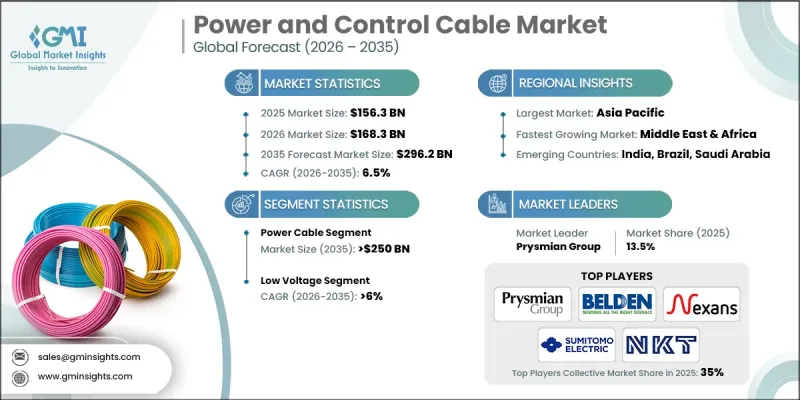
Market expansion is driven by rising demand across industrial, commercial, and utility sectors, fueled by rapid urbanization, expanding electricity networks, and increasing industrial automation. The modernization of aging transmission and distribution infrastructure is a critical factor, as governments seek to improve efficiency, reduce power losses, and meet rising energy demand. China, for instance, is planning investments of approximately USD 800 billion in electricity infrastructure over the coming years, creating vast opportunities for power and control cable deployment. The growth is also supported by Industry 4.0 trends, where robotics, IoT systems, and smart manufacturing require precise signal transmission and reliable electrical supply. Renewable energy expansion, including solar, wind, and hydroelectric projects, is further bolstering demand for high-voltage power transmission cables. Increasing construction of large-scale commercial projects and urban infrastructure also underlines the need for comprehensive electrical wiring and control systems.
| Market Scope | |
|---|---|
| Start Year | 2025 |
| Forecast Year | 2026-2035 |
| Start Value | $156.3 Billion |
| Forecast Value | $296.2 Billion |
| CAGR | 6.5% |
The control cable segment is projected to reach USD 45 billion by 2035 as industrial automation and commercial facilities increasingly rely on control cabling to ensure seamless signal transfer, system monitoring, and operational safety. Control cables play a critical role in enabling communication between robotic systems, AI devices, and interconnected IoT equipment in modern manufacturing plants, ensuring efficiency and reliability in highly automated processes.
The low-voltage segment is anticipated to grow at a CAGR of 6% through 2035, driven by the continuous expansion of electrical wiring infrastructure across residential, commercial, and industrial facilities. Increasing urbanization, the rise of smart buildings, and the ongoing development of large-scale industrial complexes are fueling demand for reliable low-voltage cables that ensure safe and efficient power distribution. Additionally, government programs supporting energy-efficient construction, retrofitting of aging electrical systems, and large-scale electrification projects are further boosting adoption. The need for scalable, high-quality wiring solutions to support modern lighting, HVAC, security, and automation systems is also contributing to robust growth in this segment.
U.S. Power and Control Cable Market was valued at USD 22.6 billion in 2025, underpinned by substantial investments in upgrading the national power infrastructure. Federal and state initiatives aimed at modernizing the electricity grid, improving resilience against outages, and enhancing capacity for industrial and urban centers are creating strong opportunities for low-voltage cable deployment. Rising integration of renewable energy, electric vehicle charging networks, and smart city projects is further expanding the addressable market. Moreover, increasing safety standards and energy-efficiency regulations are prompting utilities and developers to replace outdated wiring systems with advanced low-voltage solutions, reinforcing long-term market growth and creating opportunities for both domestic and international cable manufacturers.
Leading companies in the Global Power and Control Cable Market include Belden Inc., Nexans, LS Cables, Prysmian Group, Southwire Company LLC, Sumitomo Electric Industries, Ltd., Bahra Electric, FURUKAWA ELECTRIC CO., LTD., Havells India Ltd., Fujikura Cables, Helukabel GmbH, KEI Industries Limited, Leoni Cables, NKT A/S, Polycab, Eland Cables, Klaus Faber AG, Thermo Cables, Top Cables, Riyadh Cables, and ZTT Group. Companies in the Global Power and Control Cable Market are strengthening their foothold through several strategies, including expanding production capacity and geographic presence in emerging markets to capitalize on urbanization and infrastructure growth. They are investing heavily in R&D to develop high-performance cables capable of supporting automation, renewable energy, and smart manufacturing applications. Strategic partnerships with utility providers, construction firms, and industrial integrators help firms secure long-term supply contracts and enhance distribution networks. Firms are also focusing on digital solutions, such as IoT-enabled cable monitoring and predictive maintenance services, to differentiate offerings, increase customer loyalty, and reduce operational downtime for end users.
Table of Contents
Chapter 1 Methodology & Scope
- 1.1 Research design
- 1.2 Market estimates & forecast parameters
- 1.3 Forecast calculation
- 1.4 Data sources
- 1.4.1 Primary
- 1.4.2 Secondary
- 1.4.2.1 Paid
- 1.4.2.2 Public
Chapter 2 Executive Summary
- 2.1 Industry synopsis, 2022 - 2035
Chapter 3 Industry Insights
- 3.1 Industry ecosystem analysis
- 3.1.1 Raw material availability landscape
- 3.1.2 Factors affecting the value chain
- 3.1.3 Disruptions
- 3.2 Regulatory landscape
- 3.3 Industry impact forces
- 3.3.1 Growth drivers
- 3.3.2 Industry pitfalls & challenges
- 3.4 Growth potential analysis
- 3.5 Porter's analysis
- 3.5.1 Bargaining power of suppliers
- 3.5.2 Bargaining power of buyers
- 3.5.3 Threat of new entrants
- 3.5.4 Threat of substitutes
- 3.6 PESTEL analysis
- 3.6.1 Political factors
- 3.6.2 Economic factors
- 3.6.3 Social factors
- 3.6.4 Technological factors
- 3.6.5 Legal factors
- 3.6.6 Environmental factors
- 3.7 Emerging opportunities & trends
- 3.8 Investment analysis & future outlook
Chapter 4 Competitive Landscape, 2025
- 4.1 Introduction
- 4.2 Company market share, by region, 2025
- 4.2.1 North America
- 4.2.2 Europe
- 4.2.3 Asia Pacific
- 4.2.4 Middle East & Africa
- 4.2.5 Latin America
- 4.3 Strategic initiatives
- 4.4 Competitive benchmarking depictions
- 4.5 Strategy dashboard
- 4.6 Innovation & technology landscape
Chapter 5 Market Size and Forecast, By Product, 2022 - 2035 (USD Million)
- 5.1 Key trends
- 5.2 Power cable
- 5.3 Control cable
Chapter 6 Market Size and Forecast, By Voltage, 2022 - 2035 (USD Million)
- 6.1 Key trends
- 6.2 Low Voltage
- 6.2.1 LV Power
- 6.2.2 LV Control
- 6.3 Medium Voltage
- 6.4 High Voltage
Chapter 7 Market Size and Forecast, By Application, 2022 - 2035 (USD Million)
- 7.1 Key trends
- 7.2 Utilities
- 7.3 Industries
- 7.3.1 Oil & Gas
- 7.3.2 Cement
- 7.3.3 Others
Chapter 8 Market Size and Forecast, By Region, 2022 - 2035 (USD Million)
- 8.1 Key trends
- 8.2 North America
- 8.2.1 U.S.
- 8.2.2 Canada
- 8.2.3 Mexico
- 8.3 Europe
- 8.3.1 UK
- 8.3.2 France
- 8.3.3 Netherlands
- 8.3.4 Italy
- 8.3.5 Spain
- 8.3.6 Germany
- 8.3.7 Russia
- 8.4 Asia Pacific
- 8.4.1 China
- 8.4.2 India
- 8.4.3 Japan
- 8.4.4 South Korea
- 8.4.5 Australia
- 8.5 Middle East & Africa
- 8.5.1 Saudi Arabia
- 8.5.2 UAE
- 8.5.3 Qatar
- 8.5.4 Kuwait
- 8.5.5 South Africa
- 8.5.6 Egypt
- 8.6 Latin America
- 8.6.1 Brazil
- 8.6.2 Argentina
- 8.6.3 Peru
Chapter 9 Company Profiles
- 9.1 Bahra Electric
- 9.2 Belden Inc.
- 9.3 Eland Cables
- 9.4 Fujikura Cables
- 9.5 FURUKAWA ELECTRIC CO., LTD.
- 9.6 Havells India Ltd.
- 9.7 Helukabel GmbH
- 9.8 KEI Industries Limited
- 9.9 Klaus Faber AG
- 9.10 Leoni Cables
- 9.11 LS Cables
- 9.12 Nexans
- 9.13 NKT A/S
- 9.14 Polycab
- 9.15 Prysmian Group
- 9.16 Riyadh Cables
- 9.17 RR Kabel
- 9.18 Southwire Company LLC
- 9.19 Sumitomo Electric Industries Ltd.
- 9.20 Thermo Cables
- 9.21 Top Cables
- 9.22 ZTT Group

