PUBLISHER: Global Market Insights Inc. | PRODUCT CODE: 1959555

PUBLISHER: Global Market Insights Inc. | PRODUCT CODE: 1959555
Farm Equipment Rental Market Opportunity, Growth Drivers, Industry Trend Analysis, and Forecast 2026 - 2035
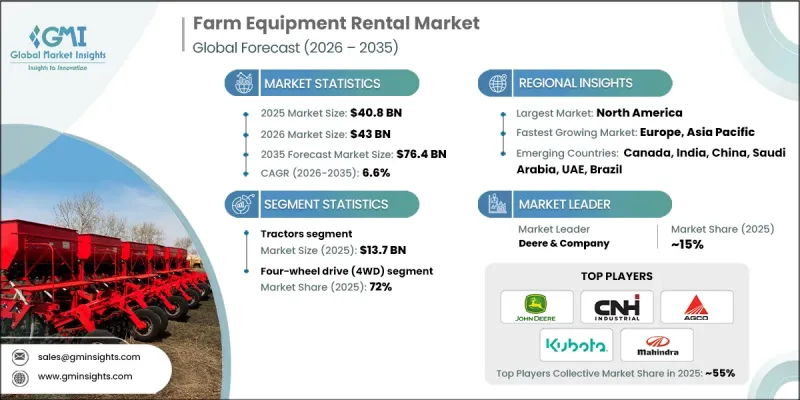
The Global Farm Equipment Rental Market was valued at USD 40.8 billion in 2025 and is estimated to grow at a CAGR of 6.6% to reach USD 76.4 billion by 2035.
The market is propelled by the high costs of acquiring modern agricultural machinery. Today's tractors, harvesters, sprayers, and other equipment come equipped with precision farming technologies, automation features, and high-horsepower capabilities, making ownership increasingly expensive. Rental companies are responding by providing an expansive range of machinery suited to diverse crop types, field conditions, and farming operations. Farmers can now access advanced equipment, from basic tractors to specialized harvesters and precision sprayers, without the financial burden of full ownership. The need for financial flexibility is a major factor driving the market, as farmers face volatile incomes due to unpredictable weather, fluctuating commodity prices, rising input costs, and labor shortages. Renting machinery allows farmers to allocate resources to critical inputs, making rentals particularly appealing in regions where access to credit is limited.
| Market Scope | |
|---|---|
| Start Year | 2025 |
| Forecast Year | 2026-2035 |
| Start Value | $40.8 Billion |
| Forecast Value | $76.4 Billion |
| CAGR | 6.6% |
The tractors segment generated USD 13.7 billion in 2025 and is expected to grow at a CAGR of 6.4% from 2026 to 2035. Their versatility in performing tasks such as plowing, tilling, hauling, planting, and land preparation ensures strong rental demand, especially among small and mid-sized farmers who cannot afford ownership. Renting tractors provides access to modern, fuel-efficient, and technologically advanced models without the burden of maintenance, storage, or depreciation. Seasonal farming cycles create peak demand periods, making temporary tractor rentals essential for timely field operations, further fueling market growth.
The four-wheel drive (4WD) tractors segment held 72% share in 2025 and is anticipated to grow at a CAGR of 6.7% through 2035. 4WD equipment is increasingly preferred for its higher traction, enhanced stability, and superior pulling power, making it ideal for heavy-duty farming activities such as deep tillage, large-scale plowing, and handling complex attachments. As farm sizes expand and mechanization becomes more prevalent, the demand for robust 4WD machinery that can operate efficiently on challenging terrains continues to rise, positioning rentals as a practical solution compared to traditional two-wheel drive machines.
U.S. Farm Equipment Rental Market reached USD 13.2 billion in 2025 and is projected to grow at a CAGR of 6.3% from 2026 to 2035. Farmers across the country are increasingly adopting rental services to reduce upfront costs associated with purchasing high-tech, high-performance machinery. Rising input prices, unpredictable commodity markets, and climate-related uncertainties are driving small and medium-sized operators toward more flexible and cost-efficient rental solutions. Rapid advancements in precision agriculture, automation, and smart machinery mean that equipment can quickly become outdated if purchased outright, further boosting the attractiveness of rental services for staying technologically current without long-term financial commitment.
Key players in the Global Farm Equipment Rental Market include Fendt, Kubota Corporation, Mahindra & Mahindra, Case IH, CNH Industrial, Claas, JCB, Massey Ferguson, New Holland Agriculture, AGCO Corporation, Bobcat Company, Deere & Company, Caterpillar (CAT), SDF Group (Same Deutz-Fahr), and Yanmar. Companies in the farm equipment rental market are adopting multiple strategies to strengthen their market foothold. They are expanding rental fleets to offer a wider variety of machinery, including specialized and high-tech models. Strategic partnerships with financial institutions and government programs help increase accessibility for small and mid-sized farmers. Firms are also investing in maintenance and logistics solutions to ensure equipment availability, reliability, and quick deployment during peak seasons. Technological integration, such as GPS-enabled tracking, IoT-based monitoring, and digital rental platforms, enhances operational efficiency and user experience.
Table of Contents
Chapter 1 Methodology & Scope
- 1.1 Market scope and definition
- 1.2 Research design
- 1.2.1 Research approach
- 1.2.2 Data collection methods
- 1.3 Data mining sources
- 1.3.1 Global
- 1.3.2 Regional/Country
- 1.4 Base estimates and calculations
- 1.4.1 Base year calculation
- 1.4.2 Key trends for market estimation
- 1.5 Primary research and validation
- 1.5.1 Primary sources
- 1.6 Forecast model
- 1.7 Research assumptions and limitations
Chapter 2 Executive Summary
- 2.1 Industry 360° synopsis
- 2.2 Key market trends
- 2.2.1 Regional
- 2.2.2 Equipment type
- 2.2.3 Drive type
- 2.2.4 Power output
- 2.2.5 Rental duration
- 2.2.6 Power source
- 2.2.7 Application
- 2.2.8 End user
- 2.3 CXO perspectives: Strategic imperatives
- 2.3.1 Key decision points for industry executives
- 2.3.2 Critical success factors for market players
- 2.4 Future outlook and strategic recommendations
Chapter 3 Industry Insights
- 3.1 Industry ecosystem analysis
- 3.1.1 Supplier landscape
- 3.1.2 Profit margin
- 3.1.3 Value addition at each stage
- 3.1.4 Factor affecting the value chain
- 3.2 Industry impact forces
- 3.2.1 Growth drivers
- 3.2.1.1 High cost of new farm equipment
- 3.2.1.2 Diverse equipment offerings by rental companies
- 3.2.1.3 Increasing need to reduce the financial burden on farmers across the globe
- 3.2.1.4 Growing demand for productivity and operational efficiency
- 3.2.2 Industry pitfalls & challenges
- 3.2.2.1 Growing government initiatives and subsidies for purchasing new farm equipment
- 3.2.2.2 Problems related to lack of safety-related regulation in developing countries
- 3.2.1 Growth drivers
- 3.3 Growth potential analysis
- 3.4 Future market trends
- 3.5 Technology and innovation landscape
- 3.5.1 Current technological trends
- 3.5.2 Emerging technologies
- 3.6 Price trends
- 3.6.1 By region
- 3.6.2 By equipment type
- 3.7 Regulatory landscape
- 3.7.1 Standards and compliance requirements
- 3.7.2 Regional regulatory frameworks
- 3.7.3 Certification standards
- 3.8 Trade statistics
- 3.8.1 Major importing countries
- 3.8.2 Major exporting countries
- 3.9 Porter’s analysis
- 3.10 PESTEL analysis
Chapter 4 Competitive Landscape, 2025
- 4.1 Introduction
- 4.2 Company market share analysis
- 4.2.1 By Region
- 4.2.1.1 North America
- 4.2.1.2 Europe
- 4.2.1.3 Asia Pacific
- 4.2.1.4 Latin America
- 4.2.1.5 Middle East & Africa
- 4.2.1 By Region
- 4.3 Company matrix analysis
- 4.4 Competitive analysis of major market players
- 4.5 Competitive positioning matrix
- 4.6 Key developments
- 4.6.1 Mergers & acquisitions
- 4.6.2 Partnerships & collaborations
- 4.6.3 New product launches
- 4.6.4 Expansion plans
Chapter 5 Market Estimates & Forecast, By Equipment Type, 2022 - 2035, (USD Billion)
- 5.1 Key trends
- 5.2 Tractors
- 5.3 Harvesters
- 5.4 Sprayers
- 5.5 Balers
- 5.6 Others
Chapter 6 Market Estimates & Forecast, By Drive Type, 2022 - 2035, (USD Billion)
- 6.1 Key trends
- 6.2 Two-wheel drive (2WD)
- 6.3 Four-wheel drive (4WD)
Chapter 7 Market Estimates & Forecast, By Power Output, 2022 - 2035, (USD Billion)
- 7.1 Key trends
- 7.2 30 HP
- 7.3 31-70 HP
- 7.4 71-130 HP
- 7.5 131-250 HP
- 7.6 >250HP
Chapter 8 Market Estimates & Forecast, By Technology, 2022 - 2035, (USD Billion)
- 8.1 Key trends
- 8.2 Short-term
- 8.3 Medium-term
- 8.4 Long-term
Chapter 9 Market Estimates & Forecast, By Power Source, 2022 - 2035, (USD Billion)
- 9.1 Key trends
- 9.2 Diesel
- 9.3 Electric
- 9.4 Hydraulic
- 9.5 Pneumatic
Chapter 10 Market Estimates & Forecast, By Application, 2022 - 2035, (USD Billion)
- 10.1 Key trends
- 10.2 Plowing & soil preparation
- 10.3 Sowing & planting
- 10.4 Plant protection & fertilization
- 10.5 Harvesting & threshing
- 10.6 Post-harvest operations
- 10.7 Livestock-related applications
- 10.8 Forest farm activities
Chapter 11 Market Estimates & Forecast, By End User, 2022 - 2035, (USD Billion)
- 11.1 Key trends
- 11.2 Individual farmers
- 11.3 Agricultural cooperatives
- 11.4 Commercial farms
- 11.5 Government agencies
- 11.6 Research institutions
Chapter 12 Market Estimates & Forecast, By Region, 2022 - 2035, (USD Billion) (Million Units)
- 12.1 Key trends
- 12.2 North America
- 12.2.1 U.S.
- 12.2.2 Canada
- 12.3 Europe
- 12.3.1 Germany
- 12.3.2 UK
- 12.3.3 France
- 12.3.4 Italy
- 12.3.5 Spain
- 12.4 Asia Pacific
- 12.4.1 China
- 12.4.2 India
- 12.4.3 Japan
- 12.4.4 South Korea
- 12.4.5 Australia
- 12.4.6 Indonesia
- 12.4.7 Malaysia
- 12.5 Latin America
- 12.5.1 Brazil
- 12.5.2 Mexico
- 12.5.3 Argentina
- 12.6 MEA
- 12.6.1 Saudi Arabia
- 12.6.2 UAE
- 12.6.3 South Africa
Chapter 13 Company Profiles
- 13.1 AGCO Corporation
- 13.2 Bobcat Company
- 13.3 Case IH
- 13.4 Caterpillar (CAT)
- 13.5 Claas
- 13.6 CNH Industrial
- 13.7 Deere & Company
- 13.8 Fendt
- 13.9 JCB
- 13.10 Kubota Corporation
- 13.11 Mahindra & Mahindra
- 13.12 Massey Ferguson
- 13.13 New Holland Agriculture
- 13.14 SDF Group (Same Deutz-Fahr)
- 13.15 Yanmar

