PUBLISHER: Global Market Insights Inc. | PRODUCT CODE: 1959582

PUBLISHER: Global Market Insights Inc. | PRODUCT CODE: 1959582
Middle East and Africa Subsea Risers Market Opportunity, Growth Drivers, Industry Trend Analysis, and Forecast 2026 - 2035
Middle East & Africa Subsea Risers Market was valued at USD 380.2 million in 2025 and is estimated to grow at a CAGR of 7.8% to reach USD 801.3 million by 2035.
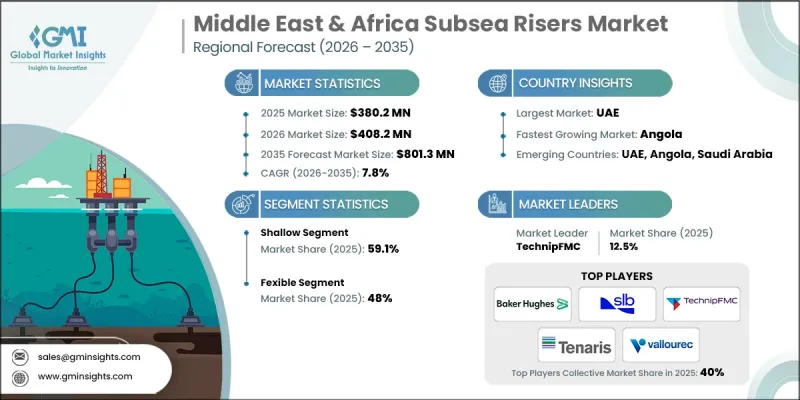
The market growth is driven by the ongoing expansion of offshore oil field operations and the continuous exploration of hydrocarbons in deep-water and ultra-deep-water environments under challenging sea conditions. Rising energy consumption and fluctuating oil prices are prompting operators to expand offshore oil fields and upgrade infrastructure to transport oil and gas efficiently from reservoirs to processing facilities. Increasing investments in floating rigs and the demand for advanced, reliable riser systems that reduce maintenance needs and failure risks are reshaping industry dynamics. Additionally, retrofitting aging offshore infrastructure, developing marginal fields, and adhering to stringent regulations to minimize emissions are further enhancing market growth. Favorable policies supporting the use of advanced materials and sustainable offshore technologies are also contributing to the market's positive trajectory.
| Market Scope | |
|---|---|
| Start Year | 2025 |
| Forecast Year | 2026-2035 |
| Start Value | $380.2 Million |
| Forecast Value | $801.3 Million |
| CAGR | 7.8% |
The shallow water segment held 59.1% share in 2025 and is expected to grow at a CAGR of 7.6% from 2026 to 2035. Growth in this segment is being driven by operators focusing on redeveloping aging offshore assets and pursuing more cost-effective nearshore exploration projects. Rising investment in nearshore oil blocks to ensure energy security, coupled with early production schemes and the development of newly discovered offshore projects, is boosting market potential.
The SCR (Steel Catenary Riser) segment was valued at USD 45.6 million in 2025. Operators are increasingly prioritizing durable, fatigue-resistant, and cost-effective solutions capable of withstanding the high pressures and strong currents typical of deepwater fields. Rising offshore oil field development, higher investment in deep and ultra-deepwater exploration, and ongoing upgrades to hydrocarbon infrastructure are supporting broader adoption of SCR systems.
UAE Middle East & Africa Subsea Risers Market held a 19.6% share, generating USD 74.5 million in 2025. Strong offshore oil and gas reserves, active exploration, and production initiatives are driving this growth. Investments in deep offshore field expansion, infrastructure modernization, and advanced rigid and flexible riser systems, alongside increasing deployment of floating rigs and cutting-edge recovery techniques, are enhancing operational efficiency and system reliability, thereby strengthening the market outlook.
Key players operating in the Middle East & Africa Subsea Risers Market include Aker Solutions, Alleima, Aquaterra Energy, ArcelorMittal, Baker Hughes, Butting Group, Dril-Quip, Expro Holdings, Hunting, John Wood Group, NOV, Oil States, OneSubsea, SLB, Subsea 7, TechnipFMC, Tenaris, Vallourec, Weatherford, and Worldwide Oilfield Machine (WOM). To strengthen their presence and market position, companies in the Middle East & Africa Subsea Risers Market are focusing on developing innovative riser solutions that enhance durability and reliability in harsh offshore conditions. Firms are investing in R&D to optimize riser materials, reduce fatigue, and improve long-term operational performance. Strategic partnerships and joint ventures with offshore operators allow companies to secure long-term contracts and expand their service networks. Additionally, firms are pursuing capacity expansions, local manufacturing, and advanced installation capabilities to meet growing regional demand.
Table of Contents
Chapter 1 Methodology & Scope
- 1.1 Research design
- 1.2 Quality commitment
- 1.2.1 GMI AI policy & data integrity commitment
- 1.2.1.1 Source consistency protocol
- 1.2.1 GMI AI policy & data integrity commitment
- 1.3 Research Trail & Confidence Scoring
- 1.3.1 Research Trail Components
- 1.3.2 Scoring components
- 1.4 Data Collection
- 1.4.1 Partial list of primary sources
- 1.5 Data mining sources
- 1.5.1 Paid Sources
- 1.5.1.1 Sources, by region
- 1.5.1 Paid Sources
- 1.6 Base estimates and calculations
- 1.6.1 Base year calculation for any one approach
- 1.7 Forecast model
- 1.8 Research transparency addendum
- 1.8.1 Source attribution framework
- 1.8.2 Quality assurance metrics
- 1.8.3 Our commitment to trust
- 1.9 Market definitions
Chapter 2 Executive Summary
- 2.1 Industry synopsis, 2022 - 2035
- 2.2 Business trends
- 2.3 Depth trends
- 2.4 Product trends
- 2.5 Country trends
Chapter 3 Industry Insights
- 3.1 Industry ecosystem analysis
- 3.1.1 Raw material availability & sourcing analysis
- 3.1.2 Key factors affecting the value chain
- 3.1.3 Disruptions
- 3.2 Regulatory landscape
- 3.3 Industry impact forces
- 3.3.1 Growth drivers
- 3.3.2 Industry pitfalls & challenges
- 3.4 Growth potential analysis
- 3.5 Porter's analysis
- 3.5.1 Bargaining power of suppliers
- 3.5.2 Bargaining power of buyers
- 3.5.3 Threat of new entrants
- 3.5.4 Threat of substitutes
- 3.6 PESTEL analysis
- 3.6.1 Political factors
- 3.6.2 Economic factors
- 3.6.3 Social factors
- 3.6.4 Technological factors
- 3.6.5 Legal factors
- 3.6.6 Environmental factors
- 3.7 Price trend analysis
- 3.7.1 By depth
- 3.7.2 By country
- 3.8 Emerging opportunities & trends
- 3.8.1 Digital transformation with IoT technologies
- 3.8.2 Emerging market penetration
- 3.9 Investment analysis & future outlook
Chapter 4 Competitive Landscape, 2025
- 4.1 Introduction
- 4.2 Company market share analysis, by country, 2025
- 4.2.1 Angola
- 4.2.2 Nigeria
- 4.2.3 Egypt
- 4.2.4 Qatar
- 4.2.5 Saudi Arabia
- 4.2.6 UAE
- 4.3 Strategic initiatives
- 4.3.1 Key partnerships & collaborations
- 4.3.2 Major M&A activities
- 4.3.3 Product innovations & launches
- 4.3.4 Market expansion strategies
- 4.4 Competitive benchmarking
- 4.5 Strategic dashboard
- 4.6 Innovation & sustainability landscape
Chapter 5 Market Size and Forecast, By Depth, 2022 - 2035 (‘000 Feet & USD Million)
- 5.1 Key trends
- 5.2 Shallow
- 5.2.1 SCR
- 5.2.2 Flexible
- 5.2.3 Others
- 5.3 Deep
- 5.3.1 SCR
- 5.3.2 Flexible
- 5.3.3 Others
- 5.4 Ultra-Deep
- 5.4.1 SCR
- 5.4.2 Flexible
- 5.4.3 Others
Chapter 6 Market Size and Forecast, By Product, 2022 - 2035 (‘000 Feet & USD Million)
- 6.1 Key trends
- 6.2 SCR
- 6.3 Flexible
- 6.4 Others
Chapter 7 Market Size and Forecast, By Country, 2022 - 2035 (‘000 Feet & USD Million)
- 7.1 Key trends
- 7.2 Angola
- 7.3 Nigeria
- 7.4 Egypt
- 7.5 Qatar
- 7.6 Saudi Arabia
- 7.7 UAE
Chapter 8 Company Profiles
- 8.1 Aker Solutions
- 8.2 Alleima
- 8.3 Aquaterra Energy
- 8.4 ArcelorMittal
- 8.5 Baker Hughes
- 8.6 Butting Group
- 8.7 Dril-Quip
- 8.8 Expro Holdings
- 8.9 Hunting
- 8.10 John Wood Group
- 8.11 NOV
- 8.12 Oil States
- 8.13 OneSubsea
- 8.14 SLB
- 8.15 Subsea 7
- 8.16 TechnipFMC
- 8.17 Tenaris
- 8.18 Vallourec
- 8.19 Weatherford
- 8.20 Worldwide Oilfield Machine (WOM)

