
PUBLISHER: Global Market Insights Inc. | PRODUCT CODE: 1959603

PUBLISHER: Global Market Insights Inc. | PRODUCT CODE: 1959603
Low Voltage Distribution Panel Market Opportunity, Growth Drivers, Industry Trend Analysis, and Forecast 2026 - 2035
The Global Low Voltage Distribution Panel Market was valued at USD 1.5 billion in 2025 and is estimated to grow at a CAGR of 5.9% to reach USD 2.9 billion by 2035.
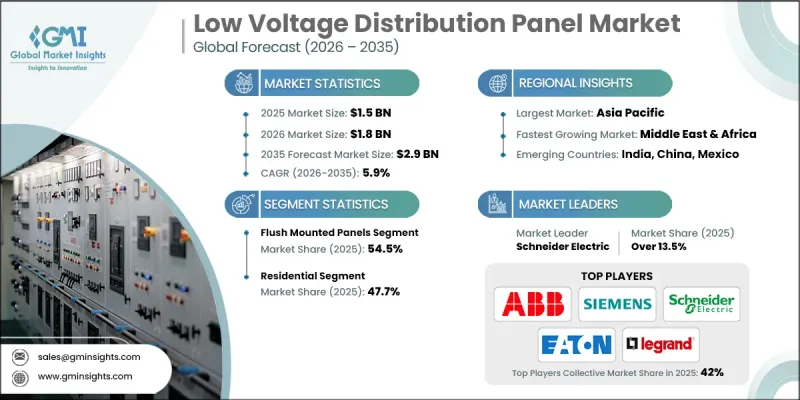
Market expansion is driven by the rapid integration of distributed renewable energy systems and behind-the-meter storage solutions across residential, commercial, and light industrial facilities. As buildings incorporate solar generation, battery storage, and electrified loads, electrical infrastructure requires modernization to support bidirectional power flows, enhanced protection coordination, and additional circuit capacity. Record renewable energy capacity additions in recent years have intensified grid interconnection activity at distribution voltage levels, accelerating the replacement of outdated panelboards with compliant, future-ready assemblies. At the same time, growth in data centers and artificial intelligence workloads is increasing demand for resilient, high-density, low-voltage power distribution systems with advanced monitoring capabilities. Expansion of electric vehicle charging infrastructure is further prompting upgrades in electrical rooms to accommodate new feeder circuits, load balancing systems, and revenue-grade metering. Investments in grid resilience, service entrance modernization, and distribution loss reduction programs continue to stimulate demand for low-voltage distribution panels across critical infrastructure and community energy networks.
| Market Scope | |
|---|---|
| Start Year | 2025 |
| Forecast Year | 2026-2035 |
| Start Value | $1.5 Billion |
| Forecast Value | $2.9 Billion |
| CAGR | 5.9% |
The flush-mounted panels segment accounted for 54.5% share in 2025, supported by rising preference for streamlined electrical installations that blend seamlessly into modern building interiors. Growing residential electrification and renovation activity is encouraging the adoption of recessed low-voltage distribution panels that maximize usable space and provide a refined appearance. Publicly supported housing efficiency initiatives are reinforcing demand for flush-mounted configurations in multi-unit retrofit projects, where compact installations enhance safety and accessibility.
The residential segment represented 47.7% share in 2025 and is expected to reach USD 1.3 billion by 2035. Residential applications generate substantial demand as panelboards are frequently upgraded during remodeling projects, electrification efforts, and code compliance improvements across a broad housing base. Market trends indicate increasing preference for compact, standards-compliant panels that accommodate expanded branch circuit requirements for electrified appliances, rooftop solar backfeed, and electric vehicle charging systems. Contractors are prioritizing designs with additional circuit capacity, simplified wiring configurations, and improved labeling to streamline installation and minimize service interventions.
United States Low Voltage Distribution Panel Market reached USD 334.9 million in 2025. Growth momentum is supported by expanding commercial construction and rising demand for energy-efficient electrical distribution solutions. Retrofit initiatives across federal and institutional facilities are contributing to panelboard replacements, subpanel installations, and upgraded protection systems as part of broader electrification and efficiency improvement programs.
Key companies operating in the Global Low Voltage Distribution Panel Market include ABB, AGS, Alfanar Group, EAMFCO, Eaton, ESL Power Systems, Evolution Interconnect System, GE Vernova, Hager Group, Industrial Electric MFG, Larsen & Toubro, Legrand, Maverick Power, Meba Electric, NHP, Norelco, Projoy Electric, Schneider Electric, Siemens, and TOSUNlux. Companies competing in the Low Voltage Distribution Panel Market are reinforcing their market position through product innovation, smart integration, and geographic expansion strategies. Leading manufacturers are developing intelligent panel solutions equipped with digital monitoring, load management, and energy analytics capabilities to meet evolving electrification needs. Strategic partnerships with renewable energy integrators and EV infrastructure providers are expanding application reach. Firms are also investing in modular and customizable panel designs to address diverse residential and commercial requirements. Emphasis on compliance with updated safety standards and energy regulations strengthens customer confidence. Additionally, companies are enhancing distribution networks and service support to improve delivery timelines and reinforce long-term relationships across construction and retrofit markets.
Table of Contents
Chapter 1 Methodology & Scope
- 1.1 Research design
- 1.1.1 Research approach
- 1.1.2 Data collection methods
- 1.2 Base estimates and calculations
- 1.2.1 Base year calculation
- 1.2.2 Market estimates & forecast parameters
- 1.3 Forecast
- 1.3.1 Key trends for market estimates
- 1.3.2 Quantified market impact analysis
- 1.3.2.1 Mathematical impact of growth parameters on forecast
- 1.3.3 Scenario analysis framework
- 1.4 Primary research and validation
- 1.4.1 Some of the primary sources (but not limited to)
- 1.5 Data mining sources
- 1.5.1 Paid Sources
- 1.5.2 Sources, by region
- 1.6 Research trail & scoring components
- 1.6.1 Research trail components
- 1.6.2 Scoring components
- 1.7 Research transparency addendum
- 1.7.1 Source attribution framework
- 1.7.2 Quality assurance metrics
- 1.7.3 Our commitment to trust
- 1.8 Market definitions
Chapter 2 Executive Summary
- 2.1 Industry synopsis, 2022 - 2035
- 2.1.1 Business trends
- 2.1.2 Mounting trends
- 2.1.3 End use trends
- 2.1.4 Regional trends
Chapter 3 Industry Insights
- 3.1 Industry ecosystem analysis
- 3.1.1 Raw material availability & sourcing analysis
- 3.1.2 Manufacturing capacity assessment
- 3.1.3 Supply chain resilience & risk factors
- 3.1.4 Distribution network analysis
- 3.2 Regulatory landscape
- 3.3 Industry impact forces
- 3.3.1 Growth drivers
- 3.3.2 Industry pitfalls & challenges
- 3.4 Growth potential analysis
- 3.5 Porter's analysis
- 3.5.1 Bargaining power of suppliers
- 3.5.2 Bargaining power of buyers
- 3.5.3 Threat of new entrants
- 3.5.4 Threat of substitutes
- 3.6 PESTEL analysis
- 3.6.1 Political factors
- 3.6.2 Economic factors
- 3.6.3 Social factors
- 3.6.4 Technological factors
- 3.6.5 Legal factors
- 3.6.6 Environmental factors
- 3.7 Cost structure analysis of low voltage distribution panels
- 3.8 Emerging opportunities & trends
- 3.9 Investment analysis & future prospects
Chapter 4 Competitive Landscape, 2025
- 4.1 Introduction
- 4.2 Company market share analysis, by region, 2025
- 4.2.1 North America
- 4.2.2 Europe
- 4.2.3 Asia Pacific
- 4.2.4 Middle East & Africa
- 4.2.5 Latin America
- 4.3 Strategic dashboard
- 4.4 Strategic initiatives
- 4.4.1 Key partnerships & collaborations
- 4.4.2 Major M&A activities
- 4.4.3 Product innovations & launches
- 4.4.4 Market expansion strategies
- 4.5 Competitive benchmarking
- 4.6 Innovation & sustainability landscape
Chapter 5 Market Size and Forecast, By Mounting, 2022 - 2035 (USD Million)
- 5.1 Key trends
- 5.2 Flush mounting
- 5.3 Surface mounting
Chapter 6 Market Size and Forecast, By End Use, 2022 - 2035 (USD Million)
- 6.1 Key trends
- 6.2 Residential
- 6.3 Commercial
- 6.4 Industrial
- 6.5 Utility
Chapter 7 Market Size and Forecast, By Region, 2022 - 2035 (USD Million)
- 7.1 Key trends
- 7.2 North America
- 7.2.1 U.S.
- 7.2.2 Canada
- 7.3 Europe
- 7.3.1 UK
- 7.3.2 France
- 7.3.3 Germany
- 7.3.4 Russia
- 7.3.5 Italy
- 7.4 Asia Pacific
- 7.4.1 China
- 7.4.2 Australia
- 7.4.3 India
- 7.4.4 Japan
- 7.4.5 South Korea
- 7.5 Middle East & Africa
- 7.5.1 Saudi Arabia
- 7.5.2 UAE
- 7.5.3 Qatar
- 7.5.4 South Africa
- 7.5.5 Egypt
- 7.6 Latin America
- 7.6.1 Brazil
- 7.6.2 Argentina
- 7.6.3 Mexico
Chapter 8 Company Profiles
- 8.1 ABB
- 8.2 AGS
- 8.3 Alfanar Group
- 8.4 EAMFCO
- 8.5 Eaton
- 8.6 ESL Power Systems
- 8.7 Evolution Interconnect System
- 8.8 GE Vernova
- 8.9 Hager Group
- 8.10 Industrial Electric MFG
- 8.11 Larsen & Toubro
- 8.12 Legrand
- 8.13 Maverick Power
- 8.14 Meba Electric
- 8.15 NHP
- 8.16 Norelco
- 8.17 Projoy Electric
- 8.18 Schneider Electric
- 8.19 Siemens
- 8.20 TOSUNlux

