PUBLISHER: Global Market Insights Inc. | PRODUCT CODE: 1959613

PUBLISHER: Global Market Insights Inc. | PRODUCT CODE: 1959613
Medium Voltage Circuit Breaker Market Opportunity, Growth Drivers, Industry Trend Analysis, and Forecast 2026 - 2035
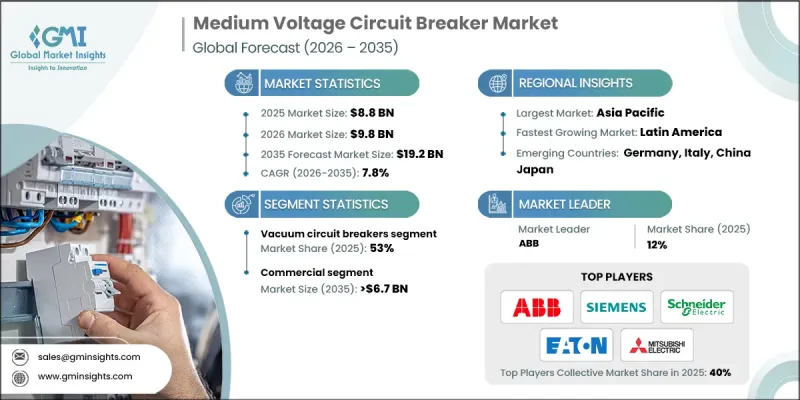
The Global Medium Voltage Circuit Breaker Market was valued at USD 8.8 billion in 2025 and is estimated to grow at a CAGR of 7.8% to reach USD 19.2 billion by 2035.
The growth is driven by global grid modernization, electrification initiatives, and the increasing need for resilience against extreme weather conditions. Rapid integration of renewable energy, such as wind and solar, is placing higher demands on MV circuit breakers, as networks must safely handle elevated fault currents, bidirectional power flows, and more frequent switching operations. Policy-driven initiatives, including the U.S. Bipartisan Infrastructure Law, are accelerating investments in distribution and transmission protection systems. Similarly, India's Revamped Distribution Sector Scheme (RDSS) is stimulating MV breaker upgrades to reduce losses, while China's renewable-driven grid expansion is raising protection requirements at substations and distribution points. European regulations focused on renewable adoption, and electrification are also promoting widespread installation of MV breakers, particularly at the distribution level. Meanwhile, growing digitalization and automation across utilities are increasing demand for smart circuit breakers with integrated sensors, remote control capabilities, and real-time monitoring. Lead time management and strategic procurement are becoming crucial as transformer and cable shortages tighten the supply chain, reinforcing the need for advanced MV breakers capable of handling higher duty cycles and smarter coordination across grids.
| Market Scope | |
|---|---|
| Start Year | 2025 |
| Forecast Year | 2026-2035 |
| Start Value | $8.8 Billion |
| Forecast Value | $19.2 Billion |
| CAGR | 7.8% |
The vacuum circuit breaker segment accounted for 53% share in 2025 and is expected to grow at a CAGR of 7.2% through 2035. The shift toward vacuum interrupters is fueled by global decarbonization initiatives and the ongoing phase-down of SF6-based equipment, prompting utilities to adopt cleaner and more sustainable switching technologies. Vacuum breakers provide high reliability, lower maintenance needs, and enhanced environmental compliance, making them the preferred choice in modern MV networks. Their ability to withstand high electrical stress while minimizing arc flash hazards positions them as a long-term solution for both distribution and industrial applications, supporting increased adoption across commercial, industrial, and renewable-integrated grids worldwide.
The commercial-scale medium voltage circuit breakers segment held 36.9% share in 2025. The rapid expansion of data centers is reshaping commercial MV protection needs, with operators requiring advanced breakers to handle higher fault currents, transformer inrush, and back-feed from UPS systems. These environments demand circuit breakers featuring high-speed relays, selective coordination, arc flash mitigation, and remote diagnostic capabilities. Commercial operators are increasingly specifying sectionalized protection schemes, bus differential arrangements, and predictive maintenance systems to maintain uptime, safety, and operational reliability. As commercial power densities continue to grow, these advanced MV solutions are becoming essential to manage energy flows efficiently while ensuring compliance with stringent reliability and safety standards.
U.S. Medium Voltage Circuit Breaker Market reached USD 1.5 billion in 2025, driven by the urgent need to upgrade aging grid infrastructure, including distribution feeders and industrial networks, to prevent fire hazards and ensure operational resilience. Federal funding and incentives for grid modernization and automation are driving the deployment of smart MV breakers integrated with sensors, remote monitoring, and automated switching. Utilities are increasingly investing in protective solutions to enhance safety, reduce downtime, and accommodate the growing integration of distributed energy resources, including renewables and electrification in transport and industry.
Key players active in the Global Medium Voltage Circuit Breaker Market include Hitachi Energy, Eaton, ABB, Chint Global, Schneider Electric, Siemens, Fuji Electric FA Components & Systems, CG Power & Industrial Solutions, LS Electric, Mitsubishi Electric, Myers Power Products, North American Switchgear, Powell Industries, Tavrida Electric, Toshiba International, Liyond, Zhejiang Zhegui Electric, Zhiyue Group, Alfanar Group, CNC Electric, and Zhejiang Tengen Electric. Companies in the Medium Voltage Circuit Breaker Market are strengthening their foothold through several strategic approaches. They are investing heavily in R&D to develop vacuum and SF6-free technologies, improving environmental compliance and operational efficiency. Many are integrating sensors, IoT, and AI capabilities into breakers to enable predictive maintenance, remote monitoring, and faster fault isolation. Firms are expanding global service networks to provide lifecycle support, retrofitting, and spare parts to maintain long-term client relationships. Strategic partnerships with utilities, data center operators, and industrial users are securing long-term contracts and repeat orders.
Table of Contents
Chapter 1 Methodology & Scope
- 1.1 Research design
- 1.1.1 Research approach
- 1.1.2 Data collection methods
- 1.2 Base estimates and calculations
- 1.2.1 Base year calculation
- 1.2.2 Market estimates & forecast parameters
- 1.3 Forecast
- 1.3.1 Key trends for market estimates
- 1.3.2 Quantified market impact analysis
- 1.3.2.1 Mathematical impact of growth parameters on forecast
- 1.3.3 Scenario analysis framework
- 1.4 Primary research and validation
- 1.4.1 Some of the primary sources (but not limited to)
- 1.5 Data mining sources
- 1.5.1 Paid Sources
- 1.5.2 Sources, by region
- 1.6 Research trail & scoring components
- 1.6.1 Research trail components
- 1.6.2 Scoring components
- 1.7 Research transparency addendum
- 1.7.1 Source attribution framework
- 1.7.2 Quality assurance metrics
- 1.7.3 Our commitment to trust
- 1.8 Market definitions
Chapter 2 Executive Summary
- 2.1 Industry synopsis, 2022 - 2035
- 2.1.1 Business trends
- 2.1.2 Product trends
- 2.1.3 End use trends
- 2.1.4 Regional trends
Chapter 3 Industry Insights
- 3.1 Industry ecosystem analysis
- 3.1.1 Raw material availability & sourcing analysis
- 3.1.2 Manufacturing capacity assessment
- 3.1.3 Supply chain resilience & risk factors
- 3.1.4 Distribution network analysis
- 3.2 Regulatory landscape
- 3.3 Industry impact forces
- 3.3.1 Growth drivers
- 3.3.2 Industry pitfalls & challenges
- 3.4 Growth potential analysis
- 3.5 Porter's analysis
- 3.5.1 Bargaining power of suppliers
- 3.5.2 Bargaining power of buyers
- 3.5.3 Threat of new entrants
- 3.5.4 Threat of substitutes
- 3.6 PESTEL analysis
- 3.6.1 Political factors
- 3.6.2 Economic factors
- 3.6.3 Social factors
- 3.6.4 Technological factors
- 3.6.5 Legal factors
- 3.6.6 Environmental factors
- 3.7 Cost structure analysis of medium voltage circuit breakers
- 3.8 Emerging opportunities & trends
- 3.9 Investment analysis & future prospects
Chapter 4 Competitive Landscape, 2025
- 4.1 Introduction
- 4.2 Company market share analysis, by region, 2025
- 4.2.1 North America
- 4.2.2 Europe
- 4.2.3 Asia Pacific
- 4.2.4 Middle East & Africa
- 4.2.5 Latin America
- 4.3 Strategic dashboard
- 4.4 Strategic initiatives
- 4.4.1 Key partnerships & collaborations
- 4.4.2 Major M&A activities
- 4.4.3 Product innovations & launches
- 4.4.4 Market expansion strategies
- 4.5 Competitive benchmarking
- 4.6 Innovation & sustainability landscape
Chapter 5 Market Size and Forecast, By Product, 2022 - 2035 (USD Million & '000 Units)
- 5.1 Key trends
- 5.2 ACB
- 5.3 VCB
- 5.4 GCB
- 5.5 Others
Chapter 6 Market Size and Forecast, By End Use, 2022 - 2035 (USD Million & '000 Units)
- 6.1 Key trends
- 6.2 Residential
- 6.3 Commercial
- 6.4 Industrial
- 6.5 Utility
Chapter 7 Market Size and Forecast, By Region, 2022 - 2035 (USD Million & '000 Units)
- 7.1 Key trends
- 7.2 North America
- 7.2.1 U.S.
- 7.2.2 Canada
- 7.2.3 Mexico
- 7.3 Europe
- 7.3.1 Germany
- 7.3.2 France
- 7.3.3 Italy
- 7.3.4 UK
- 7.3.5 Russia
- 7.4 Asia Pacific
- 7.4.1 China
- 7.4.2 India
- 7.4.3 Japan
- 7.4.4 South Korea
- 7.4.5 Australia
- 7.5 Middle East & Africa
- 7.5.1 Saudi Arabia
- 7.5.2 UAE
- 7.5.3 Qatar
- 7.5.4 Oman
- 7.5.5 South Africa
- 7.6 Latin America
- 7.6.1 Brazil
- 7.6.2 Chile
Chapter 8 Company Profiles
- 8.1 ABB
- 8.2 CG Power & Industrial Solutions
- 8.3 Chint Global
- 8.4 CNC Electric
- 8.5 Eaton
- 8.6 Fuji Electric FA Components & Systems
- 8.7 Hitachi Energy
- 8.8 Liyond
- 8.9 LS Electric
- 8.10 Mitsubishi Electric
- 8.11 Myers Power Products
- 8.12 North American Switchgear
- 8.13 Powell Industries
- 8.14 Schneider Electric
- 8.15 Siemens
- 8.16 Tavrida Electric
- 8.17 Toshiba International
- 8.18 Zhejiang Tengen Electric
- 8.19 Zhejiang Zhegui Electric
- 8.20 Zhiyue Group

