
PUBLISHER: Global Market Insights Inc. | PRODUCT CODE: 1959614

PUBLISHER: Global Market Insights Inc. | PRODUCT CODE: 1959614
Industrial Gearbox Market Opportunity, Growth Drivers, Industry Trend Analysis, and Forecast 2026 - 2035
The Global Industrial Gearbox Market was valued at USD 32.1 billion in 2025 and is estimated to grow at a CAGR of 5.1% to reach USD 52.1 billion by 2035.
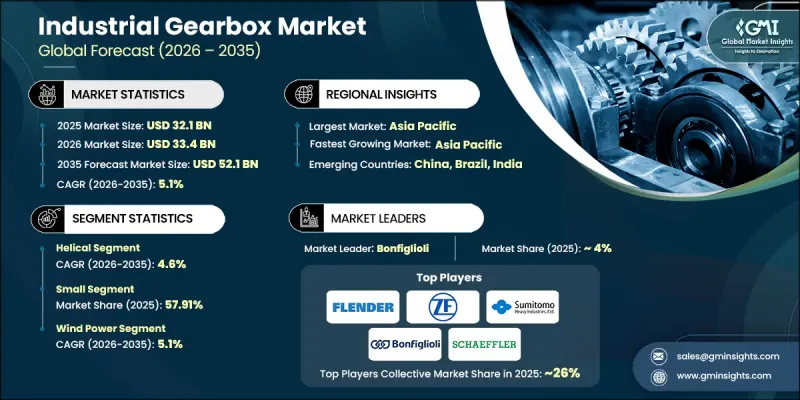
Market growth is driven by the rapid adoption of industrial automation and Industry 4.0 technologies, which demand precise torque transmission and controlled mechanical motion across manufacturing processes. Automated production lines rely on industrial gearboxes to maintain consistent speed and load, ensuring seamless operations. As connected factories and smart manufacturing solutions expand, industrial gearboxes are increasingly critical for handling mechanical stress and ensuring long-term durability. Manufacturers are also prioritizing gearboxes that support predictive maintenance and remote monitoring, enabling efficient operation of robotic systems and automated machinery. The rising intensity of automation, coupled with the need for reliable motion control and energy-efficient solutions, has significantly increased the installation rates of industrial gearboxes across sectors such as automotive, food processing, packaging, and heavy machinery production. This trend reflects the broader move toward smarter, more efficient manufacturing ecosystems.
| Market Scope | |
|---|---|
| Start Year | 2025 |
| Forecast Year | 2026-2035 |
| Start Value | $32.1 Billion |
| Forecast Value | $52.1 Billion |
| CAGR | 5.1% |
The helical gearbox segment accounted for USD 11 billion in 2025 and is anticipated to grow at a CAGR of 4.6% between 2026 and 2035. Helical gearboxes are favored in industrial settings due to their smooth power transmission, reduced vibration, and quieter operation compared to other gearbox types. Angled gear teeth allow for better torque distribution, making them ideal for heavy-duty machinery and processing equipment. Their efficiency in handling high loads and extending operational longevity reduces downtime and maintenance requirements, making them a preferred choice across multiple industrial sectors. The improved stability and energy efficiency of helical gearboxes enhance productivity while lowering operational costs, driving continued adoption.
The small power industrial gearboxes, typically up to 500 kW, held 57.91% share in 2025 and are expected to grow at a CAGR of 4.3% through 2035. These gearboxes are popular due to their versatile applications in manufacturing, packaging, and food processing industries. Their compact design allows seamless integration into equipment with limited space, while moderate power output meets the needs of both continuous and intermittent operations. The combination of affordability, reliability, and adaptability contributes to the dominance of the small gearbox segment within the market.
Germany Industrial Gearbox Market generated USD 1.84 billion in 2025 and is projected to grow at a CAGR of 4.9% from 2026 to 2035. Germany's strong manufacturing infrastructure supports the stable demand for industrial gearboxes. The rising adoption of automated production lines, energy efficiency standards, and modernization initiatives has increased demand for precision gearbox systems. Heavy-duty gearboxes are consistently required in automotive, metal processing, and industrial equipment applications. Continuous investments in advanced drive technologies and factory modernization efforts further support Germany's position as a key market in Europe.
Major companies operating in the Global Industrial Gearbox Market include Siemens, ZF Friedrichshafen, SEW-EURODRIVE, ABB Ltd., Dana Incorporated, Liebherr Group, Getriebebau NORD, Bonfiglioli Riduttori, Nabtesco Corporation, Rossi, Elecon Engineering Company, DB Santasalo, Nidec Motor Corporation, Sumitomo Heavy Industries, Ltd., and Regal Rexnord Corporation. Companies in the Industrial Gearbox Market are leveraging several strategies to strengthen their market presence and maintain a competitive advantage. Innovation in product design, including higher precision, durability, and energy-efficient gearboxes, is central to their strategy. Firms are expanding distribution networks and forming strategic partnerships with manufacturing and automation companies to increase market penetration. Investment in research and development supports the creation of smart, connected gearboxes compatible with predictive maintenance and remote monitoring.
Table of Contents
Chapter 1 Methodology & Scope
- 1.1 Market scope and definition
- 1.2 Research design
- 1.2.1 Research approach
- 1.2.2 Data collection methods
- 1.3 Data mining sources
- 1.3.1 Global
- 1.3.2 Regional/Country
- 1.4 Base estimates and calculations
- 1.4.1 Base year calculation
- 1.4.2 Key trends for market estimation
- 1.5 Primary research and validation
- 1.5.1 Primary sources
- 1.6 Forecast model
- 1.7 Research assumptions and limitations
Chapter 2 Executive Summary
- 2.1 Industry 360° synopsis
- 2.2 Key market trends
- 2.2.1 Regional
- 2.2.2 Burner design
- 2.2.3 Installation
- 2.2.4 Power Range
- 2.2.5 End Use Industry
- 2.3 CXO perspectives: Strategic imperatives
- 2.3.1 Key decision points for industry executives
- 2.3.2 Critical success factors for market players
- 2.4 Future outlook and strategic recommendations
Chapter 3 Industry Insights
- 3.1 Industry ecosystem analysis
- 3.1.1 Supplier landscape
- 3.1.2 Profit margin
- 3.1.3 Value addition at each stage
- 3.1.4 Factor affecting the value chain
- 3.2 Industry impact forces
- 3.2.1 Growth drivers
- 3.2.1.1 Rising adoption of industrial automation and Industry 4.0 technologies
- 3.2.1.2 Expansion of renewable energy infrastructure
- 3.2.1.3 Integration of smart technologies such as IoT and sensors
- 3.2.2 Pitfalls & Challenges
- 3.2.2.1 High initial cost of advanced gearbox systems
- 3.2.2.2 Intense competition and pricing pressure from low-cost manufacturers
- 3.2.3 Opportunities
- 3.2.3.1 Retrofit and modernization of legacy industrial equipment
- 3.2.3.2 Development of energy-efficient and sustainable gearbox designs
- 3.2.1 Growth drivers
- 3.3 Growth potential analysis
- 3.4 Future market trends
- 3.5 Technology and innovation landscape
- 3.5.1 Current technological trends
- 3.5.2 Emerging technologies
- 3.6 Price trends
- 3.6.1 By region
- 3.6.2 By product
- 3.7 Regulatory landscape
- 3.7.1 Standards and compliance requirements
- 3.7.2 Regional regulatory frameworks
- 3.7.3 Certification standards
- 3.8 Porter’s analysis
- 3.9 PESTEL analysis
Chapter 4 Competitive Landscape, 2025
- 4.1 Introduction
- 4.2 Company market share analysis
- 4.2.1 By Region
- 4.2.1.1 North America
- 4.2.1.2 Europe
- 4.2.1.3 Asia Pacific
- 4.2.1.4 Latin America
- 4.2.1.5 Middle East & Africa
- 4.2.1 By Region
- 4.3 Company matrix analysis
- 4.4 Competitive analysis of major market players
- 4.5 Competitive positioning matrix
- 4.6 Key developments
- 4.6.1 Mergers & acquisitions
- 4.6.2 Partnerships & collaborations
- 4.6.3 New product launches
- 4.6.4 Expansion plans
Chapter 5 Market Estimates & Forecast, By Type, 2022 - 2035, (USD Billion) (Thousand Units)
- 5.1 Key trends
- 5.2 Helical
- 5.3 Bevel
- 5.4 Worm
- 5.5 Planetary
- 5.6 Others
Chapter 6 Market Estimates & Forecast, By Power, 2022 - 2035, (USD Billion) (Thousand Units)
- 6.1 Key trends
- 6.2 Small (up to 500 kW)
- 6.3 Medium (500 kW to 10 MW)
- 6.4 Large (above 10 MW)
Chapter 7 Market Estimates & Forecast, By End Use Industry, 2022 - 2035, (USD Billion) (Thousand Units)
- 7.1 Key trends
- 7.2 Wind power
- 7.3 Material handling
- 7.4 Construction
- 7.5 Marine
- 7.6 Energy
- 7.7 Transportation
- 7.8 Others
Chapter 8 Market Estimates & Forecast, By Distribution Channel, 2022 - 2035, (USD Billion) (Thousand Units)
- 8.1 Key trends
- 8.2 Direct
- 8.3 Indirect
Chapter 9 Market Estimates & Forecast, By Region, 2022 - 2035, (USD Billion) (Thousand Units)
- 9.1 Key trends
- 9.2 North America
- 9.2.1 U.S.
- 9.2.2 Canada
- 9.3 Europe
- 9.3.1 Germany
- 9.3.2 UK
- 9.3.3 France
- 9.3.4 Italy
- 9.3.5 Spain
- 9.4 Asia Pacific
- 9.4.1 China
- 9.4.2 India
- 9.4.3 Japan
- 9.4.4 South Korea
- 9.4.5 Australia
- 9.5 Latin America
- 9.5.1 Brazil
- 9.5.2 Mexico
- 9.5.3 Argentina
- 9.6 MEA
- 9.6.1 Saudi Arabia
- 9.6.2 UAE
- 9.6.3 South Africa
Chapter 10 Company Profiles
- 10.1 ABB Ltd.
- 10.2 Bonfiglioli Riduttori
- 10.3 Dana Incorporated
- 10.4 DB Santasalo
- 10.5 Elecon Engineering Company
- 10.6 Getriebebau NORD
- 10.7 Liebherr Group
- 10.8 Nabtesco Corporation
- 10.9 Nidec Motor Corporation
- 10.10 Regal Rexnord Corporation
- 10.11 Rossi
- 10.12 SEW-EURODRIVE
- 10.13 Siemens
- 10.14 Sumitomo Heavy Industries, Ltd.
- 10.15 ZF Friedrichshafen

