PUBLISHER: Global Market Insights Inc. | PRODUCT CODE: 1959622

PUBLISHER: Global Market Insights Inc. | PRODUCT CODE: 1959622
Vitamin K Market Opportunity, Growth Drivers, Industry Trend Analysis, and Forecast 2026 - 2035
The Global Vitamin K Market was valued at USD 1.07 billion in 2025 and is estimated to grow at a CAGR of 8.5% to reach USD 2.4 billion by 2035.
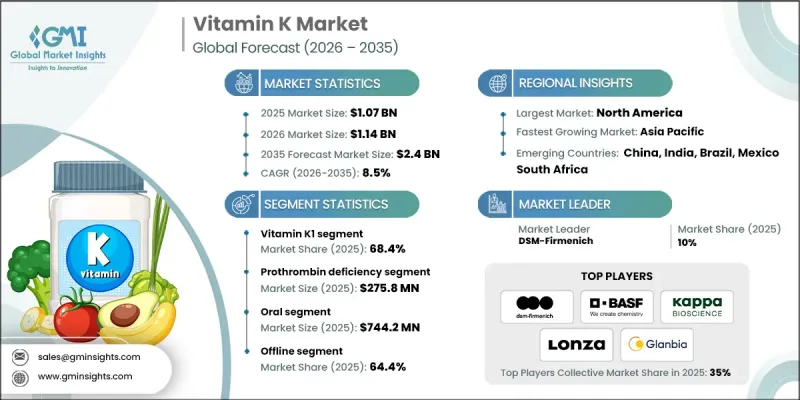
Market growth is supported by rising awareness of the physiological importance of vitamin K in blood coagulation, bone strength, and cardiovascular wellness, alongside a growing incidence of cardiovascular conditions and nutrient deficiencies among older populations. Preventive healthcare trends and increased focus on micronutrient supplementation are further strengthening demand. Vitamin K has gained significant attention in clinical nutrition and wellness applications due to its role in regulating calcium metabolism and maintaining vascular integrity. As consumers increasingly prioritize long-term health outcomes, supplementation has moved beyond deficiency correction to proactive disease risk management. The market is also benefiting from expanding nutraceutical usage, improved formulation stability, and enhanced bioavailability across supplement and pharmaceutical products. Continuous innovation in production methods and ingredient sourcing is allowing manufacturers to deliver consistent quality while addressing rising global demand. Together, these factors are shaping a steadily expanding market landscape supported by both clinical utilization and consumer-driven wellness adoption.
| Market Scope | |
|---|---|
| Start Year | 2025 |
| Forecast Year | 2026-2035 |
| Start Value | $1.07 Billion |
| Forecast Value | $2.4 Billion |
| CAGR | 8.5% |
Vitamin K represents a class of fat-soluble nutrients that are essential for activating proteins responsible for coagulation, bone mineralization, and cardiovascular balance. The market includes vitamin K1, primarily used in therapeutic and dietary formulations, and vitamin K2, which is increasingly incorporated into supplements designed to support skeletal and heart health. Both forms play a central role in regulating calcium transport and preventing improper mineral deposition, making them critical across preventive and therapeutic healthcare applications.
The vitamin K1 segment accounted for 68.4% share in 2025 and is expected to grow at a CAGR of 8.3% during 2026-2035. This segment continues to lead due to its established clinical importance in managing coagulation-related conditions and correcting deficiency states. Strong demand from pharmaceutical formulations and medical nutrition products supports its sustained adoption, while ongoing product optimization is reinforcing its relevance across healthcare settings.
The prothrombin deficiency segment generated USD 275.8 million in 2025. This segment maintained a leading position as vitamin K remains essential for the synthesis and activation of clotting factors required for normal blood function. Clinical reliance on vitamin K for managing coagulation disorders continues to drive consistent demand, particularly within hospital-based and acute care treatment protocols.
North America Vitamin K Market held 41.1% share in 2025. Regional leadership is supported by advanced healthcare systems, strong preventive health awareness, and widespread adoption of dietary supplementation. Continued investment in research, product development, and high-quality formulation technologies is reinforcing market growth, while consumer preference for scientifically backed nutritional solutions further strengthens regional demand.
Key companies operating in the Global Vitamin K Market include Pfizer, BASF SE, DSM-Firmenich, Lonza, Glanbia, Amphastar Pharmaceuticals, Gnosis by Lesaffre, Kappa Bioscience, Country Life (Kikkoman), Nature Made (Pharmavite), Nature's Bounty (Nestle Health Science), NOW Foods, Solgar, and Livealth Biopharma, with competitive positioning driven by diversified portfolios and global distribution capabilities. Companies active in the vitamin K market are strengthening their market position through continuous investment in formulation innovation, bioavailability enhancement, and product differentiation. Manufacturers are focusing on developing high-purity and stable vitamin K ingredients that meet pharmaceutical and nutraceutical quality standards. Strategic partnerships with healthcare providers and nutrition brands are expanding market reach, while geographic expansion into emerging regions is supporting long-term growth.
Table of Contents
Chapter 1 Methodology and Scope
- 1.1 Market scope and definition
- 1.2 Research approach
- 1.3 Quality commitments
- 1.3.1 GMI AI policy and data integrity commitment
- 1.3.1.1 Source consistency protocol
- 1.3.1 GMI AI policy and data integrity commitment
- 1.4 Research trail and confidence scoring
- 1.4.1 Research trail components
- 1.4.2 Scoring components
- 1.5 Data collection
- 1.5.1 Partial list of primary sources
- 1.6 Data mining sources
- 1.6.1 Paid sources
- 1.6.1.1 Sources, by region
- 1.6.1 Paid sources
- 1.7 Base estimates and calculations
- 1.7.1 Revenue share analysis
- 1.7.2 Base year calculation
- 1.8 Forecast model
- 1.9 Research transparency addendum
- 1.9.1 Source attribution framework
- 1.9.2 Quality assurance metrics
- 1.9.3 Our commitment to trust
Chapter 2 Executive Summary
- 2.1 Industry 3600 synopsis
- 2.2 Key market trends
- 2.2.1 Regional trends
- 2.2.2 Type trends
- 2.2.3 Application trends
- 2.2.4 Route of administration trends
- 2.2.5 Distribution channel trends
- 2.3 CXO perspectives: Strategic imperatives
- 2.3.1 Key decision points for industry executives
- 2.3.2 Critical success factors for market players
- 2.4 Future outlook and strategic recommendations
Chapter 3 Industry Insights
- 3.1 Industry ecosystem analysis
- 3.2 Industry impact forces
- 3.2.1 Growth drivers
- 3.2.1.1 Increasing awareness of bone and cardiovascular health
- 3.2.1.2 Growing adoption of nutraceuticals and dietary supplements
- 3.2.1.3 Advancements in formulation and bioavailability
- 3.2.1.4 Expanding pharmaceutical applications
- 3.2.2 Industry pitfalls and challenges
- 3.2.2.1 Regulatory complexity and compliance requirements
- 3.2.2.2 Risk of overdosing and side effects
- 3.2.3 Market opportunities
- 3.2.3.1 Emerging markets with rising health awareness
- 3.2.3.2 Integration with personalized nutrition and digital health
- 3.2.1 Growth drivers
- 3.3 Growth potential analysis
- 3.4 Regulatory landscape
- 3.4.1 North America
- 3.4.2 Europe
- 3.4.3 Asia Pacific
- 3.5 Future market trends
- 3.6 Porter’s analysis
- 3.7 PESTEL analysis
Chapter 4 Competitive Landscape, 2025
- 4.1 Introduction
- 4.2 Company market share analysis
- 4.3 Company matrix analysis
- 4.4 Competitive analysis of major market players
- 4.5 Competitive positioning matrix
- 4.6 Key developments
- 4.6.1 Merger and acquisition
- 4.6.2 Partnership and collaboration
- 4.6.3 New product launches
- 4.6.4 Expansion plans
Chapter 5 Market Estimates and Forecast, By Type, 2022 - 2035 ($ Mn)
- 5.1 Key trends
- 5.2 Vitamin K1
- 5.3 Vitamin K2
Chapter 6 Market Estimates and Forecast, By Application, 2022 - 2035 ($ Mn)
- 6.1 Key trends
- 6.2 Osteoporosis
- 6.3 Vitamin K-dependent clotting factors deficiency (VKCFD)
- 6.4 Prothrombin deficiency
- 6.5 Vitamin K deficiency bleeding (VKDB)
- 6.6 Dermal applications
- 6.7 Other applications
Chapter 7 Market Estimates and Forecast, By Route of Administration, 2022 - 2035 ($ Mn)
- 7.1 Key trends
- 7.2 Oral
- 7.2.1 Pills
- 7.2.2 Powders
- 7.2.3 Liquids
- 7.3 Parenteral
- 7.4 Topical
Chapter 8 Market Estimates and Forecast, By Distribution Channel, 2022 - 2035 ($ Mn)
- 8.1 Key trends
- 8.2 Offline
- 8.2.1 Hypermarkets/ supermarkets
- 8.2.2 Specialty stores
- 8.2.3 Pharmacy stores
- 8.3 Online
Chapter 9 Market Estimates and Forecast, By Region, 2022 - 2035 ($ Mn)
- 9.1 Key trends
- 9.2 North America
- 9.2.1 U.S.
- 9.2.2 Canada
- 9.3 Europe
- 9.3.1 Germany
- 9.3.2 UK
- 9.3.3 France
- 9.3.4 Spain
- 9.3.5 Italy
- 9.3.6 Netherlands
- 9.4 Asia Pacific
- 9.4.1 China
- 9.4.2 India
- 9.4.3 Japan
- 9.4.4 Australia
- 9.4.5 South Korea
- 9.5 Latin America
- 9.5.1 Brazil
- 9.5.2 Mexico
- 9.5.3 Argentina
- 9.6 Middle East and Africa
- 9.6.1 South Africa
- 9.6.2 Saudi Arabia
- 9.6.3 UAE
Chapter 10 Company Profiles
- 10.1 Amphastar Pharmaceuticals
- 10.2 BASF SE
- 10.3 Country Life (Kikkoman)
- 10.4 DSM-Firmenich
- 10.5 Glanbia
- 10.6 Gnosis by Lesaffre
- 10.7 Kappa Bioscience
- 10.8 Livealth Biopharma
- 10.9 Lonza
- 10.10 Nature's Bounty (Nestle Health Science)
- 10.11 Nature Made (Pharmavite)
- 10.12 NOW Foods
- 10.13 Pfizer
- 10.14 Solgar

