PUBLISHER: Global Market Insights Inc. | PRODUCT CODE: 1959634

PUBLISHER: Global Market Insights Inc. | PRODUCT CODE: 1959634
Wind Turbine Pitch and Yaw Drive Market Opportunity, Growth Drivers, Industry Trend Analysis, and Forecast 2026 - 2035
The Global Wind Turbine Pitch and Yaw Drive Market was valued at USD 7.1 billion in 2025 and is estimated to grow at a CAGR of 5.5% to reach USD 12.3 billion by 2035.
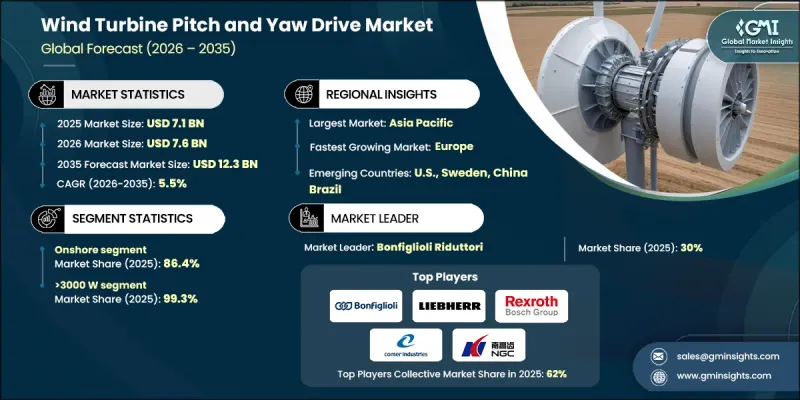
The market outlook is tied to the critical role these systems play in wind turbine performance and safety. Pitch drive systems are used to adjust blade angles in response to changing wind speeds, allowing turbines to operate efficiently while preventing excessive mechanical loads and enabling controlled shutdowns when required. Yaw drive systems ensure that turbines remain properly oriented toward wind flow, supporting consistent energy output and reducing structural fatigue. Growing global commitment to renewable energy adoption and emission reduction targets continues to reinforce market momentum. Wind power remains one of the most cost-effective renewable solutions, and ongoing improvements in turbine efficiency, durability, and automation are strengthening long-term deployment prospects. Advancements in materials, control technologies, and manufacturing precision are further improving system reliability and cost efficiency, driving sustained demand across global wind installations.
| Market Scope | |
|---|---|
| Start Year | 2025 |
| Forecast Year | 2026-2035 |
| Start Value | $7.1 Billion |
| Forecast Value | $12.3 Billion |
| CAGR | 5.5% |
The onshore installations segment accounted for 86.4% share in 2025 and is expected to grow at a CAGR of 4.5% from 2026 to 2035. This dominance is supported by lower installation and servicing expenses, established supply networks, and scalable production capabilities. Continued development of larger turbines with extended blade lengths and increased tower heights has improved energy capture, driving the need for robust pitch and yaw systems capable of handling higher loads and ensuring long operational lifespans.
The 1000 W to 3000 W capacity segment is projected to grow at a CAGR of 9% through 2035. Growth in this range is linked to the modernization of aging turbine fleets, suitability for regions with grid or space limitations, and increasing deployment across developing markets. Systems within this category commonly utilize active pitch and yaw mechanisms supported by mature technology platforms and proven supply chains, supporting cost-effective adoption.
North America Wind Turbine Pitch and Yaw Drive Market accounted for 14.8% share in 2025. The regional market benefits from ongoing technological research and innovation aimed at improving turbine efficiency and expanding deployment feasibility. Canada represents a smaller yet steadily expanding contributor within the regional landscape.
Key companies operating in the Global Wind Turbine Pitch and Yaw Drive Market include Siemens Gamesa Renewable Energy, Vestas Wind Systems, General Electric, ABB, Bosch Rexroth, Bonfiglioli, Schaeffler Group, Nordex, Nidec Conversion, Mitsubishi Heavy Industries, Liebherr, Goldwind Science and Technologies, ZOLLERN GmbH, Dana SAC UK, Nabtesco Corporation, KEBA, Comer Industries, ABM Greiffenberger, SIPCO-MLS, and Nanjing High Speed Gear Manufacturing. Companies in the wind turbine pitch and yaw drive market are strengthening their competitive positions through continuous innovation and system optimization. Many players are investing in advanced control technologies and durable materials to enhance performance and reduce lifecycle costs. Strategic partnerships with turbine manufacturers and energy developers are being used to secure long-term supply agreements. Firms are also expanding manufacturing footprints and local service capabilities to improve responsiveness and cost efficiency.
Table of Contents
Chapter 1 Methodology & Scope
- 1.1 Research design
- 1.1.1 Research approach
- 1.1.2 Data collection methods
- 1.2 Base estimates and calculations
- 1.2.1 Base year calculation
- 1.2.2 Key trends for market estimates
- 1.3 Forecast model
- 1.3.1 Key trends for market estimates
- 1.3.1.1 Quantified market impact analysis
- 1.3.1.2 Mathematical impact of growth parameters on forecast
- 1.3.2 Scenario analysis framework
- 1.3.1 Key trends for market estimates
- 1.4 Primary research and validation
- 1.4.1 Some of the primary sources (but not limited to)
- 1.5 Data mining sources
- 1.5.1 Paid Sources
- 1.5.2 Sources, by region
- 1.6 Research trail & scoring components
- 1.6.1 Research trail components
- 1.6.2 Scoring components
- 1.7 Research transparency addendum
- 1.7.1 Source attribution framework
- 1.7.2 Quality assurance metrics
- 1.7.3 Our commitment to trust
- 1.8 Market definitions
Chapter 2 Executive Summary
- 2.1 Industry 360-degree synopsis, 2022 - 2035
- 2.2 Business trends
- 2.3 End Use trends
- 2.4 Type trends
- 2.5 Pitch System trends
- 2.6 Blade Length trends
- 2.7 Regional trends
Chapter 3 Industry Insights
- 3.1 Industry ecosystem
- 3.1.1 Raw material availability & sourcing analysis
- 3.1.2 Manufacturing capacity assessment
- 3.1.3 Supply chain resilience & risk factors
- 3.1.4 Distribution network analysis
- 3.2 Regulatory landscape
- 3.3 Industry impact forces
- 3.3.1 Growth drivers
- 3.3.2 Industry pitfalls & challenges
- 3.4 Growth potential analysis
- 3.5 Price trend analysis
- 3.5.1 By type
- 3.5.2 By region
- 3.6 Cost structure analysis
- 3.7 Porter's analysis
- 3.7.1 Bargaining power of suppliers
- 3.7.2 Bargaining power of buyers
- 3.7.3 Threat of new entrants
- 3.7.4 Threat of substitutes
- 3.8 PESTEL analysis
- 3.8.1 Political factors
- 3.8.2 Economic factors
- 3.8.3 Social factors
- 3.8.4 Technological factors
- 3.8.5 Legal factors
- 3.8.6 Environmental factors
- 3.9 Emerging opportunities & trends
- 3.9.1 Digitalization & IoT integration
- 3.9.2 Emerging market penetration
- 3.10 Investment analysis and future outlook
Chapter 4 Competitive landscape, 2026
- 4.1 Introduction
- 4.2 Company market share analysis, 2025
- 4.2.1 North America
- 4.2.2 Europe
- 4.2.3 Asia Pacific
- 4.2.4 Middle East & Africa
- 4.2.5 Latin America
- 4.3 Strategic dashboard
- 4.4 Strategic initiatives
- 4.5 Innovation & technology landscape
Chapter 5 Market Size and Forecast, By End Use, 2022 - 2035 (USD Million & MW)
- 5.1 Key trends
- 5.2 Onshore
- 5.3 Offshore
Chapter 6 Market Size and Forecast, By Type, 2022 - 2035 (USD Million & MW)
- 6.1 Key trends
- 6.2 <1000 W
- 6.3 1000 W - 3000 W
- 6.4 >3000 W
Chapter 7 Market Size and Forecast, By Pitch System, 2022 - 2035 (USD Million & MW)
- 7.1 Key trends
- 7.2 Electric
- 7.3 Mechanical
- 7.4 Hydraulic
Chapter 8 Market Size and Forecast, By Blade Length, 2022 - 2035 (USD Million & MW)
- 8.1 Key trends
- 8.2 Small
- 8.3 Medium
- 8.4 Large
Chapter 9 Market Size and Forecast, By Region, 2022 - 2035 (USD Million)
- 9.1 Key trends
- 9.2 North America
- 9.2.1 U.S.
- 9.2.2 Canada
- 9.2.3 Mexico
- 9.3 Europe
- 9.3.1 Germany
- 9.3.2 Spain
- 9.3.3 UK
- 9.3.4 France
- 9.3.5 Italy
- 9.3.6 Sweden
- 9.3.7 Poland
- 9.3.8 Denmark
- 9.3.9 Portugal
- 9.3.10 Netherlands
- 9.3.11 Ireland
- 9.3.12 Belgium
- 9.4 Asia Pacific
- 9.4.1 China
- 9.4.2 India
- 9.4.3 Australia
- 9.4.4 Japan
- 9.4.5 South Korea
- 9.4.6 Vietnam
- 9.4.7 Thailand
- 9.4.8 Philippines
- 9.4.9 Taiwan
- 9.5 Middle East & Africa
- 9.5.1 South Africa
- 9.5.2 Egypt
- 9.6 Latin America
- 9.6.1 Brazil
- 9.6.2 Chile
- 9.6.3 Argentina
Chapter 10 Company Profiles
- 10.1 ABB
- 10.2 ABM Greiffenberger
- 10.3 Bosch Rexroth AG
- 10.4 Bonfiglioli S.p.A
- 10.5 Comer Industries
- 10.6 Dana SAC UK
- 10.7 General Electric
- 10.8 Goldwind Science and Technologies
- 10.9 KEBA
- 10.10 Liebherr
- 10.11 Mitsubishi Heavy Industries
- 10.12 Nabtesco Corporation
- 10.13 Nanjing High Speed Gear Manufacturing
- 10.14 Nidec Conversion
- 10.15 Nordex
- 10.16 SIPCO-MLS
- 10.17 Siemens Gamesa Renewable Energy
- 10.18 Schaeffler Group
- 10.19 Vestas Wind Systems
- 10.20 ZOLLERN GmbH

