PUBLISHER: Global Market Insights Inc. | PRODUCT CODE: 1959637

PUBLISHER: Global Market Insights Inc. | PRODUCT CODE: 1959637
Authorized Car Service Center Market Opportunity, Growth Drivers, Industry Trend Analysis, and Forecast 2026 - 2035
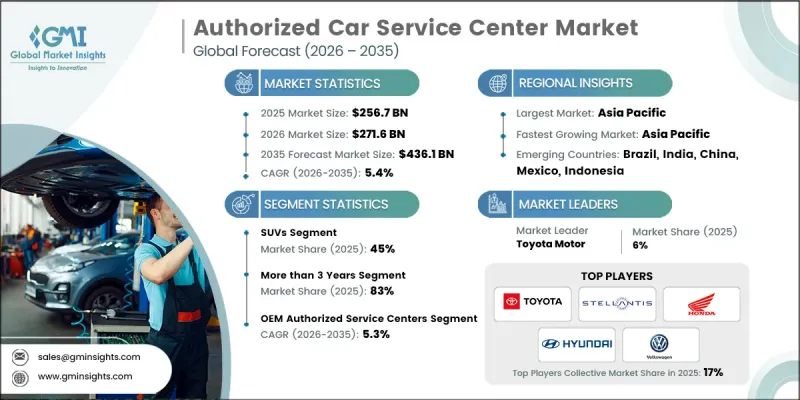
The Global Authorized Car Service Center Market was valued at USD 256.7 billion in 2025 and is estimated to grow at a CAGR of 5.4% to reach USD 436.1 billion by 2035.
Authorized service centers play a vital role in maintaining vehicle safety, performance, and longevity by offering OEM-certified maintenance, repairs, and upgrades. The market encompasses dealership service centers, multi-brand authorized workshops, and specialized maintenance chains, all providing warranty-backed repairs, diagnostic solutions, and genuine spare parts. As vehicle fleets grow and ownership cycles lengthen, vehicle complexity rises, driving demand for professional service networks. OEMs are increasingly focusing on authorized service centers to improve customer satisfaction, preserve resale value, and ensure warranty compliance. The integration of connected vehicle technologies and telematics has accelerated predictive maintenance, encouraging more frequent and proactive service visits. Digitalization is reshaping the sector, with service centers adopting integrated technology platforms to streamline customer interactions, diagnostics, parts sourcing, and service management, fundamentally transforming operational workflows and investment strategies across the industry.
| Market Scope | |
|---|---|
| Start Year | 2025 |
| Forecast Year | 2026-2035 |
| Start Value | $256.7 Billion |
| Forecast Value | $436.1 Billion |
| CAGR | 5.4% |
The SUV segment held a 45% share in 2025 and is expected to grow at a CAGR of 5.7% through 2035. SUVs are favored due to their versatility, premium positioning, and complex systems, which increase per-service revenue. Maintenance for these vehicles involves specialized attention to all-wheel-drive systems, larger brakes, complex suspension diagnostics, and more frequent tire replacements.
The OEM-authorized service centers segment held 57% share in 2025, with a 5.3% CAGR forecast through 2035. These centers operate under exclusive manufacturer authorization, offering proprietary diagnostics, warranty reimbursement, and OEM training. Their brand trust, access to genuine parts, and adherence to manufacturer guidelines give them a clear competitive advantage over independent service providers.
China Authorized Car Service Center Market reached USD 41.4 billion in 2025 and will grow at a CAGR of 5.9% through 2035. Growth is fueled by rising vehicle ownership in lower-tier cities, increasing service expenditure per vehicle, and higher demand for advanced maintenance in premium vehicles. Digital service adoption, including online booking, mobile payment, and connected vehicle diagnostics, is becoming standard. Leading Chinese OEMs are innovating service delivery through authorized centers, mobile units, and battery swap stations, enhancing convenience and efficiency.
Key players in the Global Authorized Car Service Center Market include Toyota Motor, Mercedes-Benz, Ford Motor, Honda Motor, Volkswagen, BMW, Stellantis, Hyundai Motor, Robert Bosch, and General Motors. Companies in the Authorized Car Service Center Market are strengthening their presence through multiple strategies, including expanding geographically into emerging markets, integrating digital platforms for booking, payment, and service tracking, and investing in mobile service solutions. They are forming partnerships with local operators to increase reach, leveraging data analytics to offer predictive maintenance, and improving customer experience with faster turnaround times. OEMs focus on enhancing brand loyalty by providing training, proprietary tools, and genuine parts to maintain service quality, while adopting flexible pricing and subscription-based maintenance plans to attract a broader customer base. Continuous innovation in diagnostics, connected vehicle services, and energy-efficient repairs further reinforces their competitive foothold.
Table of Contents
Chapter 1 Methodology
- 1.1 Research approach
- 1.2 Quality commitments
- 1.3 Research trail and confidence scoring
- 1.3.1 Research trail components
- 1.3.2 Scoring components
- 1.4 Data collection
- 1.4.1 Partial list of primary sources
- 1.5 Data mining sources
- 1.5.1 Paid sources
- 1.6 Best estimates and calculations
- 1.6.1 Base year calculation for any one approach
- 1.7 Forecast model
- 1.8 Research transparency addendum
Chapter 2 Executive Summary
- 2.1 Industry 360° synopsis, 2022 - 2035
- 2.2 Key market trends
- 2.2.1 Regional
- 2.2.2 Vehicles
- 2.2.3 Vehicles Age
- 2.2.4 Propulsion
- 2.2.5 Service
- 2.2.6 Service Providers
- 2.2.7 End Use
- 2.3 TAM Analysis, 2026-2035
Chapter 3 Industry Insights
- 3.1 Industry ecosystem analysis
- 3.1.1 Supplier landscape
- 3.1.2 Profit margin analysis
- 3.1.3 Cost structure
- 3.1.4 Value addition at each stage
- 3.1.5 Factor affecting the value chain
- 3.1.6 Disruptions
- 3.2 Industry impact forces
- 3.2.1 Growth drivers
- 3.2.1.1 Aging vehicle fleet and extended ownership cycles
- 3.2.1.2 Rising vehicle complexity and technology integration
- 3.2.1.3 Increasing vehicle miles traveled (VMT)
- 3.2.1.4 Stringent emission and safety standards
- 3.2.1.5 Growing consumer preference for authorized services
- 3.2.1.6 Expansion of vehicle warranty programs
- 3.2.2 Industry pitfalls and challenges
- 3.2.2.1 High infrastructure and equipment costs
- 3.2.2.2 Skilled technician shortage and training costs
- 3.2.2.3 Economic uncertainties and inflation impact
- 3.2.2.4 Supply chain disruptions and parts availability
- 3.2.3 Market opportunities
- 3.2.3.1 Electric vehicle service market emergence
- 3.2.3.2 Digital transformation and online service booking
- 3.2.3.3 Subscription-based maintenance programs
- 3.2.3.4 Expansion in emerging markets
- 3.2.3.5 Fleet management services
- 3.2.3.6 Used vehicle servicing growth
- 3.2.1 Growth drivers
- 3.3 Growth potential analysis
- 3.4 Regulatory landscape
- 3.4.1 North America
- 3.4.1.1 US- Federal vehicle safety, emissions, and post-repair service regulations
- 3.4.1.2 Canada - Certified maintenance and EV servicing framework
- 3.4.2 Europe
- 3.4.2.1 Germany- EU vehicle safety regulations & national service standards
- 3.4.2.2 UK- Post-Brexit service compliance & connected vehicle guidance
- 3.4.2.3 France- National vehicle inspection & EV servicing policy
- 3.4.2.4 Italy- ITS pilots & smart-service regulations
- 3.4.3 Asia Pacific
- 3.4.3.1 China- MIIT vehicle servicing mandates & standards
- 3.4.3.2 India- Emerging automotive service & connectivity regulations
- 3.4.3.3 Japan- ITS connect & certified service policies
- 3.4.3.4 Australia- Technology neutral ITS policies
- 3.4.4 LATAM
- 3.4.4.1 Mexico- NOM vehicle safety standards
- 3.4.4.2 Argentina- National traffic law 24.449
- 3.4.5 MEA
- 3.4.5.1 South Africa- National road traffic act (1996)
- 3.4.5.2 Saudi Arabia- Traffic law & vision 2030 transport initiatives
- 3.4.1 North America
- 3.5 Porter’s analysis
- 3.6 PESTEL analysis
- 3.7 Technology and innovation landscape
- 3.7.1 Current technological trends
- 3.7.1.1 Digital service booking platforms
- 3.7.1.2 AI-powered diagnostic systems
- 3.7.2 Emerging technologies
- 3.7.2.1 Predictive maintenance technologies
- 3.7.2.2 EV service technologies & infrastructure
- 3.7.1 Current technological trends
- 3.8 Patent analysis
- 3.9 Pricing analysis
- 3.9.1 Service pricing models
- 3.9.2 Labor cost trends
- 3.9.3 Parts markup analysis
- 3.9.4 Competitive pricing strategies
- 3.10 Use cases & success stories
- 3.11 Sustainability and environmental aspects
- 3.11.1 Sustainable practices
- 3.11.2 Waste reduction strategies
- 3.11.3 Energy efficiency in production
- 3.11.4 Eco-friendly Initiatives
- 3.11.5 Carbon footprint considerations
- 3.12 Vehicle fleet demographics & age analysis
- 3.12.1 Global vehicle parc statistics
- 3.12.2 Average vehicle age trends
- 3.12.3 Impact on service demand
- 3.13 Unit Economics & Service Center Profitability Benchmarking
- 3.14 EV Impact on Authorized Service Business Models
- 3.15 Digital Customer Journey & Experience Benchmarking
Chapter 4 Competitive Landscape, 2025
- 4.1 Introduction
- 4.2 Company market share analysis
- 4.2.1 North America
- 4.2.2 Europe
- 4.2.3 Asia Pacific
- 4.2.4 LATAM
- 4.2.5 MEA
- 4.3 Competitive analysis of major market players
- 4.4 Competitive positioning matrix
- 4.5 Strategic outlook matrix
- 4.6 Key developments
- 4.6.1 Mergers & acquisitions
- 4.6.2 Partnerships & collaborations
- 4.6.3 New product launches
- 4.6.4 Expansion plans and funding
Chapter 5 Market Estimates & Forecast, By Vehicles, 2022 - 2035 ($Bn)
- 5.1 Key trends
- 5.2 Hatchbacks
- 5.3 SUVs
- 5.4 Sedan
Chapter 6 Market Estimates & Forecast, By Vehicles Age, 2022 - 2035 ($Bn)
- 6.1 Key trends
- 6.2 Less than 3 years
- 6.3 More than 3 years
Chapter 7 Market Estimates & Forecast, By Propulsion, 2022 - 2035 ($Bn)
- 7.1 Key trends
- 7.2 ICE
- 7.3 HEV/PHEV
- 7.4 EVs
Chapter 8 Market Estimates & Forecast, By Service, 2022 - 2035 ($Bn)
- 8.1 Key trends
- 8.2 Engine
- 8.3 Transmission
- 8.4 Brakes
- 8.5 Suspension
- 8.6 Electrical
- 8.7 Body
- 8.8 Tire
- 8.9 Belts & accessories
- 8.10 Others
Chapter 9 Market Estimates & Forecast, By Service Providers, 2022 - 2035 ($Bn)
- 9.1 Key trends
- 9.2 OEM authorized service centers
- 9.3 Multi-brand service centers
- 9.4 Independent garages
Chapter 10 Market Estimates & Forecast, By End Use, 2022 - 2035 ($Bn)
- 10.1 Key trends
- 10.2 Individual customers
- 10.3 Fleet operators
- 10.4 Corporate customers
Chapter 11 Market Estimates & Forecast, By Region, 2022 - 2035 ($Bn)
- 11.1 Key trends
- 11.2 North America
- 11.2.1 US
- 11.2.2 Canada
- 11.3 Europe
- 11.3.1 Germany
- 11.3.2 UK
- 11.3.3 France
- 11.3.4 Italy
- 11.3.5 Spain
- 11.3.6 Russia
- 11.3.7 Netherlands
- 11.3.8 Sweden
- 11.3.9 Denmark
- 11.3.10 Poland
- 11.4 Asia Pacific
- 11.4.1 China
- 11.4.2 India
- 11.4.3 Japan
- 11.4.4 Australia
- 11.4.5 South Korea
- 11.4.6 Singapore
- 11.4.7 Thailand
- 11.4.8 Indonesia
- 11.4.9 Vietnam
- 11.5 Latin America
- 11.5.1 Brazil
- 11.5.2 Mexico
- 11.5.3 Argentina
- 11.5.4 Colombia
- 11.6 MEA
- 11.6.1 South Africa
- 11.6.2 Saudi Arabia
- 11.6.3 UAE
- 11.6.4 Israel
Chapter 12 Company Profiles
- 12.1 Global Players
- 12.1.1 3M
- 12.1.2 BMW
- 12.1.3 Castrol
- 12.1.4 Ford Motor
- 12.1.5 General Motors
- 12.1.6 Groupe Renault
- 12.1.7 Honda Motor
- 12.1.8 Hyundai Motor
- 12.1.9 Mercedes-Benz
- 12.1.10 Mobivia
- 12.1.11 Robert Bosch
- 12.1.12 Stellantis
- 12.1.13 Suzuki Motor
- 12.1.14 Toyota Motor
- 12.1.15 Volkswagen
- 12.2 Regional Players
- 12.2.1 Automovill Technologies
- 12.2.2 Carxpert Garage
- 12.2.3 Lansdowne Automobile
- 12.2.4 Mahindra First Choice
- 12.2.5 Meineke Car Care Centers
- 12.2.6 Mobil1 Car Care
- 12.2.7 TVS Automobile Solutions
- 12.3 Emerging Players & Technology Enablers
- 12.3.1 GoMechanic
- 12.3.2 Wrench
- 12.3.3 YourMechanic

