
PUBLISHER: Global Market Insights Inc. | PRODUCT CODE: 1959644

PUBLISHER: Global Market Insights Inc. | PRODUCT CODE: 1959644
North America Solar PV Market Opportunity, Growth Drivers, Industry Trend Analysis, and Forecast 2026 - 2035
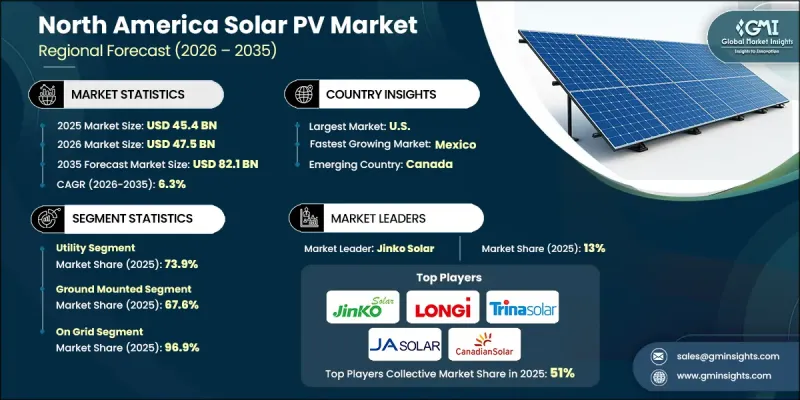
North America Solar PV Market was valued at USD 45.4 billion in 2025 and is estimated to grow at a CAGR of 6.3% to reach USD 82.1 billion by 2035.
Solar photovoltaic technology has emerged as the fastest-growing source of electricity generation in the region, fueled by increasing investments in solar infrastructure and favorable government policies. The enactment of the Inflation Reduction Act has significantly boosted manufacturing and deployment activities, driving down costs through economies of scale. Improvements in lithium-ion battery technology, thermal management, and competition among energy storage providers have reduced battery storage costs, enhancing the economic viability of solar-plus-storage systems. State-level policies encouraging energy storage integration allow excess solar generation to be captured and delivered during peak demand periods, particularly in regions with high evening consumption. The combination of distributed solar, self-consumption optimization, and smart inverter technologies enables these systems to provide advanced grid services, including peak shaving, outage resilience, and grid stabilization, creating a more efficient, reliable, and sustainable energy ecosystem.
| Market Scope | |
|---|---|
| Start Year | 2025 |
| Forecast Year | 2026-2035 |
| Start Value | $45.4 Billion |
| Forecast Value | $82.1 Billion |
| CAGR | 6.3% |
The utility segment held 73.9% share in 2025 and is expected to grow at a CAGR of 5.1% from 2026 to 2035. Increasing utility-scale solar installations across key states, alongside corporate power purchase agreements, have strengthened the segment. The expansion is supported by state renewable portfolio standards, clean energy mandates, and federal tax incentives under the Inflation Reduction Act. Utilities are increasingly integrating solar as a cost-competitive generation option, driven by long-term resource planning, the need to meet corporate sustainability demands, and economic incentives.
The rooftop solar PV segment is projected to grow at a CAGR of 5.5% by 2035, driven by falling system costs, growing federal and state incentives, and rising electricity prices that enhance solar adoption. Both commercial and residential adoption is increasing due to energy independence goals, corporate sustainability targets, and declining net-metering benefits, which make integrated solar-plus-storage solutions more economically attractive. The growing integration of battery storage into rooftop systems further improves performance and cost-effectiveness, boosting demand in commercial and industrial applications.
U.S. Solar PV Market was valued at USD 44.1 billion in 2025 and is expected to grow at a CAGR of 6.2% through 2035. The Inflation Reduction Act has been a critical policy driver, offering production and investment tax credits, manufacturing incentives, and programs targeting underserved communities. Continuous improvements in module efficiency, manufacturing scale, and supply chain optimization have lowered solar PV system costs, increasing competitiveness against traditional energy sources and accelerating deployment across residential, commercial, and utility-scale segments.
Leading companies operating in the North America Solar PV Market include Heliene, JA SOLAR Technology, LONGi Solar, Q CELLS, First Solar, Mission Solar Energy, Chint Solar, GCL-SI, SunPower Corporation, Panasonic Corporation, Canadian Solar, Solaria Corporation, Silfab Solar, Trina Solar, Tesla, LG Electronics, Suntech Power Holdings, Vikram Solar, REC Solar Holdings, and Jinko Solar. Key strategies adopted by companies in the North America Solar PV Market to strengthen their market foothold include investing heavily in research and development to improve module efficiency, durability, and performance. Firms are expanding manufacturing capacities and strategically locating production facilities to reduce costs and enhance supply chain resilience. Strategic partnerships with utilities, technology providers, and industrial clients help secure long-term power purchase agreements and market share. Companies also focus on regional expansion, targeting states with aggressive clean energy mandates.
Table of Contents
Chapter 1 Methodology & Scope
- 1.1 Research design
- 1.1.1 Research approach
- 1.1.2 Data collection methods
- 1.2 Base estimates and calculations
- 1.2.1 Base year calculation
- 1.2.2 Key trends for market estimates
- 1.3 Forecast model
- 1.3.1 Key trends for market estimates
- 1.3.1.1 Quantified market impact analysis
- 1.3.1.2 Mathematical impact of growth parameters on forecast
- 1.3.2 Scenario analysis framework
- 1.3.1 Key trends for market estimates
- 1.4 Primary research and validation
- 1.4.1 Some of the primary sources (but not limited to)
- 1.5 Data mining sources
- 1.5.1 Paid Sources
- 1.5.2 Sources, by region
- 1.6 Research trail & scoring components
- 1.6.1 Research trail components
- 1.6.2 Scoring components
- 1.7 Research transparency addendum
- 1.7.1 Source attribution framework
- 1.7.2 Quality assurance metrics
- 1.7.3 Our commitment to trust
- 1.8 Market definitions
Chapter 2 Executive Summary
- 2.1 Industry 360-degree synopsis, 2022 - 2035
- 2.2 Business trends
- 2.3 Connectivity trends
- 2.4 Mounting trends
- 2.5 End Use trends
- 2.6 Country trends
Chapter 3 Industry Insights
- 3.1 Industry ecosystem
- 3.1.1 Raw material availability & sourcing analysis
- 3.1.2 Manufacturing capacity assessment
- 3.1.3 Supply chain resilience & risk factors
- 3.1.4 Distribution network analysis
- 3.2 Regulatory landscape
- 3.3 Industry impact forces
- 3.3.1 Growth drivers
- 3.3.2 Industry pitfalls & challenges
- 3.4 Growth potential analysis
- 3.5 Price trend analysis
- 3.5.1 By end use
- 3.5.2 By country
- 3.6 Cost structure analysis
- 3.7 Porter's analysis
- 3.7.1 Bargaining power of suppliers
- 3.7.2 Bargaining power of buyers
- 3.7.3 Threat of new entrants
- 3.7.4 Threat of substitutes
- 3.8 PESTEL analysis
- 3.8.1 Political factors
- 3.8.2 Economic factors
- 3.8.3 Social factors
- 3.8.4 Technological factors
- 3.8.5 Legal factors
- 3.8.6 Environmental factors
- 3.9 Emerging opportunities & trends
- 3.9.1 Digitalization & IoT integration
- 3.9.2 Emerging market penetration
- 3.10 Investment analysis and future outlook
Chapter 4 Competitive landscape, 2026
- 4.1 Introduction
- 4.2 Company market share analysis, 2025
- 4.2.1 U.S.
- 4.2.2 Canada
- 4.2.3 Mexico
- 4.3 Strategic dashboard
- 4.4 Strategic initiatives
- 4.5 Innovation & technology landscape
Chapter 5 Market Size and Forecast, By Connectivity, 2022 - 2035 (USD Billion & MW)
- 5.1 Key trends
- 5.2 On grid
- 5.3 Off grid
Chapter 6 Market Size and Forecast, By Mounting, 2022 - 2035 (USD Billion & MW)
- 6.1 Key trends
- 6.2 Ground Mounted
- 6.3 Rooftop
Chapter 7 Market Size and Forecast, By End Use, 2022 - 2035 (USD Billion & MW)
- 7.1 Key trends
- 7.2 Residential
- 7.3 Commercial & Industrial
- 7.4 Utility
Chapter 8 Market Size and Forecast, By Country, 2022 - 2035 (USD Billion & MW)
- 8.1 Key trends
- 8.2 U.S.
- 8.3 Canada
- 8.4 Mexico
Chapter 9 Company Profiles
- 9.1 Chint Solar
- 9.2 Canadian Solar
- 9.3 First Solar
- 9.4 GCL-SI
- 9.5 Heliene
- 9.6 JA SOLAR Technology
- 9.7 Jinko Solar
- 9.8 LG Electronics
- 9.9 LONGi Solar
- 9.10 Mission Solar Energy
- 9.11 Panasonic Corporation
- 9.12 Q CELLS
- 9.13 REC Solar Holdings AS
- 9.14 Silfab Solar
- 9.15 Solaria Corporation
- 9.16 Suntech Power Holdings
- 9.17 SunPower Corporation
- 9.18 Trina Solar
- 9.19 Tesla
- 9.20 Vikram Solar

