PUBLISHER: Global Market Insights Inc. | PRODUCT CODE: 1982259

PUBLISHER: Global Market Insights Inc. | PRODUCT CODE: 1982259
Asia Pacific Sustainable Manufacturing Equipment Market Opportunity, Growth Drivers, Industry Trend Analysis, and Forecast 2026 - 2035
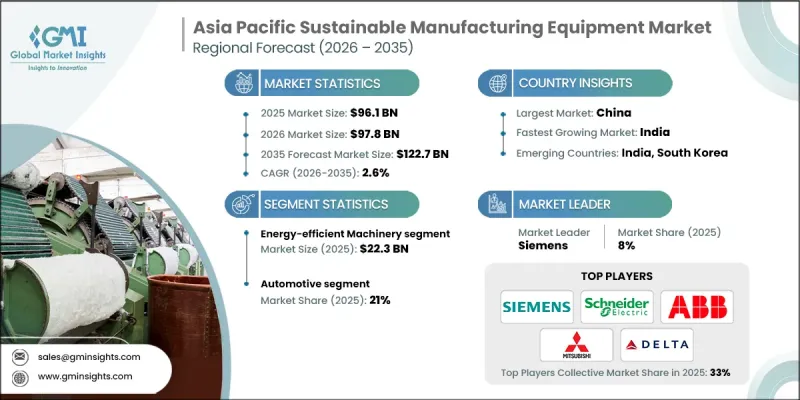
Asia Pacific Sustainable Manufacturing Equipment Market was valued at USD 96.1 billion in 2025 and is estimated to grow at a CAGR of 2.6% to reach USD 122.7 billion by 2035.
The industry is undergoing a structural transformation as businesses redefine how sustainability fits within their operational and financial strategies. Rather than treating sustainability as a secondary initiative, manufacturers across the region are embedding environmentally responsible practices into long-term corporate planning. This shift is driving the adoption of advanced equipment designed to lower energy consumption, reduce material waste, and enhance workplace safety standards. Regulatory encouragement from government bodies is reinforcing confidence among manufacturers that environmentally responsible upgrades are both practical and cost-effective over time. At the same time, increasing awareness among regional businesses regarding renewable energy adoption and circular production systems is shaping procurement decisions. Equipment innovation is increasingly focused on minimizing environmental impact, reducing emissions, optimizing water usage, and enhancing recycling efficiency. Importantly, these investments are being incorporated into long-term capital expenditure strategies, reflecting a structural evolution rather than a temporary market trend.
| Market Scope | |
|---|---|
| Start Year | 2025 |
| Forecast Year | 2026-2035 |
| Start Value | $96.1 Billion |
| Forecast Value | $122.7 Billion |
| CAGR | 2.6% |
In 2025, the energy-efficient machinery segment generated USD 22.3 billion. Manufacturers are prioritizing equipment that reduces electricity usage, limits excess heat generation, and lowers maintenance requirements to manage operating expenses more effectively. These systems are typically compatible with existing production facilities, allowing companies to enhance efficiency without implementing large-scale infrastructure changes. As cost optimization remains a primary objective across industrial sectors, demand for high-performance, low-consumption machinery continues to expand steadily.
The automotive segment accounted for 21% share in 2025, making it the leading application sector. Automotive producers require precision-driven production systems that ensure accuracy, consistency, and reduced material waste. Ongoing modernization of manufacturing facilities is enabling companies to align with stricter environmental standards while maintaining product quality. Equipment upgrades are increasingly focused on enhancing operational efficiency, improving process reliability, and reducing environmental impact. Regulatory compliance requirements and evolving global buyer expectations are further encouraging automotive manufacturers to adopt advanced sustainable equipment solutions.
China Sustainable Manufacturing Equipment Market held 41% share, generating USD 39.2 billion in 2025. Alongside China, Japan, and India represent three major pillars within the Asia Pacific sustainable manufacturing equipment landscape. Each country contributes uniquely to regional demand due to differences in industrial maturity, economic structure, and consumer behavior. China's rapid urban development and large-scale industrial base are accelerating investment in environmentally responsible technologies. Japan's focus on technological innovation and operational precision supports steady equipment upgrades, while India's expanding industrial sector is fostering new opportunities for sustainable infrastructure development. Competitive intensity remains strong as both domestic and international manufacturers aim to address evolving sustainability requirements across diverse end-use industries.
Key companies operating in the Asia Pacific Sustainable Manufacturing Equipment Market include Mitsubishi Electric Corporation, ABB Ltd., Siemens AG, Delta Electronics Inc., FANUC Corporation, Schneider Electric SE, Rockwell Automation, Inc., Atlas Copco AB, Honeywell International Inc., Yaskawa Electric Corporation, Emerson Electric Co., Omron Corporation, SMC Corporation, Yokogawa Electric Corporation, and KUKA. Companies in the Asia Pacific Sustainable Manufacturing Equipment Market are strengthening their competitive positions through continuous technological advancement and regional expansion strategies. Significant investments in research and development are enabling the launch of automation-driven, energy-optimized machinery tailored to evolving regulatory standards. Market participants are forming strategic partnerships and local manufacturing collaborations to improve supply chain efficiency and market responsiveness. Many firms are integrating digital monitoring, predictive maintenance, and smart control systems to enhance equipment performance and lifecycle value. Businesses are also expanding service portfolios, including consulting and retrofit solutions, to support customers transitioning toward sustainable operations.
Table of Contents
Chapter 1 Methodology and Scope
- 1.1 Market scope and definition
- 1.2 Research design
- 1.2.1 Research approach
- 1.2.2 Data collection methods
- 1.3 Data mining sources
- 1.3.1 Regional/Country
- 1.4 Base estimates and calculations
- 1.4.1 Base year calculation
- 1.4.2 Key trends for market estimation
- 1.5 Primary research and validation
- 1.5.1 Primary sources
- 1.6 Forecast model
- 1.7 Research assumptions and limitations
Chapter 2 Executive Summary
- 2.1 Industry 360° synopsis
- 2.2 Key market trends
- 2.2.1 Country
- 2.2.2 Equipment Type
- 2.2.3 End Use Industry
- 2.2.4 Entity
- 2.2.5 Distribution Channel
Chapter 3 Industry Insights
- 3.1 Industry ecosystem analysis
- 3.1.1 Supplier landscape
- 3.1.2 Profit margin
- 3.1.3 Value addition at each stage
- 3.1.4 Factor affecting the value chain
- 3.2 Industry impact forces
- 3.2.1 Growth drivers
- 3.2.1.1 Growing focus on cleaner industrial practices
- 3.2.1.2 Rising pressure to cut operating costs
- 3.2.1.3 Digital transformation in industrial facilities
- 3.2.2 Industry pitfalls & challenges
- 3.2.2.1 High upfront investment requirements
- 3.2.2.2 Limited technical skills and awareness
- 3.2.3 Opportunities
- 3.2.3.1 Expansion of renewable and circular production models
- 3.2.3.2 Rising entry of global manufacturers into emerging APAC markets
- 3.2.1 Growth drivers
- 3.3 Growth potential analysis
- 3.4 Major market trends and Disruptions
- 3.5 Future market trends
- 3.6 Risk and mitigation Analysis
- 3.7 Technology and innovation landscape
- 3.7.1 Current technological trends
- 3.7.2 Emerging technologies
- 3.8 Price trends
- 3.8.1 By product type
- 3.9 Regulatory landscape
- 3.10 Porter's analysis
- 3.11 PESTEL analysis
- 3.12 Trade data analysis
- 3.12.1 Import/export volume & value trends
- 3.12.2 Key trade corridors & tariff impact
- 3.13 Impact of ai & generative ai on the market
- 3.13.1 AI-driven disruption of existing business models
- 3.13.2 Gen AI use cases & adoption roadmap by segment
- 3.13.3 Risks, limitations & regulatory considerations
Chapter 4 Competitive Landscape, 2025
- 4.1 Introduction
- 4.2 Company market share analysis
- 4.3 Company matrix analysis
- 4.4 Competitive analysis of major market players
- 4.5 Competitive positioning matrix
- 4.6 Key developments
- 4.6.1 Mergers & acquisitions
- 4.6.2 Partnerships & collaborations
- 4.6.3 New product launches
- 4.6.4 Expansion plans
Chapter 5 Market Estimates & Forecast, By Equipment Type, 2022 - 2035 (USD Billion) (Thousand Units)
- 5.1 Key Trends
- 5.2 Energy-efficient machinery
- 5.3 Waste management equipment
- 5.4 Water & wastewater treatment equipment
- 5.5 Carbon emission control systems
- 5.6 Renewable energy integration equipment
- 5.7 Smart manufacturing & monitoring equipment
- 5.8 Sustainable packaging equipment
- 5.9 Additive manufacturing equipment
- 5.10 Others
Chapter 6 Market Estimates & Forecast, By End-user Industry, 2022 - 2035 (USD Billion) (Thousand Units)
- 6.1 Key trends
- 6.2 Automotive
- 6.3 Electronics and semiconductor
- 6.4 Food and beverage
- 6.5 Chemical manufacturing
- 6.6 Pharmaceuticals
- 6.7 Metals and mining
- 6.8 Consumer goods
- 6.9 Others
Chapter 7 Market Estimates & Forecast, By Entity, 2022 - 2035, (USD Billion) (Thousand Units)
- 7.1 Key trends
- 7.2 Large enterprises
- 7.3 Small & medium enterprises (smes)
- 7.4 Government & research institutes
- 7.5 Sustainable manufacturing startups
Chapter 8 Market Estimates & Forecast, By Distribution Channel, 2022 - 2035, (USD Billion) (Thousand Units)
- 8.1 Key trends
- 8.2 Direct
- 8.3 Indirect
Chapter 9 Market Estimates and Forecast, By Country, 2022 - 2035 (USD Billion) (Thousand Units)
- 9.1 Key trends
- 9.2 China
- 9.3 Japan
- 9.4 India
- 9.5 South Korea
- 9.6 Australia
- 9.7 Malaysia
- 9.8 Indonesia
Chapter 10 Company Profiles
- 10.1 ABB Ltd.
- 10.2 Atlas Copco AB
- 10.3 KUKA
- 10.4 Delta Electronics Inc.
- 10.5 Emerson Electric Co.
- 10.6 FANUC Corporation
- 10.7 Honeywell International Inc.
- 10.8 Mitsubishi Electric Corporation
- 10.9 Omron Corporation
- 10.10 Rockwell Automation, Inc.
- 10.11 Schneider Electric SE
- 10.12 Siemens AG
- 10.13 SMC Corporation
- 10.14 Yaskawa Electric Corporation
- 10.15 Yokogawa Electric Corporation

