PUBLISHER: Global Market Insights Inc. | PRODUCT CODE: 1982270

PUBLISHER: Global Market Insights Inc. | PRODUCT CODE: 1982270
Europe Air Pollution Control Equipment Market Opportunity, Growth Drivers, Industry Trend Analysis, and Forecast 2026 - 2035
Europe Air Pollution Control Equipment Market was valued at USD 4.5 billion in 2025 and is estimated to grow at a CAGR of 6.2% to reach USD 8 billion by 2035.
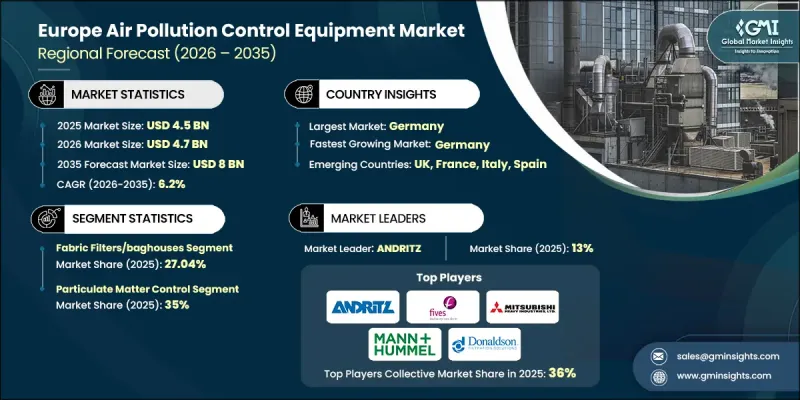
Market growth is driven by heightened environmental awareness and increasingly stringent air quality regulations across the region. Industries are under sustained pressure to reduce emissions and adopt advanced pollution mitigation technologies that align with sustainability objectives. Air pollution control equipment plays a critical role in removing harmful contaminants from industrial exhaust streams, including particulate matter, sulfur compounds, nitrogen compounds, volatile organic compounds, and other hazardous pollutants. Advanced systems are engineered to ensure precise filtration and compliance with European regulatory frameworks. The market is also benefiting from ongoing consolidation activities, strategic partnerships, and technological collaborations among leading manufacturers. With Europe's strong emphasis on decarbonization, carbon neutrality, and sustainable industrial transformation, demand for efficient and reliable emission control solutions continues to rise. Regulatory enforcement mechanisms, financial incentives, and penalties for non-compliance further accelerate modernization efforts across multiple heavy industries, reinforcing long-term growth prospects for air pollution control equipment.
| Market Scope | |
|---|---|
| Start Year | 2025 |
| Forecast Year | 2026-2035 |
| Start Value | $4.5 Billion |
| Forecast Value | $8 Billion |
| CAGR | 6.2% |
The commercial outlook for air pollution control systems remains strong, supported by Europe's strategic push toward industrial decarbonization and environmentally responsible urban development. Government-backed programs, strict emission thresholds, and regulatory accountability are compelling industries to upgrade legacy systems with modern technologies. Expanding industrial activity across sectors such as energy production, construction materials, specialty chemicals, life sciences, and metallurgy is increasing the need for highly efficient emission control solutions capable of meeting evolving standards.
The fabric filters and baghouse systems segment held a 27.04% share, generating USD 1.2 billion in 2025. This segment leads due to its strong performance in capturing fine particulate emissions and adaptability across emission-intensive industrial operations. High filtration efficiency and operational flexibility have positioned fabric-based filtration systems as a preferred technology as regulatory limits on airborne particles continue to tighten.
The power generation segment accounted for the largest share in 2025, reflecting its elevated emission levels and strict regulatory scrutiny. The segment continues to expand as operators modernize emission control infrastructure within conventional and alternative energy facilities to comply with European environmental mandates and long-term decarbonization targets.
Germany Air Pollution Control Equipment Market reached USD 1.05 billion in 2025, supported by its advanced industrial ecosystem, early implementation of emission control technologies, and rigorous enforcement of environmental standards. The broader European market benefits from comprehensive environmental frameworks, including the Industrial Emissions Directive, along with national clean air regulations that mandate continuous monitoring and reduction of particulate matter, nitrogen oxides, sulfur oxides, and hazardous airborne pollutants across industries.
Prominent companies operating in the Europe Air Pollution Control Equipment Market include ANDRITZ, GEA Group, Mitsubishi Heavy Industries, Babcock & Wilcox, John Cockerill, Camfil Group, Donaldson Company, MANN+HUMMEL, Freudenberg Filtration, Hamon Corporation, Thermax Limited, AAF International, Anguil Environmental, Bernd Munstermann GmbH & Co. KG, CTP Air Pollution Control, Ecospray Technologies, Five Group, and Socrematic. Companies in the Europe Air Pollution Control Equipment Market are strengthening their competitive position through continuous innovation, strategic alliances, and geographic expansion. Many firms are investing in advanced filtration materials, digital monitoring platforms, and energy-efficient system designs to enhance performance and regulatory compliance. Partnerships with industrial operators enable customized solutions tailored to sector-specific emission challenges. Organizations are also expanding service portfolios to include maintenance, retrofitting, and real-time emissions monitoring to generate recurring revenue streams. Mergers and acquisitions are being pursued to broaden technological capabilities and strengthen regional presence.
Table of Contents
Chapter 1 Methodology and Scope
- 1.1 Market scope and definition
- 1.2 Research design
- 1.2.1 Research approach
- 1.2.2 Data collection methods
- 1.3 Data mining sources
- 1.3.1 Country
- 1.4 Base estimates and calculations
- 1.4.1 Base year calculation
- 1.4.2 Key trends for market estimation
- 1.5 Primary research and validation
- 1.5.1 Primary sources
- 1.6 Forecast model
- 1.7 Research assumptions and limitations
Chapter 2 Executive Summary
- 2.1 Industry 360° synopsis
- 2.2 Key market trends
- 2.2.1 Regional
- 2.2.2 Control Technology
- 2.2.3 Pollutant Type
- 2.2.4 End-User
- 2.3 CXO perspectives: Strategic imperatives
- 2.3.1 Key decision points for industry executives
- 2.3.2 Critical success factors for market players
- 2.4 Future outlook and strategic recommendations
Chapter 3 Industry Insights
- 3.1 Industry ecosystem analysis
- 3.1.1 Supplier landscape
- 3.1.2 Profit margin
- 3.1.3 Value addition at each stage
- 3.1.4 Factor affecting the value chain
- 3.2 Industry impact forces
- 3.2.1 Growth drivers
- 3.2.1.1 Stringent environmental regulations & emission standards
- 3.2.1.2 Industrial modernization & retrofitting demand
- 3.2.1.3 Public health awareness & urban air quality management
- 3.2.2 Industry pitfalls & challenges
- 3.2.2.1 high capital investment & operational costs
- 3.2.2.2 System Integration & Technical Complexity
- 3.2.3 Opportunities
- 3.2.3.1 AI-enabled emission monitoring & predictive maintenance
- 3.2.3.2 Growth of service-based & compliance-as-a-service models
- 3.2.1 Growth drivers
- 3.3 Growth potential analysis
- 3.4 Future market trends
- 3.5 Technology and innovation landscape
- 3.5.1 Current technological trends
- 3.5.2 Emerging technologies
- 3.6 Price trends
- 3.6.1 By Country
- 3.6.2 By Control Technology
- 3.7 Regulatory landscape
- 3.7.1 Standards and compliance requirements
- 3.7.2 Regional regulatory frameworks
- 3.7.3 Certification standards
- 3.8 Porter's analysis
- 3.9 PESTEL analysis
Chapter 4 Competitive Landscape, 2025
- 4.1 Introduction
- 4.2 Company market share analysis
- 4.2.1 By Country
- 4.2.1.1 Germany
- 4.2.1.2 UK
- 4.2.1.3 France
- 4.2.1.4 Italy
- 4.2.1.5 Spain
- 4.2.1.6 Netherlands
- 4.2.1.7 Sweden
- 4.2.1.8 Poland
- 4.2.1 By Country
- 4.3 Company matrix analysis
- 4.4 Competitive analysis of major market players
- 4.5 Competitive positioning matrix
- 4.6 Key developments
- 4.6.1 Mergers & acquisitions
- 4.6.2 Partnerships & collaborations
- 4.6.3 New product launches
- 4.6.4 Expansion plans
Chapter 5 Market Estimates and Forecast, By Control Technology, 2022 - 2035 (USD Billion) (Thousand Units)
- 5.1 Key trends
- 5.2 Electrostatic precipitators (ESP)
- 5.3 Fabric filters / baghouses
- 5.4 Scrubbers (wet, dry)
- 5.5 Selective catalytic reduction (SCR)
- 5.6 Selective non-catalytic reduction (SNCR)
- 5.7 Thermal oxidizers (RTO/Catalytic)
- 5.8 Activated carbon adsorption
- 5.9 HEPA and high-efficiency filters
- 5.10 Other systems
Chapter 6 Market Estimates and Forecast, By Pollutant Type, 2022 - 2035 (USD Billion) (Thousand Units)
- 6.1 Key trends
- 6.2 Particulate Matter
- 6.3 Nitrogen Oxides
- 6.4 Sulfur Oxides
- 6.5 Volatile Organic Compounds (VOCs)
- 6.6 Carbon Monoxide (CO)
- 6.7 Metals and Heavy Metals
- 6.8 Other pollutants
Chapter 7 Market Estimates and Forecast, By End User, 2022 - 2035 (USD Billion) (Thousand Units)
- 7.1 Key trends
- 7.2 Power generation
- 7.3 Cement and aggregates
- 7.4 Metals and mining
- 7.5 Chemicals and petrochemicals
- 7.6 Glass manufacturing
- 7.7 Pulp and paper
- 7.8 Others
Chapter 8 Market Estimates and Forecast, By Region, 2022 - 2035 (USD Billion) (Thousand Units)
- 8.1 Key trends
- 8.2 Europe
- 8.2.1 Germany
- 8.2.2 UK
- 8.2.3 France
- 8.2.4 Italy
- 8.2.5 Spain
- 8.2.6 Netherlands
- 8.2.7 Sweden
- 8.2.8 Poland
Chapter 9 Company Profiles
- 9.1 ANDRITZ
- 9.2 Babcock & Wilcox
- 9.3 Fives Group
- 9.4 GEA Group
- 9.5 John Cockerill
- 9.6 Mitsubishi Heavy Ind.
- 9.7 AAF International
- 9.8 Anguil Environmental
- 9.9 Camfil Group
- 9.10 Donaldson Company
- 9.11 Freudenberg Filtration
- 9.12 Hamon Corporation
- 9.13 MANN+HUMMEL
- 9.14 Thermax Limited
- 9.15 Bernd Munstermann GmbH & Co. KG
- 9.16 CTP Air Pollution Control
- 9.17 Ecospray Technologies
- 9.18 Socrematic

