PUBLISHER: Global Market Insights Inc. | PRODUCT CODE: 1982283

PUBLISHER: Global Market Insights Inc. | PRODUCT CODE: 1982283
North America Pet Shampoo Market Opportunity, Growth Drivers, Industry Trend Analysis, and Forecast 2026 - 2035
North America Pet Shampoo Market was valued at USD 585.9 million in 2025 and is estimated to grow at a CAGR of 6.7% to reach USD 1.1 billion by 2035.
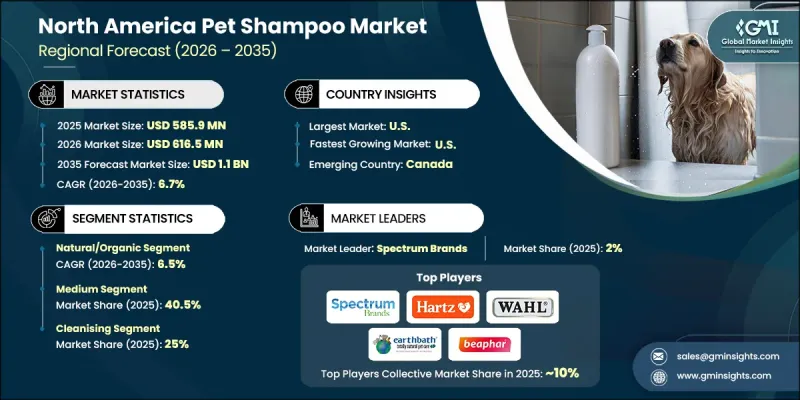
Growth in the North America pet shampoo market is being driven by strong pet humanization trends, with a significant share of owners viewing their pets as integral family members. This emotional connection is translating into higher spending on premium grooming and hygiene products. Consumers are increasingly prioritizing pet wellness, leading to rising demand for natural, organic, and medicated shampoo formulations designed to support skin health and overall hygiene. Sustainability considerations are also shaping purchasing decisions, with a growing preference for environmentally responsible and cruelty-free grooming solutions. Heightened awareness of pet skin sensitivity and hygiene maintenance is further strengthening market demand. Veterinary professionals continue to emphasize preventive skin care, encouraging the adoption of functional shampoos formulated to address dermatological concerns. As pet owners become more informed about ingredient safety and long-term health benefits, investment in specialized grooming products is steadily increasing. Expanding retail availability and e-commerce penetration across North America are also supporting consistent product accessibility and brand visibility.
| Market Scope | |
|---|---|
| Start Year | 2025 |
| Forecast Year | 2026-2035 |
| Start Value | $585.9 Million |
| Forecast Value | $1.1 Billion |
| CAGR | 6.7% |
The natural and organic segment generated USD 326.6 million in 2025 and is expected to grow at a CAGR of 6.5% from 2026 to 2035. Consumers are increasingly favoring plant-based and chemical-free grooming products due to concerns about synthetic additives and potential skin reactions. Demand for hypoallergenic formulations and transparent ingredient sourcing continues to rise, reflecting broader clean-label preferences. Ethical positioning, dermatologist-tested claims, and sustainability certifications are playing an influential role in purchasing behavior across this segment.
The medium-priced segment accounted for 40.5% share in 2025, emerging as the leading pricing category. Products within this range appeal to pet owners seeking dependable performance and skin-friendly formulations at accessible price points. This tier successfully balances cost efficiency with quality, making it attractive to value-conscious consumers who still prioritize effective grooming solutions.
United States Pet Shampoo Market reached USD 456.6 million in 2025 and is projected to grow at a CAGR of 6.4% through 2035. The U.S. market benefits from high disposable income levels, strong adoption of premium pet care products, and a well-developed retail infrastructure. Consumer preference for veterinarian-endorsed, natural, and specialty formulations continues to stimulate growth. The expansion of direct-to-consumer channels, mobile grooming services, and digital marketing strategies further reinforces product demand and market penetration.
Key companies operating in the North America Pet Shampoo Market include TropiClean, Wahl Clipper Corporation, Hartz Mountain Corporation, Earthbath, Burt's Bees, Spectrum Brands, Reckitt Benckiser, Pet Head, Oster, Beaphar, Himalaya Wellness Company, 4-Legger, Nootie, Petkin, and Sogeval. Companies in the North America Pet Shampoo Market are strengthening their competitive positioning through innovation, brand differentiation, and strategic channel expansion. Manufacturers are investing in research and development to introduce dermatologically tested, hypoallergenic, and plant-based formulations that align with consumer preferences for safer ingredients. Strategic partnerships with veterinary clinics and specialty pet retailers are enhancing product credibility and distribution reach. Brands are also expanding direct-to-consumer platforms and leveraging subscription models to build recurring revenue streams. Sustainable packaging initiatives and cruelty-free certifications are being emphasized to attract environmentally conscious buyers.
Table of Contents
Chapter 1 Methodology & Scope
- 1.1 Market scope & definitions
- 1.2 Research design
- 1.2.1 Research approach
- 1.2.2 Data collection methods
- 1.3 Base estimates and calculations
- 1.3.1 Base year calculation
- 1.3.2 Market estimates & forecasts parameters
- 1.4 Forecast Model
- 1.4.1 Key trends for market estimates
- 1.4.2 Quantified market impact analysis
- 1.4.2.1 Mathematical impact of growth parameters on forecast
- 1.4.3 Scenario analysis framework
- 1.5 Primary research and validation
- 1.5.1 Some of the primary sources (but not limited to)
- 1.6 Data mining sources
- 1.6.1 Paid Sources
- 1.7 Primary research and validation
- 1.7.1 Primary sources
- 1.8 Research Trail & confidence scoring
- 1.8.1 Research trail components
- 1.8.2 Scoring components
- 1.9 Research transparency addendum
- 1.9.1 Source attribution framework
- 1.9.2 Quality assurance metrics
- 1.9.3 Our commitment to trust
- 1.10 Market Definitions
Chapter 2 Executive Summary
- 2.1 Industry 360° synopsis
- 2.2 Key market trends
- 2.2.1 Country
- 2.2.2 Product type
- 2.2.3 Function
- 2.2.4 Price range
- 2.2.5 End user
- 2.2.6 Distribution channel
- 2.3 CXO perspectives: Strategic imperatives
- 2.3.1 Key decision points for industry executives
- 2.3.2 Critical success factors for market players
- 2.4 Future outlook and strategic recommendations
Chapter 3 Industry Insights
- 3.1 Industry ecosystem analysis
- 3.1.1 Supplier landscape
- 3.1.2 Profit margin
- 3.1.3 Value addition at each stage
- 3.1.4 Factor affecting the value chain
- 3.2 Industry impact forces
- 3.2.1 Growth drivers
- 3.2.1.1 Rising pet humanization trend
- 3.2.1.2 Growing awareness of pet hygiene & skin health
- 3.2.1.3 Expansion of the pet grooming industry
- 3.2.2 Pitfalls & Challenges
- 3.2.2.1 High competition & product commoditization
- 3.2.2.2 Regulatory variability for ingredients
- 3.2.3 Opportunities
- 3.2.3.1 Growing demand for natural & organic formulations
- 3.2.3.2 Increasing online & subscription-based sales
- 3.2.1 Growth drivers
- 3.3 Growth potential analysis
- 3.4 Future market trends
- 3.5 Technology and innovation landscape
- 3.5.1 Current technological trends
- 3.5.2 Emerging technologies
- 3.6 Price trends
- 3.6.1 By country
- 3.6.2 By product
- 3.7 Regulatory landscape
- 3.7.1 North America
- 3.7.1.1 US: Consumer Product Safety Commission (CPSC) 16 Code of Federal Regulations (CFR) part 1512
- 3.7.1.2 Canada: International Organization for Standardization (ISO) 4210
- 3.7.1 North America
- 3.8 Trade data analysis
- 3.8.1 Import/export volume & value trends
- 3.8.2 Key trade corridors & tariff impact
- 3.9 Impact of AI & generative AI on the market
- 3.9.1 AI-driven disruption of existing business models
- 3.9.2 Gen AI use cases & adoption roadmap by segment
- 3.9.3 Risks, limitations & regulatory considerations
- 3.10 Porter's analysis
- 3.11 PESTEL analysis
- 3.12 Consumer buying behaviour analysis
- 3.12.1 Demographic trends
- 3.12.2 Factors affecting buying decisions
- 3.12.3 Consumer product adoption
- 3.12.4 Preferred distribution channel
Chapter 4 Competitive Landscape, 2025
- 4.1 Introduction
- 4.2 Company market share analysis
- 4.2.1 By Country
- 4.2.1.1 U.S.
- 4.2.1.2 Canada
- 4.2.1 By Country
- 4.3 Company matrix analysis
- 4.4 Competitive analysis of major market players
- 4.5 Competitive positioning matrix
- 4.6 Key developments
- 4.6.1 Mergers & acquisitions
- 4.6.2 Partnerships & collaborations
- 4.6.3 New product launches
- 4.6.4 Expansion plans
Chapter 5 Market Estimates & Forecast, By Product Type, 2022 - 2035, (USD Million) (Thousand Units)
- 5.1 Key trends
- 5.2 Natural/ Organic
- 5.3 Chemical
Chapter 6 Market Estimates & Forecast, By Treatment Type, 2022 - 2035, (USD Million) (Thousand Units)
- 6.1 Key trends
- 6.2 Cleansing
- 6.3 Anti -Dandruff Shampoo
- 6.4 Anti-fungal Shampoo
- 6.5 Anti - Bacterial shampoo
- 6.6 Others
Chapter 7 Market Estimates & Forecast, By Form, 2022 - 2035, (USD Million) (Thousand Units)
- 7.1 Key trends
- 7.2 Liquid shampoo
- 7.3 Mousse
- 7.4 Powder shampoo
- 7.5 Spray-based shampoos
- 7.6 Others (dilutable shampoos, etc.)
Chapter 8 Market Estimates & Forecast, By Pet Type, 2022 - 2035, (USD Million) (Thousand Units)
- 8.1 Key trends
- 8.2 Dog
- 8.3 Cat
- 8.4 Other Pets
Chapter 9 Market Estimates & Forecast, By Price Range, 2022 - 2035, (USD Million) (Thousand Units)
- 9.1 Key trends
- 9.2 Low
- 9.3 Medium
- 9.4 High
Chapter 10 Market Estimates & Forecast, By End User, 2022 - 2035, (USD Million) (Thousand Units)
- 10.1 Key trends
- 10.2 Residential
- 10.3 Commercial
Chapter 11 Market Estimates & Forecast, By Distribution Channel, 2022 - 2035, (USD Million) (Thousand Units)
- 11.1 Key trends
- 11.2 Online
- 11.2.1 E-commerce
- 11.2.2 Company websites
- 11.3 Offline
- 11.3.1 Specialty stores
- 11.3.2 Pharmacies/drugstores
- 11.3.3 Department stores
Chapter 12 Market Estimates & Forecast, By Region, 2022 - 2035, (USD Million) (Thousand Units)
- 12.1 Key trends
- 12.2 North America
- 12.2.1 U.S.
- 12.2.2 Canada
Chapter 13 Company Profiles
- 13.1 4-Legger
- 13.2 Beaphar
- 13.3 Burt's Bees
- 13.4 Earthbath
- 13.5 Hartz Mountain Corporation
- 13.6 Himalya Wellness Company
- 13.7 Nootie
- 13.8 Oster
- 13.9 Pet Head
- 13.10 Petkin
- 13.11 Reckitt Benckiser
- 13.12 Sogeval
- 13.13 Spectrum Brands
- 13.14 TropiClean
- 13.15 Wahl Clipper Corporation

