
PUBLISHER: Global Market Insights Inc. | PRODUCT CODE: 1982304

PUBLISHER: Global Market Insights Inc. | PRODUCT CODE: 1982304
Golf Cart Market Opportunity, Growth Drivers, Industry Trend Analysis, and Forecast 2026 - 2035
The Global Golf Cart Market was valued at USD 2.3 billion in 2025 and is estimated to grow at a CAGR of 7.4% to reach USD 5.1 billion by 2035.
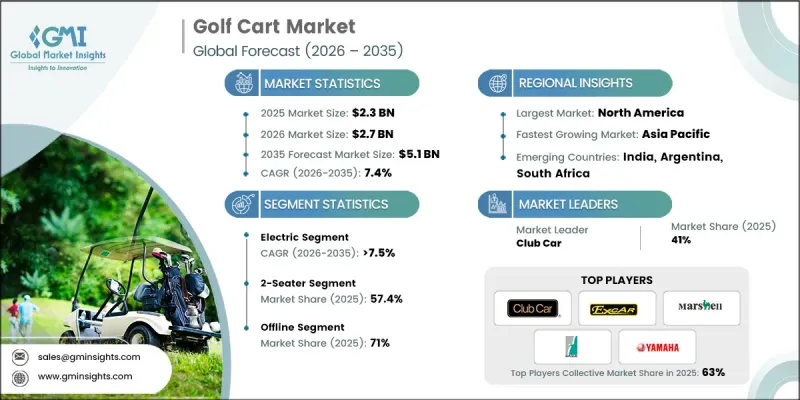
Market growth is supported by the rapid development of gated residential communities, retirement living projects, and planned smart townships that prioritize compact and low-speed mobility. Golf carts are increasingly integrated into controlled residential environments as a cost-effective and convenient transportation solution for short-distance travel. Urban development strategies that emphasize pedestrian-friendly layouts and low-emission transit options are further accelerating adoption. As a result, master-planned communities are incorporating dedicated pathways and charging infrastructure, creating steady replacement cycles and fleet expansion opportunities worldwide. In parallel, manufacturers are actively pursuing mergers, acquisitions, partnerships, and new product introductions to strengthen their competitive positioning. The ongoing transition toward lithium-ion battery systems and full electrification is reshaping the industry landscape. Compared to conventional battery technologies, lithium-ion solutions offer extended lifespan, faster charging, reduced weight, and lower maintenance requirements, improving overall ownership economics and operational efficiency while reinforcing long-term market sustainability.
| Market Scope | |
|---|---|
| Start Year | 2025 |
| Forecast Year | 2026-2035 |
| Start Value | $2.3 Billion |
| Forecast Value | $5.1 Billion |
| CAGR | 7.4% |
Beyond recreational applications, golf carts are witnessing rising deployment across commercial and institutional facilities, expanding the overall addressable market. Organizations are utilizing these vehicles for internal transportation, operational mobility, and light-duty logistics due to their compact structure, maneuverability, and low operating expenses. This shift is transforming golf carts from purely leisure-oriented vehicles into practical mobility solutions supporting diverse business functions.
The electric segment accounted for 62% share in 2025 and is anticipated to grow at a CAGR of 7.5% from 2026 to 2035. Growing emphasis on zero-emission mobility and environmentally responsible transportation solutions is driving adoption. Electric models eliminate tailpipe emissions and significantly reduce noise levels, aligning with sustainability objectives and environmental certification initiatives. These advantages are strengthening long-term procurement demand across residential and commercial settings.
The 2-seater segment held 57.4% share in 2025 and is expected to register a CAGR of 7.5% during 2026-2035. Their compact dimensions and ease of handling make them highly suitable for traditional golf course operations. Lightweight construction reduces surface impact and enhances energy efficiency, delivering cost advantages for operators managing large fleets. Continuous demand for replacement units and new purchases is supporting segment growth globally.
U.S. Golf Cart Market held an 87% share in 2025, generating USD 1.4 billion. The country benefits from an extensive network of golf facilities, sustaining consistent fleet demand. Strong participation rates across multiple age demographics contribute to steady procurement and equipment replacement cycles. Ongoing fleet modernization initiatives, including upgrades to electric and lithium-ion-powered models, are reinforcing long-term revenue growth for manufacturers operating in the region.
Key companies operating in the Global Golf Cart Market include Club Car, Yamaha, E-Z-GO, Cushman, Columbia, Marshell Green, Suzhou Eagle, Dongguan Excar, LANGQING, and Aoxiang. Companies in the Global Golf Cart Market are reinforcing their competitive strength through product innovation, battery technology advancements, and strategic partnerships. Manufacturers are investing in lithium-ion platforms, smart connectivity features, and improved vehicle design to enhance performance and user experience. Strategic alliances with residential developers and commercial operators are expanding distribution channels and long-term supply agreements. Many firms are introducing customized configurations tailored to specific end-user requirements, improving brand differentiation and customer loyalty. Geographic expansion and localized manufacturing initiatives are also being implemented to reduce production costs and strengthen regional presence.
Table of Contents
Chapter 1 Methodology
- 1.1 Research approach
- 1.2 Quality Commitments
- 1.2.1 GMI AI policy & data integrity commitment
- 1.2.1.1 Source consistency protocol
- 1.2.1 GMI AI policy & data integrity commitment
- 1.3 Research Trail & Confidence Scoring
- 1.3.1 Research Trail Components
- 1.3.2 Scoring Components
- 1.4 Data Collection
- 1.4.1 Partial list of primary sources
- 1.5 Data mining sources
- 1.5.1 Paid sources
- 1.5.2 Sources, by region
- 1.6 Base estimates and calculations
- 1.6.1 Base year calculation for any one approach
- 1.7 Forecast model
- 1.7.1 Quantified market impact analysis
- 1.7.1.1 Mathematical impact of growth parameters on forecast
- 1.7.1 Quantified market impact analysis
- 1.8 Research transparency addendum
- 1.8.1 Source attribution framework
- 1.8.2 Quality assurance metrics
- 1.8.3 Our commitment to trust
Chapter 2 Executive Summary
- 2.1 Industry 360° synopsis, 2022 - 2035
- 2.2 Key market trends
- 2.2.1 Regional
- 2.2.2 Fuel
- 2.2.3 Application
- 2.2.4 Sales channel
- 2.2.5 Seating capacity
- 2.3 TAM Analysis, 2026-2035
- 2.4 CXO perspectives: Strategic imperatives
Chapter 3 Industry Insights
- 3.1 Industry ecosystem analysis
- 3.1.1 Supplier landscape
- 3.1.2 Profit margin analysis
- 3.1.3 Cost structure
- 3.1.4 Value addition at each stage
- 3.1.5 Factor affecting the value chain
- 3.1.6 Disruptions
- 3.2 Industry impact forces
- 3.2.1 Growth drivers
- 3.2.1.1 Expansion of gated communities and smart townships
- 3.2.1.2 Growth in golf tourism and leisure activities
- 3.2.1.3 Electrification and lithium-ion battery adoption
- 3.2.1.4 Increasing use in commercial & institutional facilities
- 3.2.1.5 Customization and connected vehicle features
- 3.2.2 Industry pitfalls and challenges
- 3.2.2.1 High upfront cost of lithium-ion models
- 3.2.2.2 Regulatory restrictions on low-speed vehicles
- 3.2.2.3 Battery disposal and environmental concerns
- 3.2.2.4 Competition from alternative micro-mobility solutions
- 3.2.3 Market opportunities
- 3.2.3.1 Expansion in Asia Pacific tourism sector
- 3.2.3.2 Growth of electric utility vehicles
- 3.2.3.3 Fleet leasing and rental models
- 3.2.3.4 Technological advancements in battery management
- 3.2.1 Growth drivers
- 3.3 Growth potential analysis
- 3.4 Regulatory landscape
- 3.4.1 North America
- 3.4.1.1 Environmental Protection Agency (EPA)
- 3.4.1.2 National Highway Traffic Safety Administration (NHTSA) - FMVSS 500
- 3.4.1.3 Occupational Safety and Health Administration (OSHA)
- 3.4.1.4 Canadian Motor Vehicle Safety Standards (CMVSS)
- 3.4.1.5 State-Level Road Use Regulations
- 3.4.2 Europe
- 3.4.2.1 EU Machinery Directive
- 3.4.2.2 CE Marking Compliance
- 3.4.2.3 Low Voltage Directive (LVD)
- 3.4.2.4 Electromagnetic Compatibility (EMC) Directive
- 3.4.2.5 National Road Homologation Requirements
- 3.4.3 Asia Pacific
- 3.4.3.1 Chinese EV & LSV Regulatory Framework
- 3.4.3.2 Indian Central Motor Vehicle Rules (CMVR)
- 3.4.3.3 Japanese Road Transport Vehicle Act
- 3.4.3.4 ASEAN EV Policy Harmonization Efforts
- 3.4.3.5 Australian Design Rules (ADR)
- 3.4.4 Latin America
- 3.4.4.1 Brazilian National Traffic Council (CONTRAN) Regulations
- 3.4.4.2 Mexican NOM Standards
- 3.4.4.3 Regional Urban Mobility & EV Incentive Programs
- 3.4.5 Middle East & Africa
- 3.4.5.1 GCC Vehicle Compliance & Type Approval Regulations
- 3.4.5.2 South African National Road Traffic Act (NRTA)
- 3.4.5.3 Tourism & Free-Zone Operational Standards
- 3.4.1 North America
- 3.5 Major market trends and disruptions
- 3.6 Future market trends
- 3.7 Porter’s analysis
- 3.8 PESTEL analysis
- 3.9 Technology and innovation landscape
- 3.9.1 Current technological trends
- 3.9.2 Emerging technologies
- 3.10 Price trends
- 3.10.1 By region
- 3.10.2 By product
- 3.11 Production statistics
- 3.11.1 Production hubs
- 3.11.2 Consumption hubs
- 3.11.3 Export and import
- 3.12 Cost breakdown analysis
- 3.13 Patent analysis
- 3.14 Sustainability and environmental aspects
- 3.14.1 Sustainable practices
- 3.14.2 Waste reduction strategies
- 3.14.3 Energy efficiency in production
- 3.14.4 Eco-friendly Initiatives
- 3.14.5 Carbon footprint considerations
Chapter 4 Competitive Landscape, 2025
- 4.1 Introduction
- 4.2 Company market share analysis
- 4.2.1 North America
- 4.2.2 Europe
- 4.2.3 Asia Pacific
- 4.2.4 LATAM
- 4.2.5 MEA
- 4.3 Competitive analysis of major market players
- 4.4 Competitive positioning matrix
- 4.5 Key developments
- 4.5.1 Mergers & acquisitions
- 4.5.2 Partnerships & collaborations
- 4.5.3 New Product Launches
- 4.5.4 Expansion Plans and funding
Chapter 5 Market Estimates & Forecast, By Fuel, 2022 - 2035 ($Mn, Units)
- 5.1 Key trends
- 5.2 Gasoline
- 5.3 Electric
- 5.4 Solar-powered
Chapter 6 Market Estimates & Forecast, By Application, 2022 - 2035 ($Mn, Units)
- 6.1 Key trends
- 6.2 Golf Course
- 6.3 Hotels and Resorts
- 6.4 Airports
- 6.5 Housing Projects
- 6.6 Others
Chapter 7 Market Estimates & Forecast, By Sales Channel, 2022 - 2035 ($Mn, Units)
- 7.1 Key trends
- 7.2 Online
- 7.3 Offline
Chapter 8 Market Estimates & Forecast, By Seating Capacity, 2022 - 2035 ($Mn, Units)
- 8.1 Key trends
- 8.2 2-Seater
- 8.3 4-Seater
- 8.4 6-Seater
- 8.5 Others
Chapter 9 Market Estimates & Forecast, By Region, 2021 - 2034 ($Mn, Units)
- 9.1 Key trends
- 9.2 North America
- 9.2.1 US
- 9.2.2 Canada
- 9.3 Europe
- 9.3.1 UK
- 9.3.2 Germany
- 9.3.3 France
- 9.3.4 Italy
- 9.3.5 Spain
- 9.3.6 Poland
- 9.3.7 Netherlands
- 9.3.8 Belgium
- 9.4 Asia Pacific
- 9.4.1 China
- 9.4.2 India
- 9.4.3 Japan
- 9.4.4 South Korea
- 9.4.5 Southeast Asia
- 9.4.6 ANZ
- 9.5 Latin America
- 9.5.1 Brazil
- 9.5.2 Argentina
- 9.5.3 Mexico
- 9.6 MEA
- 9.6.1 UAE
- 9.6.2 Saudi Arabia
- 9.6.3 South Africa
Chapter 10 Company Profiles
- 10.1 Global Players
- 10.1.1 Club Car
- 10.1.2 Columbia
- 10.1.3 Cushman
- 10.1.4 E-Z-GO
- 10.1.5 Garia
- 10.1.6 Polaris
- 10.1.7 Yamaha
- 10.2 Regional Players
- 10.2.1 Advanced EV
- 10.2.2 Bintelli
- 10.2.3 Evolution EV
- 10.2.4 Melex
- 10.2.5 Pilotcar
- 10.2.6 Star EV
- 10.2.7 Tomberlin
- 10.3 Emerging Players
- 10.3.1 Eco Planeta
- 10.3.2 Guangdong Lvtong
- 10.3.3 HDK
- 10.3.4 Jinghang Sightseeing
- 10.3.5 Langqing
- 10.3.6 Marshell
- 10.3.7 Suzhou Eagle

