
PUBLISHER: Global Market Insights Inc. | PRODUCT CODE: 1892792

PUBLISHER: Global Market Insights Inc. | PRODUCT CODE: 1892792
North America Automatic Door Market Opportunity, Growth Drivers, Industry Trend Analysis, and Forecast 2026 - 2035
North America Automatic Door Market was valued at USD 1.32 billion in 2025 and is estimated to grow at a CAGR of 3.6% to reach USD 1.88 billion by 2035.
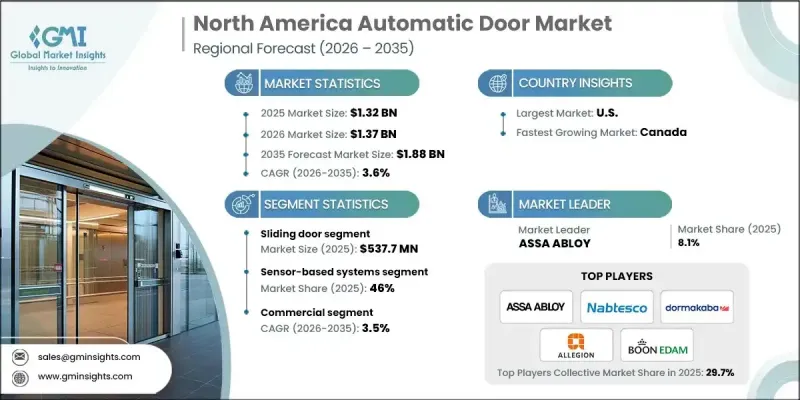
The market growth is driven by rising demand for contactless access solutions, increasing construction of commercial spaces, and growing focus on building automation. Automatic doors, once considered luxury installations, have now become integral components in commercial, healthcare, transportation, and institutional infrastructures, owing to their benefits in convenience, accessibility, hygiene, and energy efficiency. The heightened awareness around hygiene post-pandemic has significantly fueled the demand for touchless entry systems in high-traffic areas such as hospitals, retail stores, airports, and corporate buildings.
| Market Scope | |
|---|---|
| Start Year | 2025 |
| Forecast Year | 2026-2035 |
| Start Value | $1.32 Billion |
| Forecast Value | $1.88 Billion |
| CAGR | 3.6% |
Moreover, the integration of smart sensors, AI, and IoT-enabled door systems is expanding their functionality by allowing real-time access control, predictive maintenance, and enhanced security monitoring. North America, with its mature construction sector, high rate of urbanization, and stringent building safety standards, provides a fertile ground for market expansion. In addition, government mandates related to disability access (such as the Americans with Disabilities Act) are compelling commercial facilities to install automated entry systems to ensure universal accessibility. As smart city initiatives and retrofitting projects gain traction, the demand for technologically advanced and aesthetically designed automatic door systems is expected to see sustained growth across the region.
By type, the sliding doors segment generated USD 537.7 million in 2025. Sliding automatic doors are widely adopted across commercial and institutional buildings due to their space-saving design, smooth operation, and suitability for areas with high foot traffic. Their ability to provide hands-free entry while maintaining indoor climate control makes them particularly valuable in retail stores, hotels, airports, and hospitals. Sliding doors also integrate easily with security systems and sensors, allowing for better crowd management and enhanced safety. As architectural designs in commercial real estate increasingly favor open, seamless entryways, the adoption of sliding door systems continues to surge.
In terms of end-use, the commercial segment will grow at a 3.5% CAGR through 2025-2034. The high footfall in commercial spaces such as shopping malls, office complexes, hospitality venues, and entertainment centers necessitates efficient, hygienic, and secure entry solutions. Automatic doors enhance customer experience while improving energy efficiency by minimizing air exchange during entry and exit. The adoption of automatic doors in commercial environments is further driven by growing investments in green building certifications, which emphasize the role of energy-efficient and accessible infrastructure. As businesses aim to modernize their facilities to align with sustainability goals and evolving consumer expectations, demand for automatic doors with smart integration, noise reduction, and high durability is steadily increasing.
United States Automatic Door Market held a 89% share in 2024, driven by robust commercial construction activity, rapid urbanization, and the widespread implementation of smart building technologies. The U.S. market benefits from strong adoption in healthcare facilities, government buildings, transportation hubs, and retail environments, all of which demand high-performance automated entry systems. Stringent regulatory frameworks on accessibility and public safety also encourage the deployment of automatic doors across both public and private sectors. Furthermore, the increasing number of the aging population and the push for universally accessible infrastructure are amplifying the need for doors that can accommodate mobility-impaired users.
Leading players in the North America Automatic Door Market include ASSA ABLOY Group, dormakaba Group, Stanley Access Technologies (Allegion), GEZE GmbH, NABCO Entrances Inc., Horton Automatics, TORMAX (Landert Group), Record Group, Deutschtec GmbH, and KONE Corporation. These companies focus on product innovation, sensor technology advancement, smart automation integration, and expanding regional service networks to strengthen their competitive edge and meet the rising demand for intelligent entry systems across North America.
Table of Contents
Chapter 1 Methodology and scope
- 1.1 Market scope and definition
- 1.2 Research design
- 1.2.1 Research approach
- 1.2.2 Data collection methods
- 1.3 Data mining sources
- 1.3.1 Global
- 1.3.2 Regional/country
- 1.4 Base estimates and calculations
- 1.4.1 Base year calculation
- 1.4.2 Key trends for market estimation
- 1.5 Primary research and validation
- 1.5.1 Primary sources
- 1.6 Forecast model
- 1.7 Research assumptions and limitations
Chapter 2 Executive summary
- 2.1 Industry 360° synopsis
- 2.2 Key market trends
- 2.2.1 Country
- 2.2.2 Door type
- 2.2.3 Function
- 2.2.4 Installation type
- 2.2.5 End Use
- 2.2.6 Distribution channel
- 2.3 CXO perspectives: strategic imperatives
- 2.3.1 Key decision points for industry executives
- 2.3.2 Critical success factors for market players
- 2.4 Future outlook and strategic recommendations
Chapter 3 Industry insights
- 3.1 Industry ecosystem analysis
- 3.1.1 Supplier landscape
- 3.1.2 Profit margin
- 3.1.3 Value addition at each stage
- 3.1.4 Factor affecting the value chain
- 3.1.5 Disruptions
- 3.2 Industry impact forces
- 3.2.1 Growth drivers
- 3.2.2 Industry pitfalls & challenges
- 3.2.3 Opportunities
- 3.3 Growth potential analysis
- 3.4 Future market trends
- 3.5 Technology and innovation landscape
- 3.5.1 Current technological trends
- 3.5.2 Emerging technologies
- 3.6 Price trends
- 3.6.1 By Country
- 3.6.2 By Door type
- 3.7 Regulatory framework
- 3.7.1 Standards and certifications
- 3.7.2 Environmental regulations
- 3.7.3 Import export regulations
- 3.8 Trade statistics
- 3.8.1 Major importing countries
- 3.8.2 Major exporting countries
- 3.9 Porter's five forces analysis
- 3.10 PESTEL analysis
- 3.11 Consumer behavior analysis
- 3.11.1 Purchasing patterns
- 3.11.2 Preference analysis
- 3.11.3 Regional variations in consumer behavior
- 3.11.4 Impact of e-commerce on buying decisions
Chapter 4 Competitive landscape, 2025
- 4.1 Introduction
- 4.2 Company market share analysis
- 4.3 Company matrix analysis
- 4.4 Competitive analysis of major market players
- 4.5 Competitive positioning matrix
- 4.6 Key developments
- 4.6.1 Mergers & acquisitions
- 4.6.2 Partnerships & collaborations
- 4.6.3 New product launches
- 4.6.4 Expansion plans
Chapter 5 Market Estimates & Forecast, By Door Type, 2022 - 2035 ($Billion, Thousand Units)
- 5.1 Key trends
- 5.2 Sliding door
- 5.2.1 Single sliding
- 5.2.2 Bi-parting sliding
- 5.2.3 Telescopic sliding
- 5.2.4 Curved sliding
- 5.3 Swinging door
- 5.3.1 Single swing
- 5.3.2 Double swing
- 5.3.3 Low energy swing
- 5.4 Folding door
- 5.4.1 Bi fold
- 5.4.2 Multi-fold
- 5.5 Revolving door
- 5.5.1 Automatic
- 5.5.2 Security revolving
- 5.6 Specialized doors
- 5.6.1 ICU and CCU doors
- 5.6.2 Clean room doors
- 5.6.3 Fire-rated automatic doors
Chapter 6 Market Estimates & Forecast, By Function, 2022 - 2035 ($Billion, Thousand Units)
- 6.1 Key trends
- 6.2 Sensor-based systems
- 6.2.1 Motion sensors
- 6.2.2 Infrared sensors
- 6.2.3 Microwave sensors
- 6.2.4 Combination sensors
- 6.3 Switch-based systems
- 6.3.1 Push button
- 6.3.2 Touchless switches
- 6.3.3 Key card and RFID
- 6.4 Access control integration
- 6.4.1 Biometric systems
- 6.4.2 Mobile app controlled
- 6.4.3 Building management system integration
- 6.5 Smart and IoT enabled systems
- 6.5.1 Cloud connected
- 6.5.2 AI enhanced predictive maintenance
- 6.5.3 Remote monitoring capabilities
Chapter 7 Market Estimates & Forecast, By Installation Type, 2022 - 2035 ($Billion, Thousand Units)
- 7.1 Key trends
- 7.2 New installation
- 7.3 Retrofit/replacement
- 7.4 Upgrade/modernization
Chapter 8 Market Estimates & Forecast, By End Use, 2022 - 2035 ($Billion, Thousand Units)
- 8.1 Key trends
- 8.2 Commercial
- 8.2.1 Retail
- 8.2.2 Hospitality
- 8.2.3 Office buildings
- 8.2.4 Shopping malls
- 8.3 Institutional
- 8.3.1 Healthcare facilities
- 8.3.2 Educational institutions
- 8.3.3 Government buildings
- 8.3.4 Transportation terminals
- 8.4 Industrial
- 8.4.1 Manufacturing facilities
- 8.4.2 Warehouses
- 8.4.3 Distribution centres
- 8.5 Residential
- 8.5.1 Multifamily housing
- 8.5.2 Luxury residences
- 8.5.3 Senior living facilities
Chapter 9 Market Estimates & Forecast, By Distribution Channel, 2022 - 2035 ($Billion, Thousand Units)
- 9.1 Key trends
- 9.2 Online
- 9.2.1 E-commerce
- 9.2.2 Company websites
- 9.3 Offline
- 9.3.1 Supermarkets/hypermarket
- 9.3.2 Specialty retail stores
- 9.3.3 Others (independent retailer etc.)
Chapter 10 Market Estimates & Forecast, By Country, 2022 - 2035 ($Billion, Thousand Units)
- 10.1 Key trends
- 10.2 U.S.
- 10.3 Canada
Chapter 11 Company Profiles
- 11.1 Allegion Access Technologies
- 11.2 ASSA ABLOY
- 11.3 Boon Edam
- 11.4 DH Pace
- 11.5 Doorson
- 11.6 Dormakaba
- 11.7 GEZE
- 11.8 Horton
- 11.9 KONE
- 11.10 Manusa
- 11.11 Nabtesco
- 11.12 Record Group
- 11.13 STANLEY Access Technologies
- 11.14 TORMAX
- 11.15 Vortex Door

