
PUBLISHER: Global Market Insights Inc. | PRODUCT CODE: 1982324

PUBLISHER: Global Market Insights Inc. | PRODUCT CODE: 1982324
Transportation Biofuel Market Opportunity, Growth Drivers, Industry Trend Analysis, and Forecast 2026 - 2035
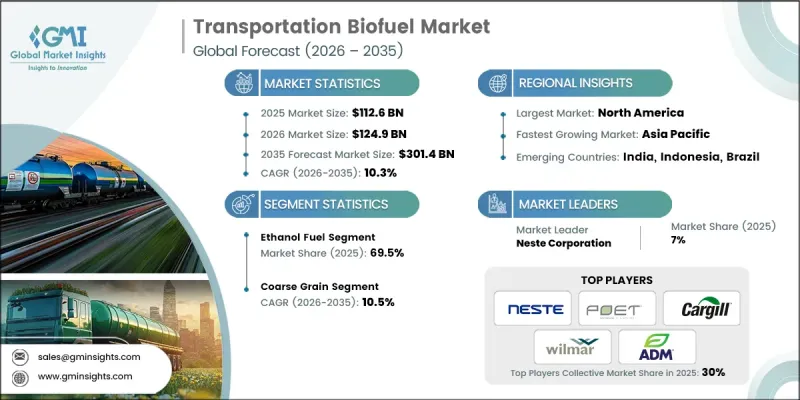
The Global Transportation Biofuel Market was valued at USD 112.6 billion in 2025 and is estimated to grow at a CAGR of 10.3% to reach USD 301.4 billion by 2035.
Policy frameworks across key markets are evolving from broad renewable targets to precise fuel mandates that embed biofuels into long-term transport decarbonization strategies. This transition is evident across aviation, road transport, and increasingly maritime sectors, where eligibility rules and sustainability criteria define which fuels qualify for compliance. As nations implement these frameworks, professionalized reporting, registry systems, and default values create a rules-driven environment that supports investment in advanced biofuels and renewable drop-in fuels. Sustainable aviation fuel (SAF) is a major growth driver, given the limited alternatives to liquid energy in aviation. Regulatory certainty around minimum blending requirements and sustainability standards is encouraging refinery conversions, co-processing initiatives, and greenfield projects. Airlines, airports, and fuel suppliers are adopting integrated procurement, certification, and book-and-claim mechanisms. As SAF moves from pilot programs to routine supply, long-term offtake agreements, capacity expansion, and feedstock diversification are accelerating across approved production pathways.
| Market Scope | |
|---|---|
| Start Year | 2025 |
| Forecast Year | 2026-2035 |
| Start Value | $112.6 Billion |
| Forecast Value | $301.4 Billion |
| CAGR | 10.3% |
The ethanol segment held 69.5% share in 2025 and is expected to grow at a CAGR of 10.5% through 2035. Growth is driven by the convergence of agricultural policy, refinery integration, and transport decarbonization incentives rewarding low-carbon octane. Governments continue expanding blending mandates and eligible feedstocks, while automakers validate higher blend compatibility and fuel retailers increase availability, reducing adoption barriers. Producers are investing in process optimization, carbon intensity reduction, and coproduct valorization to enhance competitiveness under evolving carbon accounting frameworks.
The coarse grain segment accounted for 37.8% share in 2025 and is projected to grow at a CAGR of 10.5% by 2035. Its large, geographically diversified supply, mature conversion technologies, and predictable coproduct economics make coarse grains central to the ethanol ecosystem. Despite growing electrification in light-duty fleets, coarse-grain ethanol maintains a structural role in gasoline pools due to octane contribution, broad vehicle compatibility, and potential as a platform for future bio-intermediates and e-fuel precursors.
U.S. Transportation Biofuel Market held 93% share, generating USD 33.9 billion in 2025, driven by a robust compliance framework, mature supply chains, and focus on lifecycle performance. The U.S. Renewable Fuel Standard (RFS) underpins producer and blender behavior through credit markets, pathway eligibility, and annual standards, supporting investment in cellulosic ethanol, biogas for transport, and low-carbon ethanol and biodiesel. Federal and subnational programs increasingly refine sustainability measurement, promoting process efficiency, carbon intensity reduction, heat integration, carbon capture readiness, and feedstock diversification.
Key players in the Global Transportation Biofuel Market include Neste Corporation, POET, ADM, Praj Industries, Borregaard, FutureFuel, My Eco Energy, Wilmar International, Clariant, TotalEnergies, BTG Bioliquids, Chevron Corporation, Cargill, UPM, Inpasa, Verbio, The Andersons, Munzer Bioindustrie, COFCO, and Zilor. Companies in the Global Transportation Biofuel Market are employing multiple strategies to solidify their market position. They are investing in R&D to optimize conversion efficiency, reduce carbon intensity, and expand eligible feedstocks. Strategic partnerships with OEMs, fuel distributors, and aviation stakeholders enhance market access and long-term offtake agreements. Firms are also modernizing production infrastructure, adopting co-processing and integrated refinery approaches, and expanding geographically to capture emerging demand.
Table of Contents
Chapter 1 Methodology & Scope
- 1.1 Research approach
- 1.2 Quality commitment
- 1.2.1 GMI AI policy & data integrity commitment
- 1.2.1.1 Source consistency protocol
- 1.2.1 GMI AI policy & data integrity commitment
- 1.3 Research Trail & Confidence Scoring
- 1.3.1 Research Trail Components
- 1.3.2 Scoring Components
- 1.4 Data Collection
- 1.4.1 Partial list of primary sources
- 1.5 Data mining sources
- 1.5.1 Paid sources
- 1.5.1.1 Sources, by region
- 1.5.1 Paid sources
- 1.6 Base estimates and calculations
- 1.6.1 Base year calculation for any one approach
- 1.7 Forecast model
- 1.8 Research transparency addendum
- 1.8.1 Source attribution framework
- 1.8.2 Quality assurance metrics
- 1.8.3 Our commitment to trust
- 1.9 Market definitions
Chapter 2 Executive Summary
- 2.1 Industry synopsis, 2022 - 2035
- 2.1.1 Business trends
- 2.1.2 Fuel trends
- 2.1.3 Feedstock trends
- 2.1.4 Regional trends
Chapter 3 Industry Insights
- 3.1 Industry ecosystem analysis
- 3.2 Regulatory landscape
- 3.3 Industry impact forces
- 3.3.1 Growth drivers
- 3.3.2 Industry pitfalls & challenges
- 3.4 Growth potential analysis
- 3.5 Porter's analysis
- 3.5.1 Bargaining power of suppliers
- 3.5.2 Bargaining power of buyers
- 3.5.3 Threat of new entrants
- 3.5.4 Threat of substitutes
- 3.6 PESTEL analysis
- 3.6.1 Political factors
- 3.6.2 Economic factors
- 3.6.3 Social factors
- 3.6.4 Technology factors
- 3.6.5 environmental factors
- 3.6.6 Legal factors
- 3.7 Emerging opportunities & trends
- 3.7.1 Digitalization and IoT integration
- 3.7.2 Emerging market penetration
Chapter 4 Competitive landscape, 2025
- 4.1 Introduction
- 4.2 Company market share analysis, 2025
- 4.2.1 North America
- 4.2.2 Europe
- 4.2.3 Asia Pacific
- 4.2.4 Middle East & Africa
- 4.2.5 Latin America
- 4.3 Competitive benchmarking
- 4.4 Strategic dashboard
- 4.5 Innovation & technology landscape
Chapter 5 Market Size and Forecast, By Fuel, 2022 - 2035 (USD Million, Mtoe)
- 5.1 Key trends
- 5.2 Biodiesel
- 5.3 Ethanol
- 5.4 Others
Chapter 6 Market Size and Forecast, By Feedstock, 2022 - 2035 (USD Million, Mtoe)
- 6.1 Key trends
- 6.2 Coarse grain
- 6.3 Sugar crop
- 6.4 Vegetable oil
- 6.5 Others
Chapter 7 Market Size and Forecast, By Region, 2022 - 2035 (USD Million, Mtoe)
- 7.1 Key trends
- 7.2 North America
- 7.2.1 U.S.
- 7.2.2 Canada
- 7.2.3 Mexico
- 7.3 Europe
- 7.3.1 Germany
- 7.3.2 France
- 7.3.3 Spain
- 7.3.4 UK
- 7.3.5 Italy
- 7.4 Asia Pacific
- 7.4.1 China
- 7.4.2 India
- 7.4.3 Indonesia
- 7.4.4 Australia
- 7.4.5 South Korea
- 7.5 Middle East & Africa
- 7.5.1 Saudi Arabia
- 7.5.2 South Africa
- 7.6 Latin America
- 7.6.1 Brazil
- 7.6.2 Argentina
Chapter 8 Company Profiles
- 8.1 ADM
- 8.2 Borregaard
- 8.3 BTG Bioliquids
- 8.4 Cargill
- 8.5 Chevron Corporation
- 8.6 Clariant
- 8.7 COFCO
- 8.8 FutureFuel
- 8.9 Inpasa
- 8.10 Munzer Bioindustrie
- 8.11 My Eco Energy
- 8.12 Neste Corporation
- 8.13 POET
- 8.14 Praj Industries
- 8.15 The Andersons
- 8.16 TotalEnergies
- 8.17 UPM
- 8.18 Verbio
- 8.19 Wilmar International
- 8.20 Zilor

