PUBLISHER: Global Market Insights Inc. | PRODUCT CODE: 1982335

PUBLISHER: Global Market Insights Inc. | PRODUCT CODE: 1982335
Toilet Bowl Cleaner Tablets Market Opportunity, Growth Drivers, Industry Trend Analysis, and Forecast 2026 - 2035
The Global Toilet Bowl Cleaner Tablets Market was valued at USD 1.4 billion in 2025 and is estimated to grow at a CAGR of 3.4% to reach USD 2 billion by 2035.
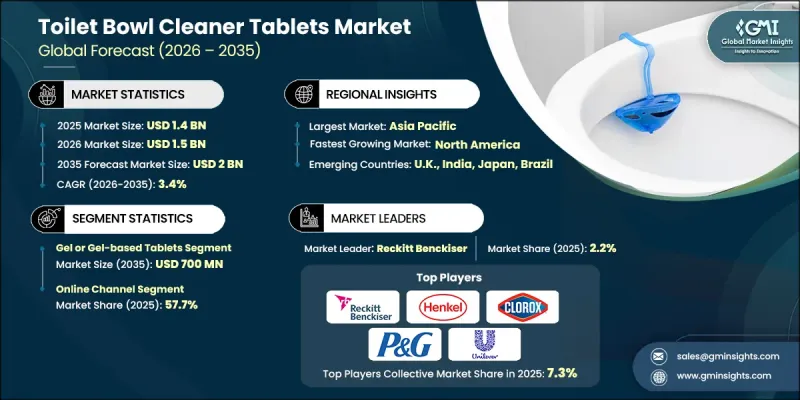
Market growth is being supported by continuous product innovation and technological advancements that enhance cleaning efficiency and user convenience. As sustainability becomes a central purchasing criterion, consumers are increasingly shifting toward environmentally responsible cleaning solutions designed to reduce overall ecological impact. Manufacturers are responding with advanced formulations that combine effective sanitation with deodorizing performance in a single application. Controlled-dissolution technologies are extending product longevity, allowing tablets to deliver consistent cleaning action over longer usage cycles. At the same time, premiumization trends are influencing product development, with brands introducing upgraded formats that emphasize ease of use, fragrance enhancement, and improved hygiene outcomes. Consumers are demonstrating a strong preference for low-maintenance cleaning systems that simplify household routines while maintaining high sanitation standards. The combination of convenience-driven demand, eco-conscious product innovation, and performance-enhancing formulations continues to shape the competitive landscape and support steady long-term expansion of the global toilet bowl cleaner tablets market.
| Market Scope | |
|---|---|
| Start Year | 2025 |
| Forecast Year | 2026-2035 |
| Start Value | $1.4 Billion |
| Forecast Value | $2 Billion |
| CAGR | 3.4% |
The gel-based tablet segment generated USD 500 million in 2025 and is forecast to reach USD 700 million by 2035. This segment leads due to its strong cleaning efficacy, user-friendly application, and enhanced adhesion properties that support sustained stain removal. Regulatory emphasis on sanitation standards and product performance has further encouraged the adoption of advanced gel-based formats, reinforcing their dominant market position.
The online distribution segment accounted for 57.7% share in 2025, making it the leading sales channel. Digital retail platforms provide broad product availability, competitive pricing structures, and convenient purchasing experiences. Consumers benefit from detailed product descriptions, user feedback, and promotional pricing, which collectively support higher conversion rates and repeat purchases. The continued expansion of e-commerce infrastructure is expected to strengthen online channel dominance.
United States Toilet Bowl Cleaner Tablets Market represented 78.3% share in 2025, maintaining regional leadership. Growth in the region is driven by widespread adoption of convenience-oriented home care solutions and strong consumer preference for automated sanitation products. Rising hygiene awareness, particularly in shared residential environments, continues to reinforce category demand. Extensive retail penetration across supermarkets, warehouse outlets, and major online marketplaces further accelerates product accessibility. Continuous improvements in long-lasting formulations, enhanced stain removal capabilities, and fragrance-forward innovations are sustaining category expansion across the U.S. market.
Key companies operating in the Global Toilet Bowl Cleaner Tablets Market include Procter & Gamble, Reckitt Benckiser, Unilever, Clorox, SC Johnson, Henkel, Church & Dwight, Seventh Generation, Diversey, Werner & Mertz, Kobayashi Pharmaceutical, Daniel Jochugiku, Pental, Future Consumer, and Ecozone. These companies compete through continuous formulation upgrades, sustainable packaging development, and broad retail distribution strategies. Companies in the Toilet Bowl Cleaner Tablets Market are reinforcing their market position by investing in product differentiation, sustainability initiatives, and advanced dissolution technologies. Many manufacturers are introducing eco-friendly ingredients and recyclable packaging to align with environmental regulations and consumer expectations. Strategic partnerships with major retailers and digital marketplaces are expanding global reach and improving supply chain efficiency. Firms are also focusing on fragrance innovation, extended-release performance, and multifunctional cleaning benefits to attract premium buyers. Marketing strategies increasingly emphasize hygiene assurance, convenience, and value-added features.
Table of Contents
Chapter 1 Methodology & Scope
- 1.1 Research approach
- 1.2 Quality Commitments
- 1.3 GMI AI policy & data integrity commitment
- 1.3.1 Source consistency protocol
- 1.4 Research Trail & Confidence Scoring
- 1.4.1 Research Trail Components
- 1.4.2 Scoring Components
- 1.5 Data Collection
- 1.5.1 Partial list of primary sources
- 1.6 Data mining sources
- 1.7 Paid sources
- 1.7.1 Sources, by region
- 1.8 Base estimates and calculations
- 1.8.1 Base year calculation for any one approach
- 1.9 Forecast model
- 1.9.1 Quantified market impact analysis
- 1.9.1.1 Mathematical impact of growth parameters on forecast
- 1.9.1 Quantified market impact analysis
- 1.10 Research transparency addendum
- 1.10.1 Source attribution framework
- 1.10.2 Quality assurance metrics
- 1.11 Our commitment to trust
Chapter 2 Executive Summary
- 2.1 Industry 360° synopsis
- 2.2 Key market trends
- 2.2.1 Regional
- 2.2.2 Tablet Type
- 2.2.3 Pack Size
- 2.2.4 Price
- 2.2.5 Packaging type
- 2.2.6 Application
- 2.2.7 Distribution Channel
Chapter 3 Industry Insights
- 3.1 Industry ecosystem analysis
- 3.1.1 Supplier landscape
- 3.1.2 Profit margin
- 3.1.3 Value addition at each stage
- 3.1.4 Factor affecting the value chain
- 3.2 Industry impact forces
- 3.2.1 Growth drivers
- 3.2.1.1 Rising per capita spending on toilet care products
- 3.2.1.2 Increased awareness of hygiene and sanitation standards
- 3.2.1.3 Rapid urbanization & infrastructure development:
- 3.2.2 Industry pitfalls & challenges
- 3.2.2.1 Inconsistent dissolution & performance across toilet types
- 3.2.2.2 Environmental & chemical safety concerns
- 3.2.3 Opportunities
- 3.2.3.1 Expansion of eco-friendly & biodegradable tablet formats
- 3.2.3.2 Growth in e-commerce, subscription, and multi-pack formats
- 3.2.1 Growth drivers
- 3.3 Growth potential analysis
- 3.4 Future market trends
- 3.5 Technology and innovation landscape
- 3.5.1 Current technological trends
- 3.5.2 Emerging technologies
- 3.6 Price trends
- 3.6.1 By product type
- 3.6.2 By region
- 3.7 Regulatory landscape
- 3.7.1 Standards and compliance requirements
- 3.7.2 Regional regulatory frameworks
- 3.7.3 Certification standards
- 3.8 Trade statistics
- 3.8.1 Major importing countries
- 3.8.2 Major exporting countries
- 3.9 Porter’s analysis
- 3.10 PESTEL analysis
- 3.11 Consumer behaviour analysis
- 3.11.1 Purchasing patterns
- 3.11.2 Preference analysis
- 3.11.3 Regional variations in consumer behaviour
- 3.11.4 Impact of e-commerce on buying decisions
Chapter 4 Competitive Landscape, 2025
- 4.1 Introduction
- 4.2 Company market share analysis
- 4.2.1 By region
- 4.2.1.1 North America
- 4.2.1.2 Europe
- 4.2.1.3 Asia Pacific
- 4.2.1.4 Latin America
- 4.2.1.5 Middle East and Africa
- 4.2.1 By region
- 4.3 Company matrix analysis
- 4.4 Competitive analysis of major market players
- 4.5 Competitive positioning matrix
- 4.6 Key developments
- 4.6.1 Mergers & acquisitions
- 4.6.2 Partnerships & collaborations
- 4.6.3 New product launches
- 4.6.4 Expansion plans
Chapter 5 Market Estimates & Forecast, By Tablet Type, 2022-2035 (USD Billion) (Million Units)
- 5.1 Key trends
- 5.2 Automatic Toilet Bowl Cleaners
- 5.3 Gel or Gel-Based Tablets
- 5.4 Septic-Safe Tablets
- 5.5 Biodegradable or Eco-Friendly Tablets
- 5.6 Others (Drop-In Tablets,etc.)
Chapter 6 Market Estimates & Forecast, By Pack Size, 2022-2035 (USD Billion) (Million Units)
- 6.1 Key trends
- 6.2 3 - 10 count
- 6.3 10 - 20 count
- 6.4 20 - 30 count
- 6.5 Above 30 count
Chapter 7 Market Estimates & Forecast, By Price, 2022-2035 (USD Billion) (Million Units)
- 7.1 Key trends
- 7.2 Low
- 7.3 Medium
- 7.4 High
Chapter 8 Market Estimates & Forecast, By Packaging Type, 2022-2035 (USD Billion) (Million Units)
- 8.1 Key trends
- 8.2 Water-Soluble Wrappers
- 8.3 Blister Packs
- 8.4 Containers
- 8.5 Resealable Bags
- 8.6 Others (Multi-Pack Boxes, etc.)
Chapter 9 Market Estimates & Forecast, By Application, 2022-2035 (USD Billion) (Million Units)
- 9.1 Key trends
- 9.2 Residential
- 9.3 Commercial
- 9.3.1 Hotels & Restaurants
- 9.3.2 Education Institutions
- 9.3.3 Offices
- 9.3.4 Government Institutions
- 9.3.5 Others (Retail Stores, etc.)
Chapter 10 Market Estimates & Forecast, By Distribution Channel, 2022-2035 (USD Billion) (Million Units)
- 10.1 Key trends
- 10.2 Online
- 10.2.1 E-Commerce
- 10.2.2 Company website
- 10.3 Offline
- 10.3.1 Supermarkets/Hypermarkets
- 10.3.2 Specialty Stores
- 10.3.3 Others (Individual stores, Departmental stores, etc.)
Chapter 11 Market Estimates & Forecast, By Region, 2022-2035 (USD Billion) (Million Units)
- 11.1 Key trends
- 11.2 North America
- 11.2.1 U.S.
- 11.2.2 Canada
- 11.3 Europe
- 11.3.1 Germany
- 11.3.2 France
- 11.3.3 UK
- 11.3.4 Italy
- 11.3.5 Spain
- 11.4 Asia Pacific
- 11.4.1 China
- 11.4.2 India
- 11.4.3 Japan
- 11.4.4 South Korea
- 11.4.5 Australia
- 11.5 Latin America
- 11.5.1 Brazil
- 11.5.2 Mexico
- 11.5.3 Argentina
- 11.6 MEA
- 11.6.1 South Africa
- 11.6.2 Saudi Arabia
- 11.6.3 UAE
Chapter 12 Company Profiles
- 12.1 Church & Dwight
- 12.2 Clorox
- 12.3 Daniel Jochugiku
- 12.4 Diversey
- 12.5 Ecozone
- 12.6 Future Consumer
- 12.7 Henkel
- 12.8 Kobayashi Pharmaceutical
- 12.9 Pental
- 12.10 Procter & Gamble
- 12.11 Reckitt Benckiser
- 12.12 SC Johnson
- 12.13 Seventh Generation
- 12.14 Unilever
- 12.15 Werner & Mertz

