
PUBLISHER: Global Market Insights Inc. | PRODUCT CODE: 1982356

PUBLISHER: Global Market Insights Inc. | PRODUCT CODE: 1982356
Remote Operated Vehicle Market Opportunity, Growth Drivers, Industry Trend Analysis, and Forecast 2026 - 2035
The Global Remote Operated Vehicle Market was valued at USD 1.9 billion in 2025 and is estimated to grow at a CAGR of 7.2% to reach USD 3.9 billion by 2035.
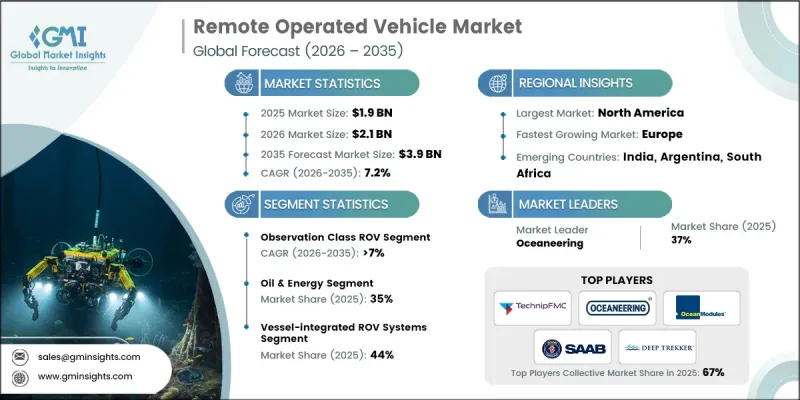
Growing financial support from research institutions and government bodies for advanced marine technologies is significantly accelerating market growth. Remote operated vehicles are increasingly deployed for complex subsea missions that require high-resolution imaging, advanced sensors, and precise maneuverability at extreme depths beyond human reach. These systems play a critical role in collecting environmental intelligence that supports marine science, oceanographic assessments, biodiversity analysis, and climate-related studies. The rising emphasis on sustainable ocean management and global environmental monitoring programs continues to strengthen adoption. In parallel, expanding offshore infrastructure across oil, gas, and renewable energy sectors is creating sustained demand for dependable underwater robotics. ROVs enhance operational safety, improve cost efficiency, and minimize human exposure to hazardous subsea environments. Their ability to deliver real-time data transmission, accurate manipulation capabilities, and remote-controlled intervention supports continuous underwater operations. Increased utilization across defense and maritime security applications further reinforces the long-term expansion trajectory of the global remote operated vehicle industry.
| Market Scope | |
|---|---|
| Start Year | 2025 |
| Forecast Year | 2026-2035 |
| Start Value | $1.9 Billion |
| Forecast Value | $3.9 Billion |
| CAGR | 7.2% |
Industry participants in the remote operated vehicle market are actively implementing inorganic growth initiatives, including product introductions, acquisitions, and strategic collaborations, to maintain competitive positioning. Rising offshore energy investments are driving substantial demand for subsea inspection, intervention, and construction services. ROV systems provide safe access to challenging underwater environments while ensuring operational precision and cost control. Their capability to execute technically demanding tasks with minimal downtime has strengthened their value proposition across energy-driven industries that rely on uninterrupted subsea performance. Additionally, expanding defense modernization efforts are contributing to greater integration of advanced remotely operated systems within maritime operations.
The observation class ROV segment accounted for 35% share in 2025 and is anticipated to grow at a CAGR of 7% from 2026 to 2035. These compact systems are widely adopted for routine underwater assessments across multiple industries due to their affordability, ease of deployment, and high maneuverability. They are particularly suited for visual inspections of submerged infrastructure and critical assets requiring consistent monitoring. Increasing regulatory oversight and asset integrity requirements are accelerating demand for high-definition visual data solutions, supporting sustained expansion of the observation class category worldwide.
The oil & energy segment held a 35% share in 2025 and is forecast to grow at a CAGR of 6.5% between 2026 and 2035. Continued offshore hydrocarbon exploration activities in deeper and more technically complex reservoirs are significantly contributing to ROV deployment. Operators rely on advanced systems to assist drilling operations, perform equipment inspections, install subsea components, and maintain pipeline infrastructure. These vehicles provide efficient, high-precision intervention capabilities that support operational continuity, enhance safety standards, and improve overall hydrocarbon recovery performance in demanding subsea conditions.
United States Remote Operated Vehicle Market held 71% share, generating USD 528 million in 2025. Sustained offshore energy production activities are a major driver of demand for advanced work-class ROV systems in the country. Ongoing maintenance of offshore assets, deepwater developments, and subsea infrastructure upgrades requires highly capable remotely operated technologies. Efforts to extend the operational life of mature offshore facilities through continuous monitoring and system upgrades further support steady fleet utilization and long-term market stability.
Key companies operating in the Global Remote Operated Vehicle Market include Forum Energy Technologies, Halma Deep Trekker, Ocean Modules, Oceaneering, Saab Seaeye, Saipem, Seamor, SLB, TechnipFMC, and VideoRay. Companies within the Global Remote Operated Vehicle Market are strengthening their competitive position by investing in research and development to introduce technologically advanced and energy-efficient systems. Strategic mergers, acquisitions, and partnerships enable broader product portfolios and expanded geographic reach. Many firms are focusing on modular system designs, enhanced data analytics integration, and improved sensor capabilities to increase operational flexibility. Establishing regional service hubs and long-term maintenance agreements with offshore operators helps secure recurring revenue streams.
Table of Contents
Chapter 1 Methodology
- 1.1 Research approach
- 1.2 Quality Commitments
- 1.2.1 GMI AI policy & data integrity commitment
- 1.2.1.1 Source consistency protocol
- 1.2.1 GMI AI policy & data integrity commitment
- 1.3 Research Trail & Confidence Scoring
- 1.3.1 Research Trail Components
- 1.3.2 Scoring Components
- 1.4 Data Collection
- 1.4.1 Partial list of primary sources
- 1.5 Data mining sources
- 1.5.1 Paid sources
- 1.5.2 Sources, by region
- 1.6 Base estimates and calculations
- 1.6.1 Base year calculation for any one approach
- 1.7 Forecast model
- 1.7.1 Quantified market impact analysis
- 1.7.1.1 Mathematical impact of growth parameters on forecast
- 1.7.1 Quantified market impact analysis
- 1.8 Research transparency addendum
- 1.8.1 Source attribution framework
- 1.8.2 Quality assurance metrics
- 1.8.3 Our commitment to trust
Chapter 2 Executive Summary
- 2.1 Industry 360° synopsis, 2022 - 2035
- 2.2 Key market trends
- 2.2.1 Regional
- 2.2.2 Class
- 2.2.3 Application
- 2.2.4 Depth rating
- 2.2.5 System architecture
- 2.3 TAM Analysis, 2026-2035
- 2.4 CXO perspectives: Strategic imperatives
Chapter 3 Industry Insights
- 3.1 Industry ecosystem analysis
- 3.1.1 Supplier landscape
- 3.1.2 Profit margin analysis
- 3.1.3 Cost structure
- 3.1.4 Value addition at each stage
- 3.1.5 Factor affecting the value chain
- 3.1.6 Disruptions
- 3.2 Industry impact forces
- 3.2.1 Growth drivers
- 3.2.1.1 Expansion of offshore oil & gas exploration
- 3.2.1.2 Rapid growth of offshore wind energy
- 3.2.1.3 Rising defense and naval modernization programs
- 3.2.1.4 Growth in subsea telecom and power cable infrastructure
- 3.2.1.5 Technological advancements in robotics and AI integration
- 3.2.2 Industry pitfalls and challenges
- 3.2.2.1 High capital and operational costs
- 3.2.2.2 Skilled operator shortage
- 3.2.2.3 Harsh offshore operating environments
- 3.2.2.4 Dependency on offshore energy cycles
- 3.2.3 Market opportunities
- 3.2.3.1 Expansion of deep-sea mining activities
- 3.2.3.2 Growth in marine research and environmental monitoring
- 3.2.3.3 Rising aquaculture and offshore farming operations
- 3.2.3.4 Integration with autonomous underwater vehicles (AUVs)
- 3.2.1 Growth drivers
- 3.3 Growth potential analysis
- 3.4 Regulatory landscape
- 3.4.1 North America
- 3.4.1.1 US Vessel Incidental Discharge Act
- 3.4.1.2 US coast guard safety regulations
- 3.4.1.3 Bureau of Safety and Environmental Enforcement (BSEE) Offshore Rules
- 3.4.2 Europe
- 3.4.2.1 EU Offshore Safety Directive
- 3.4.2.2 CE Marking & Machinery Directive Compliance
- 3.4.2.3 National Maritime Authority Variations
- 3.4.2.4 Offshore Renewable Energy Regulations
- 3.4.2.5 Diver Safety & Subsea Intervention Regulations
- 3.4.3 Asia Pacific
- 3.4.3.1 Chinese Offshore Regulatory Framework
- 3.4.3.2 Indian Offshore Regulatory Environment
- 3.4.3.3 ASEAN Maritime Harmonization Efforts
- 3.4.3.4 Japanese Maritime & Offshore Framework
- 3.4.3.5 Australia & South Korea Offshore Compliance Standards
- 3.4.4 Latin America
- 3.4.4.1 Brazilian Offshore Regulatory Framework
- 3.4.4.2 Mexican Offshore Safety & Environmental Regulations
- 3.4.4.3 Regional Offshore Harmonization Initiatives
- 3.4.5 Middle East & Africa
- 3.4.5.1 GCC Offshore Regulatory Framework
- 3.4.5.2 South African Maritime Safety Regulations
- 3.4.5.3 West Africa & Red Sea Offshore Development Regulations
- 3.4.1 North America
- 3.5 Major market trends and disruptions
- 3.6 Future market trends
- 3.7 Porter’s analysis
- 3.8 PESTEL analysis
- 3.9 Technology and innovation landscape
- 3.9.1 Current technological trends
- 3.9.2 Emerging technologies
- 3.10 Price trends
- 3.10.1 By region
- 3.10.2 By product
- 3.11 Production statistics
- 3.11.1 Production hubs
- 3.11.2 Consumption hubs
- 3.11.3 Export and import
- 3.12 Cost breakdown analysis
- 3.13 Patent analysis
- 3.14 Sustainability and environmental aspects
- 3.14.1 Sustainable practices
- 3.14.2 Waste reduction strategies
- 3.14.3 Energy efficiency in production
- 3.14.4 Eco-friendly Initiatives
- 3.14.5 Carbon footprint considerations
Chapter 4 Competitive Landscape, 2024
- 4.1 Introduction
- 4.2 Company market share analysis
- 4.2.1 North America
- 4.2.2 Europe
- 4.2.3 Asia Pacific
- 4.2.4 LATAM
- 4.2.5 MEA
- 4.3 Competitive analysis of major market players
- 4.4 Competitive positioning matrix
- 4.5 Key developments
- 4.5.1 Mergers & acquisitions
- 4.5.2 Partnerships & collaborations
- 4.5.3 New Product Launches
- 4.5.4 Expansion Plans and funding
Chapter 5 Market Estimates & Forecast, By Class, 2022 - 2035 ($Mn, Units)
- 5.1 Key trends
- 5.2 Work class ROV
- 5.3 Light work class ROV
- 5.4 Observation class ROV
- 5.5 Micro/mini ROV
Chapter 6 Market Estimates & Forecast, By Application, 2022 - 2035 ($Mn, Units)
- 6.1 Key trends
- 6.2 Aquaculture
- 6.3 Commercial & salvage diving
- 6.4 Municipal INFRASTRUCTURE
- 6.5 Military
- 6.6 Oil & Energy
- 6.7 Others
Chapter 7 Market Estimates & Forecast, By Depth Rating, 2022 - 2035 ($Mn, Units)
- 7.1 Key trends
- 7.2 Shallow water ROVs (≤1,000 msw)
- 7.3 Mid-water ROVs (1,000-3,000 msw)
- 7.4 Deepwater ROVs (3,000-6,000 msw)
- 7.5 Ultra-deepwater ROVs (more than 6,000 msw)
Chapter 8 Market Estimates & Forecast, By System Architecture, 2022 - 2035 ($Mn, Units)
- 8.1 Key trends
- 8.2 Vessel-integrated ROV systems
- 8.3 Modular containerized ROV systems
- 8.4 Fully containerized ROV systems
Chapter 9 Market Estimates & Forecast, By Region, 2021 - 2034 ($Mn, Units)
- 9.1 Key trends
- 9.2 North America
- 9.2.1 US
- 9.2.2 Canada
- 9.3 Europe
- 9.3.1 UK
- 9.3.2 Germany
- 9.3.3 France
- 9.3.4 Italy
- 9.3.5 Spain
- 9.3.6 Russia
- 9.3.7 Netherlands
- 9.3.8 Nordics
- 9.4 Asia Pacific
- 9.4.1 China
- 9.4.2 India
- 9.4.3 Japan
- 9.4.4 South Korea
- 9.4.5 Australia
- 9.4.6 Southeast Asia
- 9.5 Latin America
- 9.5.1 Brazil
- 9.5.2 Argentina
- 9.5.3 Mexico
- 9.6 MEA
- 9.6.1 UAE
- 9.6.2 Saudi Arabia
- 9.6.3 South Africa
Chapter 10 Company Profiles
- 10.1 Global Players
- 10.1.1 DeepOcean
- 10.1.2 DOF Subsea
- 10.1.3 Forum Energy Technologies
- 10.1.4 Fugro
- 10.1.5 Kongsberg Maritime
- 10.1.6 Oceaneering International
- 10.1.7 Saab Seaeye
- 10.1.8 Saipem
- 10.1.9 SLB (Schlumberger)
- 10.1.10 TechnipFMC
- 10.2 Regional Players
- 10.2.1 ROVOP
- 10.2.2 AC-CESS Co UK
- 10.2.3 Anritsu Corp
- 10.2.4 Deep Ocean Engineering
- 10.2.5 Deep Ocean Search
- 10.2.6 SEAMOR Marine
- 10.2.7 Seatronics
- 10.3 Emerging Players
- 10.3.1 Deep Trekker
- 10.3.2 Rovtech
- 10.3.3 VideoRay

