PUBLISHER: Global Market Insights Inc. | PRODUCT CODE: 1982361

PUBLISHER: Global Market Insights Inc. | PRODUCT CODE: 1982361
Signals Intelligence (SIGINT) Market Opportunity, Growth Drivers, Industry Trend Analysis, and Forecast 2026 - 2035
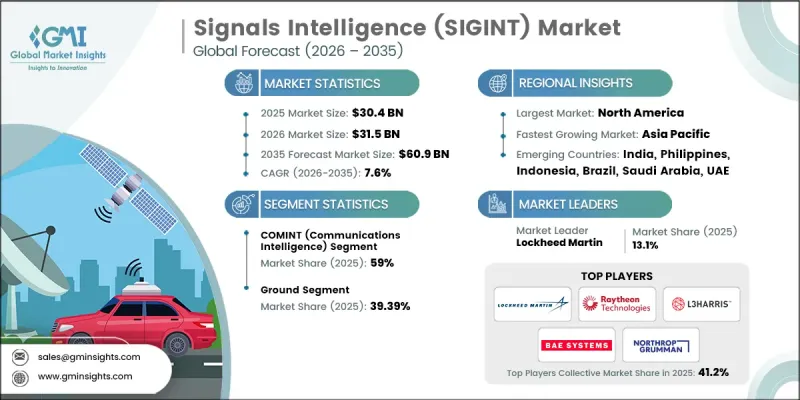
The Global Signals Intelligence (SIGINT) Market was valued at USD 30.4 billion in 2025 and is estimated to grow 7.6% to reach USD 60.9 billion by 2035.
The signals intelligence (SIGINT) industry is evolving into a critical pillar of modern defense and national security strategies. Shifting geopolitical dynamics, rising cyber threats, spectrum congestion, and expanding electronic warfare activities are driving governments to elevate SIGINT capabilities from supporting functions to central strategic assets. Intelligence agencies are increasingly relying on advanced SIGINT systems to obtain real-time situational awareness, identify emerging threats, and maintain operational superiority across complex security environments. Growing defense allocations, asymmetric conflict scenarios, and rapid digitalization of global communications networks are accelerating the deployment of sophisticated SIGINT platforms. Solutions across land, air, naval, and space domains are being integrated to provide multi-layered intelligence coverage. Technological advancements such as artificial intelligence, machine learning, cloud-enabled analytics, and software-defined architectures are transforming data processing capabilities. Enhanced signal detection, automated classification, and faster analysis of electromagnetic data streams are strengthening operational efficiency and intelligence accuracy across defense ecosystems.
| Market Scope | |
|---|---|
| Start Year | 2025 |
| Forecast Year | 2026-2035 |
| Start Value | $30.4 Billion |
| Forecast Value | $60.9 Billion |
| CAGR | 7.6% |
The communications intelligence (COMINT) segment held 59% share in 2025 and is projected to grow at a CAGR of 7.8% through 2035. COMINT maintains a dominant position due to the essential requirement to intercept and analyze communication signals across diverse networks. Its capability to provide actionable insights into adversarial coordination and intent supports defense, security, and strategic operations. The growing complexity of encrypted and multi-channel communications is increasing the need for advanced COMINT systems capable of managing high data volumes while delivering precise and timely intelligence outputs.
The ground segment held 39.39% share in 2025 and is anticipated to grow at a CAGR of 6.2% between 2026 and 2035. Ground-based SIGINT platforms remain central to intelligence operations due to their reliability and adaptability in various operational environments. These systems support continuous monitoring and signal interception in strategically sensitive locations. Their integration with broader defense networks enhances command-level decision-making and operational coordination. Flexible deployment capabilities and interoperability with other intelligence frameworks further reinforce the segment's leadership within the signals intelligence market.
United States Signals Intelligence (SIGINT) Market held 93% share, generating USD 16.4 billion in 2025. Market growth in the country is supported by sustained federal investment in defense modernization and intelligence capabilities. Rising geopolitical tensions and expanding cyber and electronic warfare challenges are strengthening long-term demand for advanced SIGINT technologies. Defense and intelligence agencies are prioritizing real-time intelligence solutions to maintain information superiority across multiple operational domains. Continuous innovation in AI-driven analytics, cloud computing integration, and modular system architectures is accelerating technology upgrades and extending the lifecycle performance of SIGINT platforms.
Key companies operating in the Global Signals Intelligence (SIGINT) Market include Lockheed Martin Corporation, Northrop Grumman Corporation, Raytheon Technologies Corporation (RTX), L3Harris Technologies, Inc., Thales, BAE Systems plc, Leidos Holdings, Mitsubishi Electric Corporation, QinetiQ Limited, and Ultra Electronics. Companies in the Signals Intelligence (SIGINT) Market are reinforcing their competitive position through sustained investment in research and development and strategic defense partnerships. Leading firms are integrating artificial intelligence, advanced analytics, and secure cloud architectures into next-generation SIGINT systems to enhance data processing speed and accuracy. Collaboration with government defense agencies and military organizations supports long-term contracts and modernization initiatives. Companies are also focusing on modular, software-defined platforms that allow scalable upgrades and lifecycle extensions. Expanding global presence through joint ventures and regional alliances strengthens market penetration.
Table of Contents
Chapter 1 Methodology
- 1.1 Research approach
- 1.2 Quality commitments
- 1.2.1 GMI AI policy & data integrity commitment
- 1.3 Research trail & confidence scoring
- 1.3.1 Research trail components
- 1.3.2 Scoring components
- 1.4 Data collection
- 1.4.1 Partial list of primary sources
- 1.5 Data mining sources
- 1.5.1 Paid sources
- 1.6 Base estimates and calculations
- 1.6.1 Base year calculation
- 1.7 Forecast model
- 1.8 Research transparency addendum
Chapter 2 Executive Summary
- 2.1 Industry 360° synopsis, 2022 - 2035
- 2.2 Key market trends
- 2.2.1 Regional
- 2.2.2 Type
- 2.2.3 Application
- 2.2.4 Mobility
- 2.2.5 End Use
- 2.3 TAM Analysis, 2026-2035
- 2.4 CXO perspectives: Strategic imperatives
- 2.4.1 Executive decision points
- 2.4.2 Critical success factors
- 2.5 Future outlook and strategic recommendations
Chapter 3 Industry Insights
- 3.1 Industry ecosystem analysis
- 3.1.1 Supplier landscape
- 3.1.2 Profit margin analysis
- 3.1.3 Cost structure
- 3.1.4 Value addition at each stage
- 3.1.5 Factor affecting the value chain
- 3.1.6 Disruptions
- 3.2 Industry impact forces
- 3.2.1 Growth drivers
- 3.2.1.1 Increase in defense modernization programs
- 3.2.1.2 Surge in cyberattacks and network intrusions
- 3.2.1.3 Rise in adoption of AI and machine learning
- 3.2.1.4 Increase in deployment of space- and satellite-based SIGINT platforms
- 3.2.1.5 Rise in use of unmanned and portable SIGINT systems
- 3.2.2 Industry pitfalls and challenges
- 3.2.2.1 High Costs of Advanced SIGINT Systems
- 3.2.2.2 Regulatory and Privacy Concerns
- 3.2.3 Market opportunities
- 3.2.3.1 Increase in demand from commercial and private sectors
- 3.2.3.2 Surge in SIGINT adoption in emerging markets
- 3.2.3.3 Rise in integration with IoT and 5G networks
- 3.2.3.4 Increase in managed SIGINT service models
- 3.2.3.5 Rise in multi-domain intelligence operations
- 3.2.1 Growth drivers
- 3.3 Growth potential analysis
- 3.4 Regulatory landscape
- 3.4.1 North America
- 3.4.1.1 Foreign Intelligence Surveillance Act (FISA)
- 3.4.1.2 National Defense Authorization Act (NDAA)
- 3.4.1.3 Communications Security Establishment Act (Canada)
- 3.4.1.4 Controlled Goods Program (CGP)
- 3.4.2 Europe
- 3.4.2.1 Germany: Telecommunications Act (TKG)
- 3.4.2.2 UK: Security of Network and Information Systems (NIS) Regulations
- 3.4.2.3 Italy: Legislative Decree on Cybersecurity
- 3.4.2.4 France: Digital Republic Act
- 3.4.3 Asia Pacific
- 3.4.3.1 China: National Intelligence Law
- 3.4.3.2 India: Information Technology (IT) Act
- 3.4.3.3 Japan: Act on Prohibition of Unauthorized Computer Access
- 3.4.3.4 Australia: Security of Critical Infrastructure Act
- 3.4.4 Latin America
- 3.4.4.1 Brazil: National Intelligence Law
- 3.4.4.2 Mexico: Federal Law on Intelligence and National Security
- 3.4.4.3 Argentina: Cyber Defense Regulations
- 3.4.5 MEA
- 3.4.5.1 UAE: Federal Decree Law on Cybersecurity
- 3.4.5.2 Saudi Arabia: Cybersecurity & Information Protection Framework (CIPF)
- 3.4.5.3 South Africa: Regulation of Interception of Communications and Provision of Communication-Related Information Act (RICA)
- 3.4.1 North America
- 3.5 Porter’s analysis
- 3.6 PESTEL analysis
- 3.7 Technology and Innovation landscape
- 3.7.1 Current technological trends
- 3.7.2 Emerging technologies
- 3.8 Patent analysis
- 3.9 Cost breakdown analysis
- 3.10 Sustainability and environmental impact analysis
- 3.10.1 Sustainable practices
- 3.10.2 Waste reduction strategies
- 3.10.3 Energy efficiency in production
- 3.10.4 Eco-friendly initiatives
- 3.10.5 Carbon footprint considerations
- 3.11 Defense Procurement & Acquisition Framework
- 3.12 Platform Architecture & Deployment Models
- 3.13 Software-Defined & AI-Enabled SIGINT Evolution
- 3.14 Multi-Domain & Cross-Intelligence Integration
- 3.15 Future outlook & opportunities
Chapter 4 Competitive Landscape, 2025
- 4.1 Introduction
- 4.2 Company market share analysis
- 4.2.1 North America
- 4.2.2 Europe
- 4.2.3 Asia Pacific
- 4.2.4 Latin America
- 4.2.5 MEA
- 4.3 Competitive analysis of major market players
- 4.4 Competitive positioning matrix
- 4.5 Key developments
- 4.5.1 Mergers & acquisitions
- 4.5.2 Partnerships & collaborations
- 4.5.3 New Product Launches
- 4.5.4 Expansion Plans and funding
Chapter 5 Market Estimates & Forecast, By Type, 2022 - 2035 ($Bn)
- 5.1 Key trends
- 5.2 COMINT (Communications Intelligence)
- 5.3 ELINT (Electronic Intelligence)
- 5.4 FISINT (Foreign Instrumentation Signals Intelligence)
Chapter 6 Market Estimates & Forecast, By Application, 2022 - 2035 ($Bn)
- 6.1 Key trends
- 6.2 Cyber & Network
- 6.3 Ground
- 6.4 Airborne
- 6.4.1 Fighter Jets
- 6.4.2 Transport Aircrafts
- 6.4.3 Unmanned Aerial Vehicles (UAVs)
- 6.5 Naval
- 6.5.1 Ships
- 6.5.2 Submarines
- 6.5.3 Unmanned Marine Vehicles (UMVs)
- 6.6 Space
Chapter 7 Market Estimates & Forecast, By Mobility, 2022 - 2035 ($Bn)
- 7.1 Key trends
- 7.2 Fixed
- 7.3 Portable
Chapter 8 Market Estimates & Forecast, By End Use, 2022 - 2035 ($Bn)
- 8.1 Key trends
- 8.2 Military & Defense
- 8.3 Government & Law Enforcement
- 8.4 Commercial & Private Sector
Chapter 9 Market Estimates & Forecast, By Region, 2022 - 2035 ($Bn)
- 9.1 Key trends
- 9.2 North America
- 9.2.1 US
- 9.2.2 Canada
- 9.3 Europe
- 9.3.1 Germany
- 9.3.2 UK
- 9.3.3 France
- 9.3.4 Italy
- 9.3.5 Spain
- 9.3.6 Russia
- 9.3.7 Belgium
- 9.3.8 Netherlands
- 9.4 Asia Pacific
- 9.4.1 China
- 9.4.2 India
- 9.4.3 Japan
- 9.4.4 Australia
- 9.4.5 South Korea
- 9.4.6 Philippines
- 9.4.7 Indonesia
- 9.5 Latin America
- 9.5.1 Brazil
- 9.5.2 Mexico
- 9.5.3 Argentina
- 9.6 MEA
- 9.6.1 South Africa
- 9.6.2 Saudi Arabia
- 9.6.3 UAE
Chapter 10 Company Profiles
- 10.1 Global Players
- 10.1.1 BAE Systems
- 10.1.2 Boeing Defense
- 10.1.3 General Dynamics Mission Systems
- 10.1.4 L3Harris Technologies
- 10.1.5 Leonardo
- 10.1.6 Lockheed Martin
- 10.1.7 Northrop Grumman
- 10.1.8 Raytheon Technologies
- 10.1.9 Thales
- 10.1.10 Mitsubishi Electric
- 10.2 Regional Players
- 10.2.1 Babcock International
- 10.2.2 CACI International
- 10.2.3 HENSOLDT
- 10.2.4 Leidos
- 10.2.5 QinetiQ
- 10.2.6 Ultra Electronics
- 10.3 Emerging Players
- 10.3.1 Kawasaki Heavy Industries
- 10.3.2 Mercury Systems
- 10.3.3 NEC Corporation
- 10.3.4 Palantir Technologies

