PUBLISHER: Global Market Insights Inc. | PRODUCT CODE: 1982362

PUBLISHER: Global Market Insights Inc. | PRODUCT CODE: 1982362
Long Duration Energy Storage Market Opportunity, Growth Drivers, Industry Trend Analysis, and Forecast 2026 - 2035
The Global Long Duration Energy Storage Market was valued at USD 3.6 billion in 2025 and is estimated to grow at a CAGR of 10.5% to reach USD 9.5 billion by 2035.
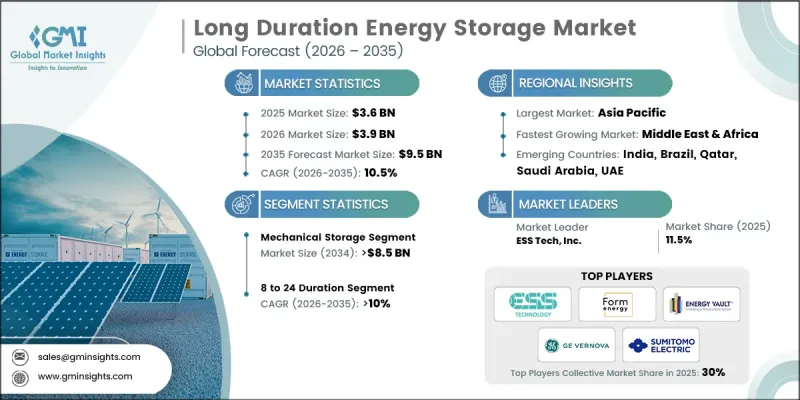
The long duration energy storage (LDES) industry is gaining strong momentum as renewable power generation continues to expand worldwide. With solar and wind contributing a larger share to electricity generation, grid operators are increasingly prioritizing storage systems capable of delivering energy for extended periods. Unlike short-duration batteries, LDES technologies can discharge power for 10 hours or longer, making them essential for maintaining grid balance during prolonged supply fluctuations. The accelerating push toward decarbonization, combined with the need for reliable and resilient electricity networks, is driving investment in advanced storage infrastructure. Power systems must manage variability caused by changing weather conditions and seasonal demand patterns, reinforcing the importance of scalable long-duration solutions. Supportive federal and state-level initiatives are encouraging development across multiple storage pathways. Industry stakeholders are focusing on innovative technologies designed to provide firm capacity, stabilize renewable integration, and enhance long-term grid reliability in evolving energy markets.
| Market Scope | |
|---|---|
| Start Year | 2025 |
| Forecast Year | 2026-2035 |
| Start Value | $3.6 Billion |
| Forecast Value | $9.5 Billion |
| CAGR | 10.5% |
Based on storage duration, the 8 to 24-hour segment is projected to grow at a CAGR of 10% through 2035. Systems capable of delivering electricity within the 8-24-hour and over 24-36-hour ranges play a critical role in addressing daily and multi-day supply imbalances. While shorter-duration batteries manage brief demand shifts, longer-duration systems provide stability during extended periods of reduced renewable output. This capability reduces dependency on conventional peak-generation resources and supports broader decarbonization objectives by enabling consistent renewable energy utilization.
The electromechanical energy storage technologies segment generated significant revenues in 2025, fueled by flywheel systems along with motor-driven mechanical configurations that utilize kinetic or potential energy to store electricity. These solutions are increasingly recognized for their suitability in inter-day and multi-day grid balancing scenarios. Their rapid-response capabilities make them valuable for frequency regulation and grid support services. Additionally, reliance on established industrial components supports faster deployment timelines and cost efficiencies compared to emerging chemical or thermal storage technologies.
U.S. Long Duration Energy Storage Market was valued at USD 813.2 million in 2025. This steady growth trajectory highlights increasing adoption of LDES solutions as integral elements of grid modernization strategies. Rising deployment reflects expanding confidence in long-duration technologies to manage renewable intermittency, enhance system resilience, and strengthen energy security across the United States.
Key companies operating in the Global Long Duration Energy Storage Market include Form Energy, Highview Power, Energy Vault, Inc., ESS Tech, Inc., EOS Energy Enterprise, Invinity Energy Systems, Sumitomo Electric, Malta Inc., Ambri Incorporated, GE Vernova, LG Energy Solutions, Enersys, Storelectric Ltd., VoltStorage, Primus Power, CMBlu Energy AG, RheEnergise Limited, QuantumScape Battery, Inc., Alsym Energy, Inc., Rondo Energy, Inc., e-Zinc Inc., VFlowTech Pte. Ltd., MGA Thermal Pty. Ltd., Lina Energy Ltd., and MAN Energy Solutions. Companies in the Long Duration Energy Storage Market are reinforcing their competitive position through diversified technology development and strategic collaborations. Industry leaders are investing in advanced materials research, system efficiency improvements, and scalable manufacturing processes to lower costs and improve performance. Partnerships with utilities, grid operators, and renewable energy developers are accelerating commercial deployment and demonstration projects. Firms are also pursuing government-backed funding opportunities to support pilot programs and infrastructure expansion. Expanding global supply chains and localized production capabilities are helping companies reduce lead times and enhance reliability.
Table of Contents
Chapter 1 Methodology & Scope
- 1.1 Research design
- 1.2 Market estimates & forecast parameters
- 1.3 Forecast calculation
- 1.4 Data sources
- 1.4.1 Primary
- 1.4.2 Secondary
- 1.4.2.1 Paid
- 1.4.2.2 Public
Chapter 2 Executive Summary
- 2.1 Industry synopsis, 2022- 2035
Chapter 3 Industry Insights
- 3.1 Industry ecosystem analysis
- 3.2 Industry impact forces
- 3.2.1 Growth drivers
- 3.2.2 Industry pitfalls & challenges
- 3.3 Growth potential analysis
- 3.4 Regulatory landscape
- 3.5 Porter's analysis
- 3.5.1 Bargaining power of suppliers
- 3.5.2 Bargaining power of buyers
- 3.5.3 Threat of new entrants
- 3.5.4 Threat of substitutes
- 3.6 PESTEL analysis
- 3.6.1 Political factors
- 3.6.2 Economic factors
- 3.6.3 Social factors
- 3.6.4 Technological factors
- 3.6.5 Legal factors
- 3.6.6 Environmental factors
- 3.7 Emerging opportunities & trends
- 3.7.1 Digitalization & IoT integration
- 3.7.2 Emerging market penetration
- 3.8 Investment analysis & future outlook
Chapter 4 Competitive Landscape, 2026
- 4.1 Introduction
- 4.2 Company market share analysis, by Region, 2025
- 4.2.1 North America
- 4.2.2 Europe
- 4.2.3 Asia Pacific
- 4.2.4 Middle East & Africa
- 4.2.5 Latin America
- 4.3 Strategic initiatives
- 4.4 Competitive benchmarking depictions
- 4.5 Strategy dashboard
- 4.6 Innovation & technology landscape
Chapter 5 Long Duration Energy Storage Market Size and Forecast, By Technology, 2022 - 2035 (USD Million)
- 5.1 Key trends
- 5.2 Mechanical storage
- 5.3 Thermal storage
- 5.4 Electromechanical storage
- 5.5 Chemical storage
Chapter 6 Long Duration Energy Storage Market Size and Forecast, By Duration, 2022 - 2035 (USD Million)
- 6.1 Key trends
- 6.2 8 to 24
- 6.3 > 24 to 36
- 6.4 > 36
Chapter 7 Long Duration Energy Storage Market Size and Forecast, By Capacity, 2022 - 2035 (USD Million)
- 7.1 Key trends
- 7.2 Up to 50 MW
- 7.3 50-100 MW
- 7.4 More than 100 MW
Chapter 8 Long Duration Energy Storage Market Size and Forecast, By Application, 2022 - 2035 (USD Million)
- 8.1 Key trends
- 8.2 Grid management
- 8.3 Power backup
- 8.4 Renewable energy integration
- 8.5 Off grid & microgrid systems
Chapter 9 Long Duration Energy Storage Market Size and Forecast, By Region, 2022 - 2035 (USD Million)
- 9.1 North America
- 9.1.1 U.S.
- 9.1.2 Canada
- 9.1.3 Mexico
- 9.2 Europe
- 9.2.1 UK
- 9.2.2 France
- 9.2.3 Germany
- 9.2.4 Italy
- 9.2.5 Russia
- 9.2.6 Spain
- 9.3 Asia Pacific
- 9.3.1 China
- 9.3.2 Australia
- 9.3.3 India
- 9.3.4 Japan
- 9.3.5 South Korea
- 9.4 Middle East & Africa
- 9.4.1 Saudi Arabia
- 9.4.2 UAE
- 9.4.3 Turkey
- 9.4.4 South Africa
- 9.4.5 Egypt
- 9.5 Latin America
- 9.5.1 Brazil
- 9.5.2 Argentina
Chapter 10 Company Profiles
- 10.1 Sumitomo Electric
- 10.2 ESS Tech, Inc.
- 10.3 EOS Energy Enterprise
- 10.4 Invinity Energy Systems
- 10.5 Energy Vault, Inc.
- 10.6 MAN, Energy Solutions
- 10.7 Highview Power
- 10.8 Primus Power
- 10.9 CMBlu Energy AG
- 10.10 Malta Inc.
- 10.11 RheEnergise Limited
- 10.12 QuantumScape Battery, Inc.
- 10.13 Form Energy
- 10.14 Alsym Energy, Inc.
- 10.15 Ambri Incorporated
- 10.16 VFlowTech Pte. Ltd.
- 10.17 VoltStorage
- 10.18 MGA Thermal Pty. Ltd.
- 10.19 Rondo Energy, Inc.
- 10.20 Lina Energy Ltd.
- 10.21 e-Zinc Inc.
- 10.22 GE Vernova
- 10.23 Enersys
- 10.24 LG Energy Solutions
- 10.25 Store electric Ltd.

