PUBLISHER: Global Market Insights Inc. | PRODUCT CODE: 1982374

PUBLISHER: Global Market Insights Inc. | PRODUCT CODE: 1982374
Middle East Water Heater Market Opportunity, Growth Drivers, Industry Trend Analysis, and Forecast 2026 - 2035
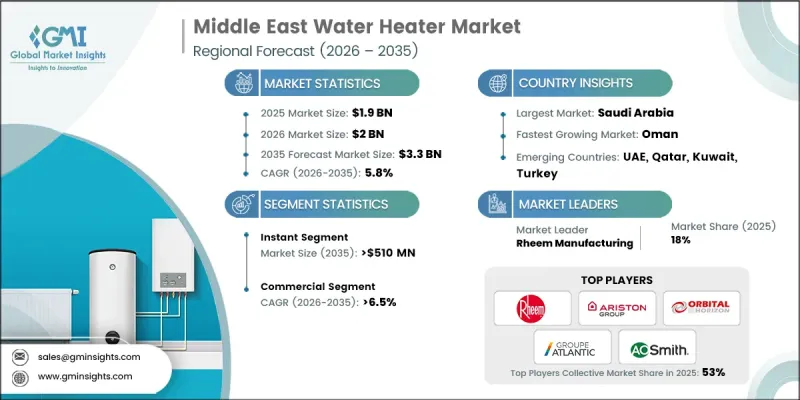
Middle East Water Heater Market was valued at USD 1.9 billion in 2025 and is estimated to grow at a CAGR of 5.8% to reach USD 3.3 billion by 2035.
Market growth is driven by rising disposable income levels and harsh climatic conditions across GCC countries, encouraging both households and commercial establishments to adopt efficient water heating technologies. Demand is increasing for electric and gas-based systems, along with advanced smart and heat pump water heaters that deliver improved energy savings. Large-scale infrastructure expansion, hospitality development, and government-backed energy efficiency initiatives are further accelerating product adoption. Escalating electricity prices and heightened awareness around water conservation are reinforcing the shift toward sustainable and high-efficiency water heating systems. Regulatory measures aimed at reducing power consumption, combined with financial incentives for eco-friendly appliances, are strengthening market penetration. Digital transformation is also shaping the industry, as IoT-enabled smart water heaters gain popularity in urban areas. Expanding installation across residential and commercial properties is broadening the addressable market. Additionally, hybrid systems that combine renewable energy sources with conventional backups are gaining traction in commercial and industrial applications, while smart monitoring technologies support predictive maintenance and optimized energy management.
| Market Scope | |
|---|---|
| Start Year | 2025 |
| Forecast Year | 2026-2035 |
| Start Value | $1.9 Billion |
| Forecast Value | $3.3 Billion |
| CAGR | 5.8% |
The instant water heater segment is expected to reach USD 510 million by 2035, supported by increasing awareness of energy efficiency, rapid urban expansion, and growing demand for compact and user-friendly solutions. Government-led initiatives promoting efficient appliances, particularly in major Middle Eastern economies, are strengthening market prospects. The expansion of urban housing developments and the introduction of space-saving product designs tailored to modern residential layouts are contributing to sustained growth in this segment.
The commercial segment is anticipated to grow at a CAGR of 6.5% through 2035. Industries requiring a consistent and high-volume hot water supply are prioritizing advanced systems that improve operational efficiency and reduce long-term energy costs. In hospitality-driven markets, high-performance water heaters equipped with smart monitoring features are being adopted to lower operational expenses, particularly in regions with elevated energy tariffs.
UAE Water Heater Market is forecast to reach USD 500 million by 2035, driven by the country's emphasis on sustainable construction practices, advanced technology integration, and continuous urbanization. High-efficiency systems aligned with national performance standards are gaining strong acceptance as they contribute to meeting energy reduction goals. Incentive programs encouraging environmentally responsible appliances across residential and commercial sectors are reinforcing demand. Rapid urban development and premium real estate expansion in leading cities are further boosting the need for compact, efficient, and technologically advanced water heating solutions that integrate seamlessly into contemporary building designs.
Key companies operating in the Middle East Water Heater Market include Rheem Manufacturing Company, A. O. Smith Corporation, Ariston Holding, Bosch Thermotechnology, Rinnai Corporation, Vaillant Group, Groupe Atlantic, Bradford White Corporation, Midea Group, Haier Group Corporation, Navien Inc., Ferroli S.p.A, Panasonic Corporation, Stiebel Eltron, Jaquar Group, Atmor Industries Ltd., Powrmatic, ELCO Burner, Orbital Horizon, and Al Jawdah Electric Water Heaters. Companies in the Middle East Water Heater Market are enhancing their competitive position through innovation, localization, and strategic partnerships. Leading manufacturers are investing in smart, IoT-enabled technologies and high-efficiency heat pump systems to align with regional sustainability targets. Many firms are expanding distribution networks and establishing local manufacturing or assembly units to improve supply chain efficiency and reduce costs. Strategic collaborations with real estate developers and infrastructure contractors are strengthening project-based sales opportunities. Product portfolio diversification, including hybrid and compact solutions tailored to urban housing, is supporting differentiation.
Table of Contents
Chapter 1 Methodology & Scope
- 1.1 Research design
- 1.1.1 Research approach
- 1.1.2 Data collection methods
- 1.2 Base estimates and calculations
- 1.2.1 Base year calculation
- 1.2.2 Key trends for market estimates
- 1.3 Forecast model
- 1.3.1 Key trends for market estimates
- 1.3.1.1 Quantified market impact analysis
- 1.3.1.2 Mathematical impact of growth parameters on forecast
- 1.3.2 Scenario analysis framework
- 1.3.1 Key trends for market estimates
- 1.4 Primary research and validation
- 1.4.1 Some of the primary sources (but not limited to)
- 1.5 Data mining sources
- 1.5.1 Paid Sources
- 1.5.2 Sources, by region
- 1.6 Research trail & scoring components
- 1.6.1 Research trail components
- 1.6.2 Scoring components
- 1.7 Research transparency addendum
- 1.7.1 Source attribution framework
- 1.7.2 Quality assurance metrics
- 1.7.3 Our commitment to trust
- 1.8 Market definitions
Chapter 2 Executive Summary
- 2.1 Industry 360-degree synopsis, 2022 - 2035
- 2.2 Business trends
- 2.3 Product trends
- 2.4 Application trends
- 2.5 Capacity trends
- 2.6 End use trends
- 2.7 Country trends
Chapter 3 Industry Insights
- 3.1 Industry ecosystem
- 3.1.1 Raw material availability & sourcing analysis
- 3.1.2 Manufacturing capacity assessment
- 3.1.3 Supply chain resilience & risk factors
- 3.1.4 Distribution network analysis
- 3.2 Regulatory landscape
- 3.3 Industry impact forces
- 3.3.1 Growth drivers
- 3.3.2 Industry pitfalls & challenges
- 3.4 Growth potential analysis
- 3.5 Price trend analysis
- 3.5.1 By capacity
- 3.5.2 By country
- 3.6 Porter's analysis
- 3.6.1 Bargaining power of suppliers
- 3.6.2 Bargaining power of buyers
- 3.6.3 Threat of new entrants
- 3.6.4 Threat of substitutes
- 3.7 PESTEL analysis
- 3.7.1 Political factors
- 3.7.2 Economic factors
- 3.7.3 Social factors
- 3.7.4 Technological factors
- 3.7.5 Legal factors
- 3.7.6 Environmental factors
- 3.8 Emerging opportunities & trends
- 3.8.1 Digitalization & IoT integration
- 3.8.2 Emerging market penetration
- 3.9 Investment analysis and future outlook
Chapter 4 Competitive landscape, 2026
- 4.1 Introduction
- 4.2 Company market share analysis, 2025
- 4.2.1 Saudi Arabia
- 4.2.2 UAE
- 4.2.3 Qatar
- 4.2.4 Kuwait
- 4.2.5 Oman
- 4.2.6 Turkey
- 4.2.7 Iraq
- 4.2.8 Israel
- 4.3 Strategic dashboard
- 4.4 Strategic initiatives
- 4.5 Innovation & technology landscape
Chapter 5 Market Size and Forecast, By Product, 2022 - 2035 (USD Billion & ‘000 Units)
- 5.1 Key trends
- 5.2 Instant
- 5.2.1 Electric
- 5.2.2 Gas
- 5.3 Storage
- 5.3.1 Electric
- 5.3.2 Gas
Chapter 6 Market Size and Forecast, By Application, 2022 - 2035 (USD Billion & ‘000 Units)
- 6.1 Key trends
- 6.2 Residential
- 6.3 Commercial
- 6.3.1 College/University
- 6.3.2 Offices
- 6.3.3 Government/Military
- 6.3.4 Others
Chapter 7 Market Size and Forecast, By Capacity, 2022 - 2035 (USD Billion & ‘000 Units)
- 7.1 Key trends
- 7.2 < 30 Liters
- 7.3 30 - 100 Liters
- 7.4 >100 - 250 Liters
- 7.5 >250 - 400 Liters
- 7.6 > 400 Liters
Chapter 8 Market Size and Forecast, By Fuel, 2022 - 2035 (USD Billion & ‘000 Units)
- 8.1 Key trends
- 8.2 Natural Gas
- 8.3 LPG
Chapter 9 Market Size and Forecast, By Country, 2022 - 2035 (USD Billion & ‘000 Units)
- 9.1 Key trends
- 9.2 Saudi Arabia
- 9.3 UAE
- 9.4 Qatar
- 9.5 Kuwait
- 9.6 Oman
- 9.7 Turkey
- 9.8 Iraq
- 9.9 Israel
Chapter 10 Company Profiles
- 10.1 A. O. Smith Corporation
- 10.2 Al Jawdah Electric Water Heaters
- 10.3 Ariston Holding
- 10.4 Atmor Industries Ltd.
- 10.5 Bosch Thermotechnology
- 10.6 Bradford White Corporation
- 10.7 ELCO Burner
- 10.8 Ferroli S.p.A
- 10.9 Groupe Atlantic
- 10.10 Haier Group Corporation
- 10.11 Jaquar Group
- 10.12 Midea Group
- 10.13 Navien Inc.
- 10.14 Orbital Horizon
- 10.15 Panasonic Corporation
- 10.16 Powrmatic
- 10.17 Rheem Manufacturing Company
- 10.18 Rinnai Corporation
- 10.19 Stiebel Electron
- 10.20 Vaillant Group

