
PUBLISHER: Global Market Insights Inc. | PRODUCT CODE: 1998655

PUBLISHER: Global Market Insights Inc. | PRODUCT CODE: 1998655
Europe Bicycle Market Opportunity, Growth Drivers, Industry Trend Analysis, and Forecast 2026 - 2035
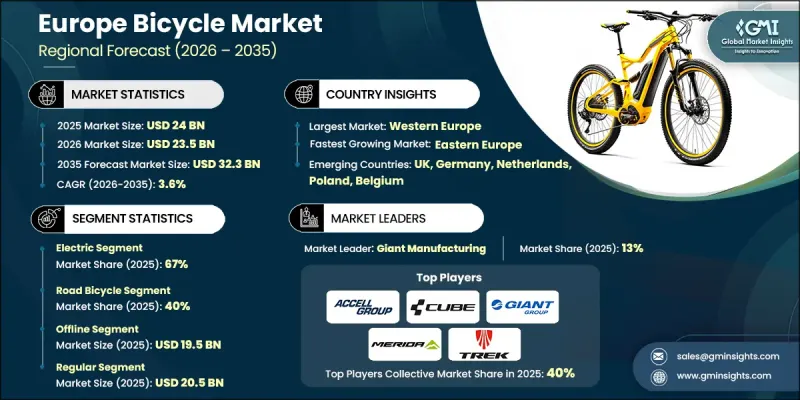
Europe Bicycle Market was valued at USD 24 billion in 2025 and is estimated to grow at a CAGR of 3.6% to reach USD 32.3 billion by 2035.
The growing demand for bicycles across Europe is strongly linked to increasing urban mobility challenges, including persistent traffic congestion, limited parking infrastructure, and pressure on public transportation systems. As cities become more densely populated, bicycles are increasingly viewed as a practical and efficient mode of daily transportation. Regulatory measures aimed at reducing vehicle traffic in urban areas are further encouraging individuals to adopt cycling for short-distance travel and commuting. Although cycling habits differ widely between European countries, participation levels across the region are steadily increasing as governments, city planners, and communities promote sustainable mobility options. In addition, urban logistics is gradually evolving, with businesses and service providers adopting alternative bicycle-based transportation solutions to navigate crowded city environments more efficiently. Electrically assisted bicycles are also gaining traction as they allow riders to cover longer distances with less physical effort, making cycling an appealing transportation choice for commuters traveling across busy metropolitan areas where road congestion and parking shortages remain significant challenges.
| Market Scope | |
|---|---|
| Start Year | 2025 |
| Forecast Year | 2026-2035 |
| Start Value | $24 Billion |
| Forecast Value | $32.3 Billion |
| CAGR | 3.6% |
In 2025, the road bicycle segment held a 40% share. Road bicycles continue to attract strong demand from a wide range of riders, including competitive cyclists and individuals focused on fitness and endurance training. Demand for this segment originates from recreational activities, organized sports participation, and consumers seeking cycling as a lifestyle fitness activity. To remain competitive in the premium segment, manufacturers are increasingly investing in advanced product engineering. Companies are focusing on developing lightweight frame materials, enhancing aerodynamic performance, and integrating advanced drivetrain technologies to improve ride efficiency and overall cycling performance. These innovations are designed to appeal to experienced riders as well as performance-oriented customers seeking high-end bicycle models.
The offline sales channels segment generated USD 19.5 billion in 2025. Traditional retail outlets and wholesale distribution networks remain central to the sale of high-quality bicycles and related components across the region. Many consumers prefer purchasing bicycles through physical retail stores because these locations offer expert guidance, product demonstrations, and professional servicing support. Established distributor networks also play a critical role in connecting international manufacturers with local dealers, enabling efficient product availability in regional markets. The presence of experienced retailers allows consumers to receive personalized recommendations, technical assistance, and maintenance services, which further strengthens the role of offline channels in the overall market distribution structure.
Germany Bicycle Market reached USD 6.6 billion in 2025 supported by strong public policies and sustained investment in cycling infrastructure development. Governments across Western Europe are actively promoting bicycle usage as part of broader initiatives aimed at improving urban mobility, reducing environmental impact, and encouraging healthier lifestyles. Growing environmental awareness, increasing urban traffic, and rising health consciousness among consumers are contributing to the popularity of bicycles and electric bicycles across the region. Electrically assisted bicycles are particularly appealing to commuters seeking convenient transportation options that require less physical effort while covering longer travel distances. Daily commuting has gradually become a major driver of bicycle usage in many urban areas, surpassing purely recreational cycling activities.
Key companies operating in the Europe Bicycle Market include Accell, Canyon Bicycles, Merida Industry, Trek Bicycle, Brompton, Giant Manufacturing, Specialized Bicycle Components Inc., Cube Bikes, Derby Cycle, and Shimano Inc. Companies participating in the Europe Bicycle Market are implementing several strategic initiatives to strengthen their competitive position and expand their market presence. Manufacturers are increasingly investing in research and development to introduce innovative bicycle technologies, including lightweight materials, improved drivetrain systems, and enhanced electric assistance features. Product portfolio diversification is another key strategy, allowing companies to address evolving consumer preferences across commuter, performance, and utility segments. Businesses are also strengthening distribution networks by collaborating with established retailers and expanding their dealership presence across major European markets. In addition, companies are focusing on brand positioning through targeted marketing initiatives that promote cycling as a sustainable and healthy mobility solution.
Table of Contents
Chapter 1 Methodology & Scope
- 1.1 Research approach
- 1.2 Quality Commitments
- 1.2.1 GMI AI policy & data integrity commitment
- 1.2.1.1 Source consistency protocol
- 1.2.1 GMI AI policy & data integrity commitment
- 1.3 Research Trail & Confidence Scoring
- 1.3.1 Research Trail Components
- 1.3.2 Scoring Components
- 1.4 Data Collection
- 1.4.1 Partial list of primary sources
- 1.5 Data mining sources
- 1.5.1 Paid sources
- 1.5.1.1 Sources, by region
- 1.5.1 Paid sources
- 1.6 Base estimates and calculations
- 1.6.1 Base year calculation for any one approach
- 1.7 Forecast
- 1.7.1 Quantified market impact analysis
- 1.7.1.1 Mathematical impact of growth parameters on forecast
- 1.7.1 Quantified market impact analysis
- 1.8 Research transparency addendum
- 1.8.1 Source attribution framework
- 1.8.2 Quality assurance metrics
- 1.8.3 Our commitment to trust
Chapter 2 Executive Summary
- 2.1 Industry 360° synopsis
- 2.2 Key market trends
- 2.2.1 Regional
- 2.2.2 Technology
- 2.2.3 Product
- 2.2.4 Design
- 2.2.5 Distribution Channel
- 2.2.6 End Use
- 2.3 TAM Analysis, 2026-2035
- 2.4 CXO perspectives: Strategic imperatives
Chapter 3 Industry Insights
- 3.1 Industry ecosystem analysis
- 3.1.1 Supplier landscape
- 3.1.2 Cost structure
- 3.1.3 Profit margin
- 3.1.4 Value addition at each stage
- 3.1.5 Vertical integration trends
- 3.1.6 Disruptors
- 3.2 Impact on forces
- 3.2.1 Growth drivers
- 3.2.1.1 E-bikes as the Primary Growth Engine
- 3.2.1.2 Rise of Specialized Segments
- 3.2.1.3 Transformation of Sales Channels
- 3.2.1.4 Government support for eco-friendly transport
- 3.2.2 Industry pitfalls & challenges
- 3.2.2.1 Supply Chain Volatility
- 3.2.2.2 High Cost of E-bikes
- 3.2.3 Market opportunities
- 3.2.3.1 Reshoring & Regional Production
- 3.2.3.2 Smart & Connected Bikes
- 3.2.1 Growth drivers
- 3.3 Technology trends & innovation ecosystem
- 3.3.1 Current technologies
- 3.3.2 Emerging technologies
- 3.4 Growth potential analysis
- 3.5 Regulatory landscape
- 3.5.1 Western Europe
- 3.5.1.1 EU Sustainable Urban Mobility Plans (SUMP)
- 3.5.1.2 European Union Alternative Fuels Infrastructure Regulation (AFIR)
- 3.5.2 Eastern Europe
- 3.5.2.1 Poland National Cycling Strategy
- 3.5.2.2 Portugal National Urban Mobility Plan
- 3.5.3 Northern Europe
- 3.5.3.1 Denmark Cycling Promotion Act
- 3.5.3.2 UK Active Travel Framework
- 3.5.4 Southern Europe
- 3.5.4.1 Spain National Cycling Plan
- 3.5.4.2 Italy Road Safety and Bicycle Carrier Regulations
- 3.5.1 Western Europe
- 3.6 Porter's analysis
- 3.7 PESTEL analysis
- 3.8 Pricing Analysis (Driven by Primary Research)
- 3.8.1 Historical Price Trend Analysis
- 3.8.2 Pricing Strategy by Player Type
- 3.9 Patent analysis (Driven by Primary Research)
- 3.10 Impact of AI & generative AI on the market
- 3.10.1 AI-driven disruption of existing business models
- 3.10.2 Predictive maintenance & bicycle management AI
- 3.10.3 Automated bicycle design optimization
- 3.10.4 Supply chain AI for demand forecasting
- 3.10.5 GenAI use cases & adoption roadmap by segment
- 3.10.5.1 Tread pattern design generation
- 3.10.5.2 Customer service chatbots & technical support
- 3.10.5.3 Marketing content creation
- 3.10.6 Risks, limitations & regulatory considerations
- 3.10.6.1 Data privacy in IoT-enabled smart bicycle
- 3.10.6.2 AI algorithm transparency requirements
- 3.10.6.3 Liability in AI-driven product failures
- 3.10.7 Risks, limitations & regulatory considerations
- 3.11 Production statistics
- 3.11.1 Production hubs
- 3.11.2 Consumption hubs
- 3.11.3 Export and import
- 3.12 Sustainability and environmental aspects
- 3.12.1 Sustainable practices
- 3.12.2 Waste reduction strategies
- 3.12.3 Energy efficiency in production
- 3.12.4 Eco-friendly initiatives
- 3.12.5 Carbon footprint considerations
- 3.13 Forecast assumptions & scenario analysis (Driven by Primary Research)
- 3.13.1 Base Case - key macro & industry variables driving CAGR
- 3.13.2 Optimistic Scenarios - Favorable Macro and Industry Tailwinds
- 3.13.3 Pessimistic Scenario - Macroeconomic slowdown or industry headwinds
Chapter 4 Competitive Landscape, 2025
- 4.1 Introduction
- 4.2 Company market share analysis
- 4.2.1 Western Europe
- 4.2.2 Eastern Europe
- 4.2.3 Northern Europe
- 4.2.4 Southern Europe
- 4.3 Competitive analysis of major market players
- 4.4 Competitive positioning matrix
- 4.5 Key developments
- 4.5.1 Mergers & acquisitions
- 4.5.2 Partnerships & collaborations
- 4.5.3 New product launches
- 4.5.4 Expansion plans and funding
- 4.6 Company Tier Benchmarking
- 4.6.1 Tier classification criteria & qualifying thresholds
- 4.6.2 Tier positioning matrix by revenue, geography & innovation
Chapter 5 Market Estimates & Forecast, By Technology, 2022 - 2035 ($ Bn, Units)
- 5.1 Key trends
- 5.2 Electric
- 5.3 Conventional
Chapter 6 Market Estimates & Forecast, By Product, 2022 - 2035 ($ Bn, Units)
- 6.1 Key trends
- 6.2 Road bicycle
- 6.3 Cargo bicycle
- 6.4 Mountain bicycle
- 6.5 Others
Chapter 7 Market Estimates & Forecast, By Design, 2022 - 2035 ($ Bn, Units)
- 7.1 Key trends
- 7.2 Regular
- 7.3 Folding
Chapter 8 Market Estimates & Forecast, By Distribution Channel, 2022 - 2035 ($ Bn, Units)
- 8.1 Key trends
- 8.2 Offline
- 8.3 Online
Chapter 9 Market Estimates & Forecast, By End Use, 2022 - 2035 ($ Bn, Units)
- 9.1 Key trends
- 9.2 Men
- 9.3 Women
- 9.4 Kids
Chapter 10 Market Estimates & Forecast, By Region, 2022 - 2035 ($ Bn, Units)
- 10.1 Key trends
- 10.2 Western Europe
- 10.2.1 Germany
- 10.2.2 France
- 10.2.3 Netherlands
- 10.2.4 Belgium
- 10.2.5 Switzerland
- 10.2.6 Austria
- 10.2.7 Ireland
- 10.3 Eastern Europe
- 10.3.1 Poland
- 10.3.2 Czech Republic
- 10.3.3 Portugal
- 10.3.4 Serbia
- 10.3.5 Albania
- 10.3.6 Slovakia
- 10.3.7 Romania
- 10.3.8 Estonia
- 10.4 Northern Europe
- 10.4.1 UK
- 10.4.2 Denmark
- 10.4.3 Sweden
- 10.4.4 Norway
- 10.4.5 Iceland
- 10.4.6 Faroe Islands
- 10.5 Southern Europe
- 10.5.1 Italy
- 10.5.2 Spain
- 10.5.3 Greece
- 10.5.4 Cyprus
Chapter 11 Company Profiles
- 11.1 Global players
- 11.1.1 Giant Manufacturing
- 11.1.2 Trek Bicycle
- 11.1.3 Merida Industry
- 11.1.4 Shimano
- 11.1.5 Accell
- 11.1.6 Specialized Bicycle Components
- 11.1.7 Dorel Industries
- 11.1.8 Hero Cycles
- 11.2 Regional players
- 11.2.1 Canyon Bicycles
- 11.2.2 Cube Bikes
- 11.2.3 Derby Cycle
- 11.2.4 Flying Pigeon
- 11.2.5 Riese & Muller
- 11.2.6 Gazelle
- 11.2.7 Focus Bikes
- 11.3 Emerging players
- 11.3.1 VanMoof
- 11.3.2 Rad Power Bikes
- 11.3.3 Cowboy
- 11.3.4 Brompton Bicycle
- 11.3.5 Stromer

