
PUBLISHER: Global Market Insights Inc. | PRODUCT CODE: 1998696

PUBLISHER: Global Market Insights Inc. | PRODUCT CODE: 1998696
Hovercraft Market Opportunity, Growth Drivers, Industry Trend Analysis, and Forecast 2026 - 2035
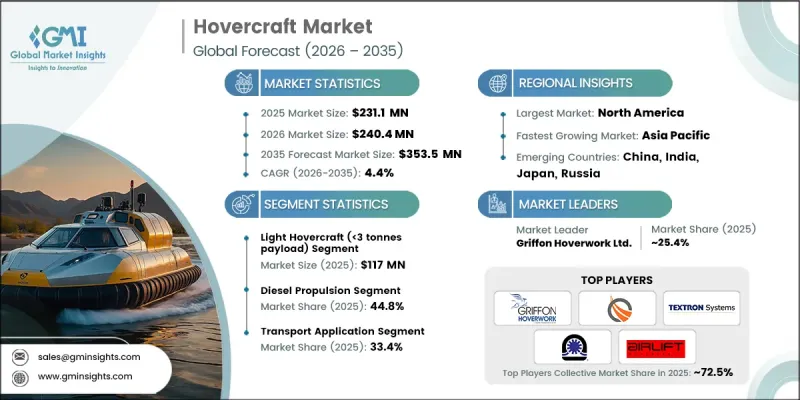
The Global Hovercraft Market was valued at USD 231.1 million in 2025 and is estimated to grow at a CAGR of 4.4% to reach USD 353.5 million in 2035.
Market expansion is driven by rising demand for shallow-water and Arctic patrol deployments, increasing requirements for coastal disaster response, and the growing need for multi-terrain mobility platforms. Agencies are seeking rapid-access solutions capable of operating in sensitive ecosystems such as marshlands, tidal flats, and deltas, which is boosting procurement across defense, energy, and emergency response sectors. Investments in offshore renewable energy, modernization of amphibious fleets, and strategic planning for disaster response are further fueling demand. Modern hovercraft now integrate digital navigation systems, fly-by-wire controls, and advanced situational awareness technology, which improves crew safety and operational precision, particularly in complex littoral and Arctic environments. These technological adoptions are expected to continue through 2030 as part of broader naval and industrial modernization cycles.
| Market Scope | |
|---|---|
| Start Year | 2025 |
| Forecast Year | 2026-2035 |
| Start Value | $231.1 Million |
| Forecast Value | $353.5 Million |
| CAGR | 4.4% |
The light hovercraft segment, weighing less than 3 tonnes, held USD 117 million in 2025. Light hovercraft are highly favored for rescue operations, coastal patrol, tourism, and inland transport across shallow rivers and marshlands. Their affordability, ease of operation, and minimal infrastructure requirements make them ideal for public safety agencies and commercial operators. Their versatility and ability to access remote or hard-to-reach areas maintain strong demand, particularly in emerging economies and coastal regions.
The diesel propulsion systems segment held a 44.8% share in 2025, due to their ability to deliver robust power, reliable performance, and long operational endurance. Diesel-powered hovercraft are essential for heavy-duty military, industrial, and commercial applications, including offshore support and long-range patrol missions. Their established fueling infrastructure, operational dependability, and performance under extreme environmental conditions make them the preferred choice for naval and industrial operators worldwide.
North America Hovercraft Market held a 29.7% share in 2025. Growth in the region is driven by defense modernization programs, expanding coastal patrol operations, and enhanced disaster response requirements. Government agencies are increasingly prioritizing rapid-deployment platforms capable of operating in shallow waters, marshlands, and Arctic conditions. Adoption of next-generation hovercraft with advanced navigation and control systems is rising across military, emergency response, and industrial applications, positioning North America as a global leader in amphibious mobility solutions and operational readiness for the coming decade.
Key players operating in the Global Hovercraft Market include Aerohod Ltd., Airlift Hovercraft Pty Ltd, Christy Hovercraft, Griffon Hoverwork Ltd, Hov Pod Hovercraft, Hoverstream LLC, Hovertechnics, LLC, Kaiman Hovercraft, Neoteric Hovercraft Inc, Pacific Hovercraft, Textron Systems, and Vanair Hovercraft. Companies in the Global Hovercraft Market are adopting multiple strategies to strengthen their market presence and maintain a competitive advantage. They are investing heavily in R&D to develop multi-terrain hovercraft with advanced navigation, fly-by-wire control, and situational awareness systems. Strategic collaborations with defense, emergency response, and industrial operators ensure integration of cutting-edge hovercraft solutions into operational fleets. Expanding production capacity and establishing regional service and maintenance facilities improve operational reach and customer satisfaction. Additionally, firms are leveraging technology licensing, joint ventures, and targeted marketing campaigns that highlight safety, reliability, and environmental versatility to enhance brand visibility and secure long-term contracts across government and commercial segments.
Table of Contents
Chapter 1 Methodology and Scope
- 1.1 Market scope and definition
- 1.2 Research design
- 1.2.1 Research approach
- 1.2.2 Data collection methods
- 1.3 Data mining sources
- 1.3.1 Global
- 1.3.2 Regional/Country
- 1.4 Base estimates and calculations
- 1.4.1 Base year calculation
- 1.4.2 Key trends for market estimation
- 1.5 Primary research and validation
- 1.5.1 Primary sources
- 1.6 Forecast model
- 1.7 Research assumptions and limitations
Chapter 2 Executive Summary
- 2.1 Industry 360° synopsis, 2022 - 2035
- 2.2 Key market trends
- 2.2.1 Payload capacity trends
- 2.2.2 Propulsion type trends
- 2.2.3 Application trends
- 2.2.4 End-user trends
- 2.2.5 Regional trends
- 2.3 TAM Analysis, 2026-2035
- 2.4 CXO perspectives: Strategic imperatives
- 2.4.1 Executive decision points
- 2.4.2 critical success factors
- 2.5 Future outlook and strategic recommendations
Chapter 3 Industry Insights
- 3.1 Industry ecosystem analysis
- 3.1.1 Supplier Landscape
- 3.1.2 Profit Margin
- 3.1.3 Cost structure
- 3.1.4 Value addition at each stage
- 3.1.5 Factor affecting the value chain
- 3.1.6 Disruptions
- 3.2 Industry impact forces
- 3.2.1 Growth drivers
- 3.2.1.1 Rising Arctic and shallow-water patrol deployments
- 3.2.1.2 Expanding offshore wind farm service logistics
- 3.2.1.3 Growth in amphibious military modernization programs
- 3.2.1.4 Oil spill response and environmental monitoring needs
- 3.2.1.5 Increased coastal disaster response requirements
- 3.2.2 Industry pitfalls and challenges
- 3.2.2.1 High fuel consumption and operating costs
- 3.2.2.2 Limited skilled maintenance workforce availability
- 3.2.3 Market opportunities
- 3.2.3.1 Hybrid-electric propulsion system integration
- 3.2.3.2 Autonomous unmanned hovercraft for defense surveillance
- 3.2.1 Growth drivers
- 3.3 Growth potential analysis
- 3.4 Regulatory landscape
- 3.4.1 North America
- 3.4.2 Europe
- 3.4.3 Asia Pacific
- 3.4.4 Latin America
- 3.4.5 Middle East & Africa
- 3.5 Porter's analysis
- 3.6 PESTEL analysis
- 3.7 Technology and Innovation landscape
- 3.7.1 Current technological trends
- 3.7.2 Emerging technologies
- 3.8 Price trends
- 3.8.1 By region
- 3.8.2 By product
- 3.9 Pricing Strategies
- 3.10 Emerging Business Models
- 3.11 Compliance Requirements
- 3.12 Patent and IP analysis
- 3.13 Geopolitical and trade dynamics
Chapter 4 Competitive Landscape, 2025
- 4.1 Introduction
- 4.2 Company market share analysis
- 4.2.1 By region
- 4.2.1.1 North America
- 4.2.1.2 Europe
- 4.2.1.3 Asia Pacific
- 4.2.1.4 Latin America
- 4.2.1.5 Middle East & Africa
- 4.2.2 Market concentration analysis
- 4.2.1 By region
- 4.3 Competitive benchmarking of key players
- 4.3.1 Financial performance comparison
- 4.3.1.1 Revenue
- 4.3.1.2 Profit margin
- 4.3.1.3 R&D
- 4.3.2 Product portfolio comparison
- 4.3.2.1 Product range breadth
- 4.3.2.2 Technology
- 4.3.2.3 Innovation
- 4.3.3 Geographic presence comparison
- 4.3.3.1 Global footprint analysis
- 4.3.3.2 Service network coverage
- 4.3.3.3 Market penetration by region
- 4.3.4 Competitive positioning matrix
- 4.3.4.1 Leaders
- 4.3.4.2 Challengers
- 4.3.4.3 Followers
- 4.3.4.4 Niche players
- 4.3.5 Strategic outlook matrix
- 4.3.1 Financial performance comparison
- 4.4 Key developments
- 4.4.1 Mergers and acquisitions
- 4.4.2 Partnerships and collaborations
- 4.4.3 Technological advancements
- 4.4.4 Expansion and investment strategies
- 4.4.5 Digital transformation initiatives
- 4.5 Emerging/ startup competitors landscape
Chapter 5 Market Estimates and Forecast, By Payload Capacity, 2022 - 2035 (USD Million)
- 5.1 Key trends
- 5.2 Light hovercraft (<3 tonnes payload)
- 5.3 Medium hovercraft (3-25 tonnes payload)
- 5.4 Heavy hovercraft (>25 tonnes payload)
Chapter 6 Market Estimates and Forecast, By Propulsion Type, 2022 - 2035 (USD Million)
- 6.1 Key trends
- 6.2 Gas turbine
- 6.3 Diesel
- 6.4 Petrol
- 6.5 Fully electric
- 6.6 Hybrid-electric
Chapter 7 Market Estimates and Forecast, By Application, 2022 - 2035 (USD Million)
- 7.1 Key trends
- 7.2 Transport
- 7.3 Security & patrol
- 7.4 Emergency response
- 7.5 Offshore/industrial support
- 7.6 Specialized industrial & environmental operations
Chapter 8 Market Estimates and Forecast, By End-User, 2022 - 2035 (USD Million)
- 8.1 Key trends
- 8.2 Defense & military
- 8.3 Civil government agencies
- 8.4 Commercial operators
- 8.5 Private owners
Chapter 9 Market Estimates and Forecast, By Region, 2022 - 2035 (USD Million)
- 9.1 Key trends
- 9.2 North America
- 9.2.1 U.S.
- 9.2.2 Canada
- 9.3 Europe
- 9.3.1 Germany
- 9.3.2 UK
- 9.3.3 France
- 9.3.4 Spain
- 9.3.5 Italy
- 9.3.6 Russia
- 9.4 Asia Pacific
- 9.4.1 China
- 9.4.2 India
- 9.4.3 Japan
- 9.4.4 Australia
- 9.4.5 South Korea
- 9.5 Latin America
- 9.5.1 Brazil
- 9.5.2 Mexico
- 9.5.3 Argentina
- 9.6 Middle East and Africa
- 9.6.1 South Africa
- 9.6.2 Saudi Arabia
- 9.6.3 UAE
Chapter 10 Company Profiles
- 10.1 Global Key Players
- 10.1.1 Griffon Hoverwork Ltd.
- 10.1.2 Textron Systems
- 10.1.3 Airlift Hovercraft Pty Ltd.
- 10.2 Regional key players
- 10.2.1 North America
- 10.2.1.1 Neoteric Hovercraft Inc.
- 10.2.1.2 Hovertechnics, LLC
- 10.2.1.3 Hov Pod Hovercraft
- 10.2.2 Asia Pacific
- 10.2.2.1 Aerohod Ltd.
- 10.2.2.2 Pacific Hovercraft
- 10.2.3 Europe
- 10.2.3.1 Christy Hovercraft
- 10.2.3.2 Vanair Hovercraft
- 10.2.1 North America
- 10.3 Niche Players/Disruptors
- 10.3.1 Hoverstream LLC
- 10.3.2 Kaiman Hovercraft

