
PUBLISHER: Global Market Insights Inc. | PRODUCT CODE: 1998704

PUBLISHER: Global Market Insights Inc. | PRODUCT CODE: 1998704
Male Hypogonadism Market Opportunity, Growth Drivers, Industry Trend Analysis, and Forecast 2026 - 2035
The Global Male Hypogonadism Market was valued at USD 4.2 billion in 2025 and is estimated to grow at a CAGR of 5.4% to reach USD 7.1 billion by 2035.
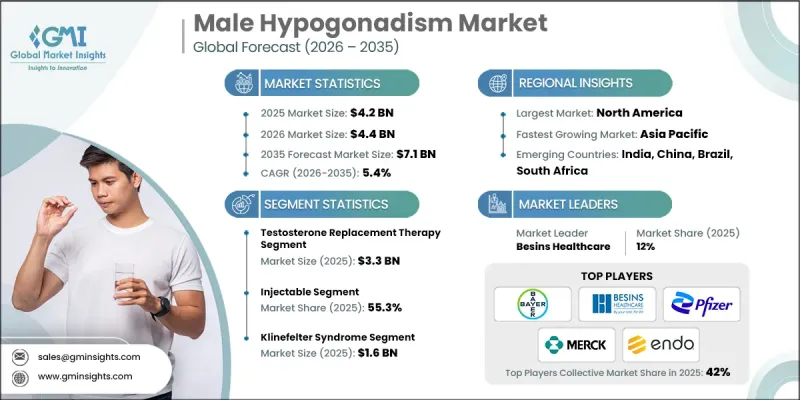
Growing initiatives by healthcare providers, government agencies, and private organizations are focusing on promoting early diagnosis, preventive care, and education around male hypogonadism. This condition occurs when the testicles fail to produce sufficient testosterone or function properly, leading to physical, sexual, and psychological complications. Advancements in testosterone replacement therapy (TRT) are transforming disease management through safer, more effective, and convenient treatment options. Improved formulations, personalized treatment plans, innovative delivery systems, and integration with digital health tools are helping patients maintain stable hormone levels while minimizing side effects. With rising clinical awareness and the adoption of advanced therapeutic options, the market is benefiting from enhanced patient outcomes, stronger healthcare infrastructure, and increased acceptance of long-term management strategies for testosterone deficiency.
| Market Scope | |
|---|---|
| Start Year | 2025 |
| Forecast Year | 2026-2035 |
| Start Value | $4.2 Billion |
| Forecast Value | $7.1 Billion |
| CAGR | 5.4% |
The testosterone replacement therapy segment reached USD 3.3 billion in 2025 and is expected to experience steady growth at a CAGR of 5.5% through 2035. TRT plays a critical role in restoring normal testosterone levels, which improves sexual health, libido, erectile function, and overall well-being. Beyond sexual health, testosterone impacts fat distribution and metabolism, making low levels a contributor to increased visceral fat accumulation. Supportive healthcare policies and regulatory frameworks have expanded patient access to TRT and incentivized research into new therapies. As physicians increasingly focus on precision dosing and personalized management, the adoption of advanced testosterone therapies continues to strengthen market growth.
The injectable segment reached USD 2.3 billion in 2025, representing 55.3% share. Injectable testosterone therapies, such as enanthate and cypionate, provide stable hormone levels, reducing mood fluctuations, fatigue, and libido variations. The ability to precisely adjust dosages allows clinicians to tailor treatment plans for individual patients, optimizing efficacy while minimizing side effects. Injectable formulations remain a preferred option for patients and healthcare providers due to their proven reliability, consistent results, and adaptability in clinical practice.
North America Male Hypogonadism Market accounted for USD 1.8 billion in 2025 and is expected to reach USD 3.3 billion by 2035. The region's strong position is supported by high awareness of men's health, widespread use of TRT, and advanced diagnostic services. Mature healthcare ecosystems, including specialized endocrinology and urology clinics, along with expanding telehealth TRT programs, have facilitated early diagnosis and treatment adoption. The U.S. and Canada benefit from comprehensive hormone testing coverage, robust pharmaceutical presence, and the availability of advanced delivery methods, including transdermal gels, long-acting injectables, and subcutaneous implants. These factors collectively strengthen the market's dominance in the region.
Key players in the Global Male Hypogonadism Market include Antares Pharma, Acerus Pharmaceuticals, Aspen Pharmacare, Aurobindo Pharmaceutical, Bayer AG, Besins Healthcare, Bharat Serums and Vaccines, Eli Lilly and Company, Endo Pharmaceuticals, Lupin Pharmaceuticals, Merck, Simple Pharma, Pfizer, Teva Pharmaceutical Industries, and Viatris. Companies in the Male Hypogonadism Market are pursuing multiple strategies to reinforce their market presence and competitive positioning. They are focusing on developing innovative testosterone formulations with improved bioavailability, extended-release profiles, and patient-friendly delivery systems to enhance treatment adherence. Many are investing in R&D to create personalized therapies tailored to individual hormonal profiles. Strategic partnerships with healthcare providers, clinics, and telehealth platforms are expanding distribution networks and patient access. Additionally, marketing campaigns and educational programs are increasing awareness of men's health issues, supporting early diagnosis and adoption of therapies. Regulatory compliance and engagement with advocacy initiatives further strengthen their credibility and market footprint.
Table of Contents
Chapter 1 Methodology and Scope
- 1.1 Market scope and definition
- 1.2 Research approach
- 1.3 Quality commitments
- 1.3.1 GMI AI policy and data integrity commitment
- 1.3.1.1 Source consistency protocol
- 1.3.1 GMI AI policy and data integrity commitment
- 1.4 Research trail and confidence scoring
- 1.4.1 Research trail components
- 1.4.2 Scoring components
- 1.5 Data collection
- 1.5.1 Partial list of primary sources
- 1.6 Data mining sources
- 1.6.1 Paid sources
- 1.6.1.1 Sources, by region
- 1.6.1 Paid sources
- 1.7 Base estimates and calculations
- 1.7.1 Revenue share analysis
- 1.7.2 Base year calculation
- 1.8 Forecast model
- 1.9 Research transparency addendum
- 1.9.1 Source attribution framework
- 1.9.2 Quality assurance metrics
- 1.10 Our commitment to trust
Chapter 2 Executive Summary
- 2.1 Industry 360° synopsis
- 2.2 Business trends
- 2.2.1 Treatment type trends
- 2.2.2 Route of administration trends
- 2.2.3 Application trends
- 2.2.4 Regional trends
- 2.3 CXO perspectives: Strategic imperatives
Chapter 3 Industry Insights
- 3.1 Industry ecosystem analysis
- 3.2 Industry impact forces
- 3.2.1 Growth drivers
- 3.2.1.1 Increasing awareness and diagnosis
- 3.2.1.2 Rising incidence of hypogonadism
- 3.2.1.3 Advancements in testosterone replacement therapies
- 3.2.1.4 Growth in men’s health and wellness programs
- 3.2.2 Industry pitfalls and challenges
- 3.2.2.1 Safety concerns and side effects
- 3.2.2.2 Stringent regulatory compliance
- 3.2.3 Market opportunity
- 3.2.3.1 Expansion of telemedicine-based TRT platforms
- 3.2.1 Growth drivers
- 3.3 Growth potential analysis
- 3.4 Regulatory landscape
- 3.4.1 North America
- 3.4.2 Europe
- 3.4.3 Asia Pacific
- 3.4.4 Latin America
- 3.4.5 Middle East and Africa
- 3.5 Technological landscape
- 3.5.1 Current technology
- 3.5.1.1 Injectable testosterone formulations as the primary standard of care
- 3.5.1.2 Growing adoption of transdermal gels and patches for stable daily hormone delivery
- 3.5.2 Emerging technology
- 3.5.2.1 Growing focus towards long-acting, controlled-release therapies
- 3.5.2.2 Development of next-generation oral testosterone formulations
- 3.5.2.3 Advancements in microneedle and transdermal delivery systems
- 3.5.1 Current technology
- 3.6 Future market trends
- 3.7 Investment and funding landscape
- 3.8 Pipeline analysis
- 3.9 Porter's analysis
- 3.10 PESTEL analysis
Chapter 4 Competitive Landscape, 2025
- 4.1 Introduction
- 4.2 Company market share analysis
- 4.2.1 Global
- 4.2.2 North America
- 4.2.3 Europe
- 4.2.4 Asia Pacific
- 4.3 Company matrix analysis
- 4.4 Competitive analysis of major market players
- 4.5 Competitive positioning matrix
- 4.6 Key developments
- 4.6.1 Merger and acquisition
- 4.6.2 Partnership and collaboration
- 4.6.3 New product launches
- 4.6.4 Expansion plans
Chapter 5 Market Estimates and Forecast, By Treatment Type, 2022 - 2035 ($ Mn)
- 5.1 Key trends
- 5.2 Testosterone replacement therapy
- 5.3 Gonadotropin therapy
Chapter 6 Market Estimates and Forecast, By Route of Administration, 2022 - 2035 ($ Mn)
- 6.1 Key trends
- 6.2 Injectable
- 6.3 Topical
- 6.4 Oral
Chapter 7 Market Estimates and Forecast, By Application, 2022 - 2035 ($ Mn)
- 7.1 Key trends
- 7.2 Kallmann syndrome
- 7.3 Klinefelter syndrome
- 7.4 Pituitary disorders
- 7.5 Other applications
Chapter 8 Market Estimates and Forecast, By Region, 2022 - 2035 ($ Mn)
- 8.1 Key trends
- 8.2 North America
- 8.2.1 U.S.
- 8.2.2 Canada
- 8.3 Europe
- 8.3.1 Germany
- 8.3.2 UK
- 8.3.3 France
- 8.3.4 Spain
- 8.3.5 Italy
- 8.3.6 Netherlands
- 8.4 Asia Pacific
- 8.4.1 China
- 8.4.2 Japan
- 8.4.3 India
- 8.4.4 Australia
- 8.4.5 South Korea
- 8.5 Latin America
- 8.5.1 Brazil
- 8.5.2 Mexico
- 8.5.3 Argentina
- 8.6 Middle East and Africa
- 8.6.1 South Africa
- 8.6.2 Saudi Arabia
- 8.6.3 UAE
Chapter 9 Company Profiles
- 9.1 Antares Pharma
- 9.2 Acerus Pharmaceuticals
- 9.3 Aspen Pharmacare
- 9.4 Aurobindo Pharmaceutical
- 9.5 Bayer AG
- 9.6 Besins Healthcare
- 9.7 Bharat Serums and Vaccines
- 9.8 Eli Lilly and Company
- 9.9 Endo Pharmaceuticals
- 9.10 Lupin Pharmaceuticals
- 9.11 Merck
- 9.12 Simple Pharma
- 9.13 Pfizer
- 9.14 Teva Pharmaceutical Industries
- 9.15 Viatris

