PUBLISHER: Global Market Insights Inc. | PRODUCT CODE: 1998710

PUBLISHER: Global Market Insights Inc. | PRODUCT CODE: 1998710
Naval-based Remote Weapons Station Market Opportunity, Growth Drivers, Industry Trend Analysis, and Forecast 2026 - 2035
The Global Naval-based Remote Weapons Station Market was valued at USD 1.4 billion in 2025 and is estimated to grow at a CAGR of 6.8% to reach USD 2.7 billion by 2035.
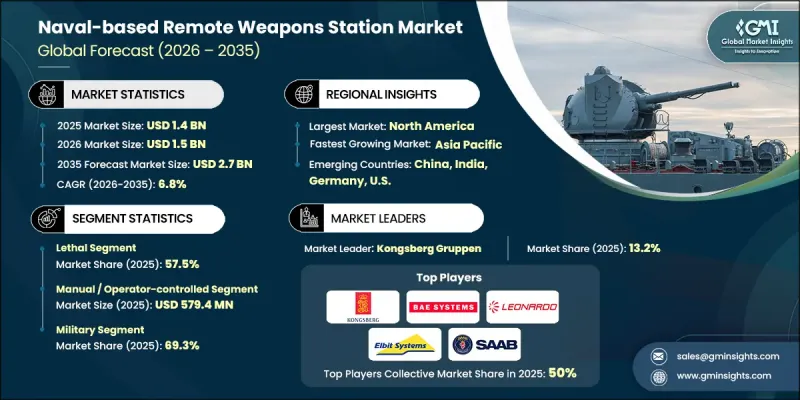
The increasing demand for compact, lightweight, and advanced remote-controlled weapons is being driven by modern naval requirements that prioritize multi-role operational capabilities over sheer firepower. Navies are focusing on asymmetric warfare strategies, which require vessels to handle diverse threats while keeping the crew safe inside the ship. Remote weapons stations enhance maritime defense by enabling operators to engage targets from within the vessel, maintaining effectiveness in rough weather and under hostile conditions. Rising adoption of these systems in both new and retrofitted ships, coupled with growing investment in sensor integration, targeting optics, and medium-caliber weaponry, is propelling market expansion globally. The market is also benefiting from naval modernization programs and increasing budgets for fleet defense upgrades.
| Market Scope | |
|---|---|
| Start Year | 2025 |
| Forecast Year | 2026-2035 |
| Start Value | $1.4 Billion |
| Forecast Value | $2.7 Billion |
| CAGR | 6.8% |
Naval RWS are evolving with features like unmanned vehicle compatibility, modular designs, and advanced sensor fusion, enabling them to meet contemporary operational needs. Developers are designing systems to operate in multiple marine environments while maintaining compliance with international standards. The industry has expanded beyond crewed vessels to include non-crewed platforms, driven by a demand for broader vessel compatibility. Innovations in lightweight materials and efficient power sources are also supporting environmentally responsible operations without compromising performance. These advancements are improving flexibility, reliability, and integration across multi-domain naval missions.
The lethal segment accounted for 57.5% share in 2025. Lethal RWS remain central to modern naval defense, typically outfitted with stabilized cannons, automatic grenade launchers, or heavy machine guns. These systems allow vessels to counter fast attack craft, piracy threats, and asymmetric warfare scenarios with precision while keeping operators protected inside the ship. High demand exists for systems capable of maintaining accuracy in high-speed maneuvers and rough seas, making them essential for fleet modernization programs.
The manual or operator-controlled segment reached USD 579.4 million in 2025. Operator-controlled RWS continue to be vital where human judgment is crucial, allowing real-time decision-making in complex and ambiguous combat scenarios while adhering to rules of engagement and minimizing collateral damage. Ergonomic designs are being emphasized to reduce operator fatigue and enhance accuracy during extended operations, making these systems reliable and operationally effective.
North America Naval-based Remote Weapons Station Market held 38.5% share in 2025. The U.S. market is focusing on technological advancements and fleet capability enhancement. Integration of artificial intelligence and automation into RWS has facilitated autonomous operations and improved targeting precision. Market demand is shifting toward customized systems that can seamlessly integrate with both manned and unmanned platforms, particularly unmanned surface vessels, to support versatile multi-domain naval operations.
Key players operating in the Global Naval-based Remote Weapons Station Market include BAE Systems, Rafael Advanced Defense Systems, Kongsberg Gruppen, MSI-Defence Systems, Leonardo, FN Herstal, and Aselsan. Companies in the Naval-based Remote Weapons Station Market are pursuing strategies such as enhancing R&D for modular and multi-platform systems, expanding into international naval markets, and collaborating with defense agencies to customize solutions for specific fleet requirements. Firms are investing in AI, automation, and advanced sensor integration to improve targeting accuracy and operational efficiency. Strategic partnerships and joint ventures are being leveraged to strengthen supply chains and access emerging markets. Continuous product innovation, upgrades to lethal and non-lethal systems, and robust after-sales support help these companies maintain a competitive advantage while meeting modern naval defense needs.
Table of Contents
Chapter 1 Methodology and Scope
- 1.1 Market scope and definition
- 1.2 Research design
- 1.2.1 Research approach
- 1.2.2 Data collection methods
- 1.3 Data mining sources
- 1.3.1 Global
- 1.3.2 Regional/Country
- 1.4 Base estimates and calculations
- 1.4.1 Base year calculation
- 1.4.2 Key trends for market estimation
- 1.5 Primary research and validation
- 1.5.1 Primary sources
- 1.6 Forecast model
- 1.7 Research assumptions and limitations
Chapter 2 Executive Summary
- 2.1 Industry 360° synopsis, 2022 - 2035
- 2.2 Key market trends
- 2.2.1 Platform trends
- 2.2.2 Degree of autonomy trends
- 2.2.3 Weapon type trends
- 2.2.4 Application type trends
- 2.2.5 Regional trends
- 2.3 TAM Analysis, 2026-2035
- 2.4 CXO perspectives: Strategic imperatives
Chapter 3 Industry Insights
- 3.1 Industry ecosystem analysis
- 3.1.1 Supplier Landscape
- 3.1.2 Profit Margin
- 3.1.3 Cost structure
- 3.1.4 Value addition at each stage
- 3.1.5 Factor affecting the value chain
- 3.1.6 Disruptions
- 3.2 Industry impact forces
- 3.2.1 Growth drivers
- 3.2.1.1 Ongoing global naval modernization efforts
- 3.2.1.2 Escalating regional conflicts and maritime security threats
- 3.2.1.3 Increasing use of unmanned surface vessels (USVs) and drones in naval operations
- 3.2.1.4 Advancements in AI, automation, and sensor technologies
- 3.2.1.5 Focus on crew safety and operational efficiency
- 3.2.2 Industry pitfalls and challenges
- 3.2.2.1 High development and acquisition costs
- 3.2.2.2 Integration with legacy systems
- 3.2.3 Market opportunities
- 3.2.3.1 Retrofitting legacy platforms with stabilized remote weapon systems
- 3.2.3.2 Smart ammunition and precision-guided naval weapon integration
- 3.2.1 Growth drivers
- 3.3 Growth potential analysis
- 3.4 Regulatory landscape
- 3.4.1 North America
- 3.4.2 Europe
- 3.4.3 Asia Pacific
- 3.4.4 Latin America
- 3.4.5 Middle East & Africa
- 3.5 Porter's analysis
- 3.6 PESTEL analysis
- 3.7 Technology and Innovation landscape
- 3.7.1 Current technological trends
- 3.7.2 Emerging technologies
- 3.8 Emerging business models
- 3.9 Compliance requirements
- 3.10 Defense budget analysis
- 3.11 Global defense spending trends
- 3.12 Regional defense budget allocation
- 3.12.1 North America
- 3.12.2 Europe
- 3.12.3 Asia Pacific
- 3.12.4 Middle East and Africa
- 3.12.5 Latin America
- 3.13 Key defense modernization programs
- 3.14 Budget forecast (2025-2034)
- 3.14.1 Impact on industry growth
- 3.14.2 Defense budgets by country
- 3.14.3 Defense budget allocation by segment
- 3.14.3.1 Personnel
- 3.14.3.2 Operations and maintenance
- 3.14.3.3 Procurement
- 3.14.3.4 Research, development, test and evaluation
- 3.14.3.5 Infrastructure and construction
- 3.14.3.6 Technology and innovation
- 3.15 Supply chain resilience
- 3.16 Geopolitical analysis
- 3.17 Workforce analysis
- 3.18 Digital transformation
- 3.19 Mergers, acquisitions, and strategic partnerships landscape
- 3.20 Risk assessment and management
- 3.21 Major contract awards (2022-2025)
Chapter 4 Competitive Landscape, 2025
- 4.1 Introduction
- 4.2 Company market share analysis
- 4.2.1 By region
- 4.2.1.1 North America
- 4.2.1.2 Europe
- 4.2.1.3 Asia Pacific
- 4.2.1.4 Latin America
- 4.2.1.5 Middle East & Africa
- 4.2.2 Market concentration analysis
- 4.2.1 By region
- 4.3 Competitive benchmarking of key players
- 4.3.1 Financial performance comparison
- 4.3.1.1 Revenue
- 4.3.1.2 Profit margin
- 4.3.1.3 R&D
- 4.3.2 Product portfolio comparison
- 4.3.2.1 Product range breadth
- 4.3.2.2 Technology
- 4.3.2.3 Innovation
- 4.3.3 Geographic presence comparison
- 4.3.3.1 Global footprint analysis
- 4.3.3.2 Service network coverage
- 4.3.3.3 Market penetration by region
- 4.3.4 Competitive positioning matrix
- 4.3.4.1 Leaders
- 4.3.4.2 Challengers
- 4.3.4.3 Followers
- 4.3.4.4 Niche players
- 4.3.5 Strategic outlook matrix
- 4.3.1 Financial performance comparison
- 4.4 Key developments
- 4.4.1 Mergers and acquisitions
- 4.4.2 Partnerships and collaborations
- 4.4.3 Technological advancements
- 4.4.4 Expansion and investment strategies
- 4.4.5 Digital transformation initiatives
- 4.5 Emerging/ startup competitors landscape
Chapter 5 Market Estimates and Forecast, By Platform, 2022 - 2035 (USD Million)
- 5.1 Key trends
- 5.2 Destroyers
- 5.3 Frigates
- 5.4 Corvettes
- 5.5 Patrol & mine countermeasures vessels
- 5.6 Offshore patrol vessels (OPVs)
- 5.7 Amphibious vessels
- 5.8 Unmanned surface vehicles
Chapter 6 Market Estimates and Forecast, By Degree of Autonomy, 2022 - 2035 (USD Million)
- 6.1 Key trends
- 6.2 Manual / operator controlled
- 6.3 Semi automated
- 6.4 Fully automated / AI-enabled systems
Chapter 7 Market Estimates and Forecast, By Weapon Type, 2022 - 2035 (USD Million)
- 7.1 Key trends
- 7.2 Lethal weapons
- 7.2.1 Small caliber
- 7.2.1.1 5.56mm
- 7.2.1.2 7.62mm
- 7.2.1.3 12.7mm
- 7.2.2 Medium caliber
- 7.2.2.1 20mm
- 7.2.2.2 25mm
- 7.2.2.3 30mm
- 7.2.2.4 40mm
- 7.2.1 Small caliber
- 7.3 Non-lethal weapons
Chapter 8 Market Estimates and Forecast, By Application, 2022 - 2035 (USD Million)
- 8.1 Key trends
- 8.2 Military
- 8.3 Homeland security
- 8.3.1 Maritime law enforcement
- 8.3.2 Border patrol & anti-smuggling operations
- 8.3.3 Others
Chapter 9 Market Estimates and Forecast, By Region, 2022 - 2035 (USD Million)
- 9.1 Key trends
- 9.2 North America
- 9.2.1 U.S.
- 9.2.2 Canada
- 9.3 Europe
- 9.3.1 Germany
- 9.3.2 UK
- 9.3.3 France
- 9.3.4 Spain
- 9.3.5 Italy
- 9.3.6 Russia
- 9.3.7 Rest of Europe
- 9.4 Asia Pacific
- 9.4.1 China
- 9.4.2 India
- 9.4.3 Japan
- 9.4.4 Australia
- 9.4.5 South Korea
- 9.4.6 Rest of Asia Pacific
- 9.5 Latin America
- 9.5.1 Brazil
- 9.5.2 Mexico
- 9.5.3 Argentina
- 9.5.4 Rest of Latin America
- 9.6 Middle East and Africa
- 9.6.1 South Africa
- 9.6.2 Saudi Arabia
- 9.6.3 UAE
- 9.6.4 Rest of Middle East & Africa
Chapter 10 Company Profiles
- 10.1 Global Key Players
- 10.1.1 BAE Systems
- 10.1.2 Leonardo
- 10.1.3 Rheinmetall AG
- 10.1.4 Northrop Grumman
- 10.1.5 Raytheon Technologies
- 10.1.6 Thales Group
- 10.1.7 General Dynamics
- 10.2 Regional key players
- 10.2.1 Rafael Advanced Defense Systems
- 10.2.2 Kongsberg Gruppen
- 10.2.3 Aselsan
- 10.2.4 FN Herstal
- 10.2.5 Israel Aerospace Industries
- 10.2.6 KNDS
- 10.2.7 Saab
- 10.2.8 Elbit Systems
- 10.3 Niche Players/Disruptors
- 10.3.1 MSI-Defence Systems
- 10.3.2 Electro Optic Systems
- 10.3.3 EM&E GROUP

