PUBLISHER: Global Market Insights Inc. | PRODUCT CODE: 1998734

PUBLISHER: Global Market Insights Inc. | PRODUCT CODE: 1998734
All-Terrain Vehicle (ATV) Market Opportunity, Growth Drivers, Industry Trend Analysis, and Forecast 2026 - 2035
The Global All-Terrain Vehicle (ATV) Market was valued at USD 2.8 billion in 2025 and is estimated to grow at a CAGR of 4.5% to reach USD 4.4 billion by 2035.
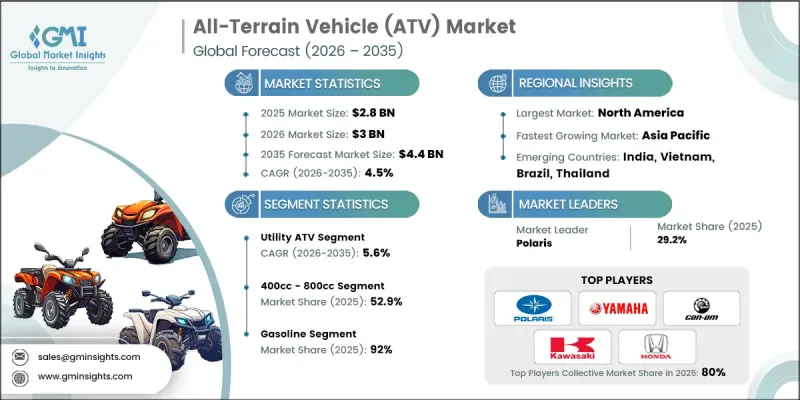
Growth in the all-terrain vehicle market is largely supported by increasing participation in outdoor activities and the growing need for vehicles capable of navigating challenging landscapes. As interest in outdoor recreation continues to rise, consumers are increasingly seeking vehicles designed for reliable off-road mobility and access to remote areas. At the same time, industries that operate in rugged environments are contributing to the demand for durable and versatile transportation solutions. The expanding use of all-terrain vehicles in professional applications such as agriculture and land management is also strengthening market development. These vehicles provide mobility and operational efficiency in areas where conventional transportation options are less practical. Regulatory frameworks and land management policies are also influencing the direction of the market, encouraging manufacturers to design vehicles that comply with environmental standards and usage guidelines. In response, companies are introducing innovative vehicle designs that focus on improved performance, durability, and sustainability. The gradual adoption of electric all-terrain vehicles is also emerging as an important trend as industries and recreational users look for environmentally responsible alternatives.
| Market Scope | |
|---|---|
| Start Year | 2025 |
| Forecast Year | 2026-2035 |
| Start Value | $2.8 Billion |
| Forecast Value | $4.4 Billion |
| CAGR | 4.5% |
The utility ATV segment held 56% share in 2025 and is projected to grow at a CAGR of 5.6% between 2026 and 2035. Demand for these vehicles is largely supported by their practical applications in sectors that require reliable transportation across uneven or difficult terrain. Utility all-terrain vehicles are widely utilized for operational activities that require mobility and equipment handling in outdoor environments. Their versatility and durability make them suitable for tasks that involve the transportation of materials, routine inspections, and general field operations. As industries continue to prioritize efficiency in outdoor work environments, the demand for vehicles that can support these functions is expected to remain strong. The increasing mechanization of land management and agricultural operations also contributes to the consistent adoption of utility-focused all-terrain vehicles.
The gasoline segment held a share of 92% in 2025. Gasoline-powered vehicles remain widely preferred due to their dependable performance and the convenience of refueling infrastructure. These vehicles continue to support a broad range of operational and recreational uses where a reliable energy supply is essential. The extensive availability of gasoline refueling points across many regions ensures consistent access to fuel, which strengthens the continued adoption of gasoline-powered all-terrain vehicles. Their strong engine performance and long operational range make them suitable for demanding applications in remote environments where consistent vehicle performance is critical.
United States All-Terrain Vehicle (ATV) Market accounted for 85% share, generating USD 1.7 billion in 2025. The market in the country is well established and operates within a structured regulatory environment that emphasizes safety, land usage guidelines, and vehicle standards. Demand for all-terrain vehicles is particularly strong in rural areas where off-road mobility plays a key role in daily operations. The widespread use of these vehicles in agricultural and land management activities supports steady market demand. Large land areas used for farming and ranching create consistent requirements for reliable transportation across extensive properties. In addition, recreational off-road activities remain an important contributor to market demand, supported by designated trails and accessible outdoor spaces that encourage responsible vehicle use.
Key companies participating in the Global All-Terrain Vehicle (ATV) Market include Polaris, Yamaha, Honda, Kawasaki, Suzuki, Arctic Cat, BRP, Textron, CFMoto, and Kymco. Companies operating in the Global All-Terrain Vehicle (ATV) Market are focusing on several strategic initiatives to strengthen their competitive position and expand their market reach. Product innovation remains a primary strategy, with manufacturers investing in advanced vehicle technologies that enhance durability, performance, and user safety. Many companies are also developing electric and environmentally friendly vehicle options to align with evolving environmental regulations and sustainability goals. Strategic partnerships with distributors and regional dealers are helping manufacturers expand their presence across key geographic markets. Additionally, firms are increasing investments in research and development to improve vehicle efficiency and introduce new features that enhance user experience. Expanding production capacity and strengthening supply chain networks are also helping companies respond effectively to growing global demand for all-terrain vehicles.
Table of Contents
Chapter 1 Methodology
- 1.1 Research approach
- 1.2 Quality Commitments
- 1.2.1 GMI AI policy & data integrity commitment
- 1.2.1.1 Source consistency protocol
- 1.2.1 GMI AI policy & data integrity commitment
- 1.3 Research Trail & Confidence Scoring
- 1.3.1 Research Trail Components
- 1.3.2 Scoring Components
- 1.4 Data Collection
- 1.4.1 Partial list of primary sources
- 1.5 Data mining sources
- 1.5.1 Paid sources
- 1.5.1.1 Sources, by region
- 1.5.1 Paid sources
- 1.6 Base estimates and calculations
- 1.6.1 Base year calculation for any one approach
- 1.7 Forecast model
- 1.7.1 Quantified market impact analysis
- 1.7.1.1 Mathematical impact of growth parameters on forecast
- 1.7.1 Quantified market impact analysis
- 1.8 Research transparency addendum
- 1.8.1 Source attribution framework
- 1.8.2 Quality assurance metrics
- 1.8.3 Our commitment to trust
Chapter 2 Executive Summary
- 2.1 Industry 360° synopsis, 2022 - 2035
- 2.2 Key market trends
- 2.2.1 Regional
- 2.2.2 Vehicle
- 2.2.3 Displacement
- 2.2.4 Fuel
- 2.2.5 Drive
- 2.2.6 Application
- 2.3 TAM Analysis, 2026-2035
- 2.4 CXO perspectives: Strategic imperatives
Chapter 3 Industry Insights
- 3.1 Industry ecosystem analysis
- 3.1.1 Supplier landscape
- 3.1.2 Profit margin analysis
- 3.1.3 Cost structure
- 3.1.4 Value addition at each stage
- 3.1.5 Factor affecting the value chain
- 3.1.6 Disruptions
- 3.2 Industry impact forces
- 3.2.1 Growth drivers
- 3.2.1.1 Growth in outdoor recreation participation
- 3.2.1.2 Expansion of precision agriculture practices
- 3.2.1.3 Rising rural infrastructure and land management spending
- 3.2.1.4 Product innovation in powertrain and suspension systems
- 3.2.2 Industry pitfalls and challenges
- 3.2.2.1 Safety concerns and accident rates
- 3.2.2.2 Environmental restrictions on off road access
- 3.2.3 Market opportunities
- 3.2.3.1 Electrification of off-road vehicles
- 3.2.3.2 Growth in defense and border surveillance applications
- 3.2.3.3 Aftermarket accessories and performance upgrades
- 3.2.1 Growth drivers
- 3.3 Growth potential analysis
- 3.4 Regulatory landscape
- 3.4.1 North America
- 3.4.1.1 United States all terrain vehicle safety regulations and Consumer Product Safety Commission guidelines
- 3.4.1.2 Federal land access and off road vehicle management rules
- 3.4.1.3 Emission standards for off road spark ignition engines
- 3.4.1.4 Canada off road vehicle safety and provincial registration requirements
- 3.4.2 Europe
- 3.4.2.1 European Union type approval framework for quadricycles and off road vehicles
- 3.4.2.2 ECE vehicle safety and braking system regulations
- 3.4.2.3 Country level homologation and road use restrictions
- 3.4.2.4 Environmental and noise emission compliance standards
- 3.4.3 Asia Pacific
- 3.4.3.1 China off road vehicle manufacturing and emission standards
- 3.4.3.2 India quadricycle and off highway vehicle homologation norms
- 3.4.3.3 Japan vehicle safety and small off road mobility guidelines
- 3.4.3.4 Australia off road vehicle design and safety requirements
- 3.4.3.5 ASEAN regional vehicle certification frameworks
- 3.4.4 Latin America
- 3.4.4.1 Brazil off road vehicle safety and environmental compliance rules
- 3.4.4.2 Argentina vehicle registration and usage regulations
- 3.4.4.3 Mexico manufacturing standards and safety compliance
- 3.4.4.4 Regional off road vehicle regulatory frameworks
- 3.4.5 Middle East & Africa
- 3.4.5.1 UAE off road vehicle licensing and desert operation rules
- 3.4.5.2 Saudi Arabia vehicle safety and inspection standards
- 3.4.5.3 South Africa off road vehicle registration and safety requirements
- 3.4.1 North America
- 3.5 Porter's analysis
- 3.6 PESTEL analysis
- 3.7 Technology and innovation landscape
- 3.7.1 Current technological trends
- 3.7.2 Emerging technologies
- 3.8 Pricing Analysis (Driven by primary research)
- 3.8.1 Historical Price Trend Analysis
- 3.8.2 Pricing Strategy by Player Type
- 3.9 Trade Data Analysis (Driven by paid database)
- 3.9.1 Import/export volume & value trends
- 3.9.2 Key trade corridors & tariff impact
- 3.10 Capacity & Production Landscape (Driven by primary research)
- 3.10.1 Installed Capacity by Region & Key Producer
- 3.10.2 Capacity Utilization Rates & Expansion Pipelines
- 3.11 Cost breakdown analysis
- 3.12 Patent analysis (Driven by primary research)
- 3.13 Sustainability and environmental aspects
- 3.13.1 Sustainable practices
- 3.13.2 Waste reduction strategies
- 3.13.3 Energy efficiency in production
- 3.13.4 Eco-friendly Initiatives
- 3.13.5 Carbon footprint considerations
- 3.14 Impact of AI and Generative AI on the Market
- 3.14.1 AI Driven Disruption of Existing Business Models
- 3.14.2 GenAI Use Cases and Adoption Roadmap by Segment
- 3.14.3 Risks Limitations and Regulatory Considerations
- 3.15 Forecast assumptions & scenario analysis (Driven by primary research)
- 3.15.1 Base Case- Key Macro & Industry Variables Driving CAGR
- 3.15.2 Optimistic Scenarios- Favorable macro and industry tailwinds
- 3.15.3 Pessimistic Scenario - Macroeconomic slowdown or industry headwinds
Chapter 4 Competitive Landscape, 2025
- 4.1 Introduction
- 4.2 Company market share analysis
- 4.2.1 North America
- 4.2.2 Europe
- 4.2.3 Asia Pacific
- 4.2.4 LATAM
- 4.2.5 MEA
- 4.3 Competitive analysis of major market players
- 4.4 Competitive positioning matrix
- 4.5 Key developments
- 4.5.1 Mergers & acquisitions
- 4.5.2 Partnerships & collaborations
- 4.5.3 New Product Launches
- 4.5.4 Expansion Plans and funding
Chapter 5 Market Estimates & Forecast, By Vehicle, 2022 - 2035 (USD Mn, Units)
- 5.1 Key trends
- 5.2 Utility ATV
- 5.3 Sport ATV
- 5.4 Recreational ATV
- 5.5 Youth ATV
Chapter 6 Market Estimates & Forecast, By Displacement, 2022 - 2035 (USD Mn, Units)
- 6.1 Key trends
- 6.2 Below 400cc
- 6.3 400cc - 800cc
- 6.4 Above 800cc
Chapter 7 Market Estimates & Forecast, By Fuel, 2022 - 2035 (USD Mn, Units)
- 7.1 Key trends
- 7.2 Gasoline
- 7.3 Electric
Chapter 8 Market Estimates & Forecast, By Drive, 2022 - 2035 (USD Mn, Units)
- 8.1 Key trends
- 8.2 2-Wheel Drive (2WD)
- 8.3 4-Wheel Drive (4WD)
- 8.4 All-Wheel Drive (AWD)
Chapter 9 Market Estimates & Forecast, By Application, 2022 - 2035 (USD Mn, Units)
- 9.1 Key trends
- 9.2 Agriculture & Farming
- 9.3 Forestry
- 9.4 Military & Defense
- 9.5 Sports & Racing
- 9.6 Recreation & Tourism
- 9.7 Industrial & Utility Services
- 9.8 Others
Chapter 10 Market Estimates & Forecast, By Region, 2022 - 2035 (USD Mn, Units)
- 10.1 Key trends
- 10.2 North America
- 10.2.1 US
- 10.2.2 Canada
- 10.3 Europe
- 10.3.1 Germany
- 10.3.2 UK
- 10.3.3 France
- 10.3.4 Italy
- 10.3.5 Spain
- 10.3.6 Russia
- 10.3.7 Norway
- 10.3.8 Netherlands
- 10.3.9 Sweden
- 10.4 Asia Pacific
- 10.4.1 China
- 10.4.2 India
- 10.4.3 Japan
- 10.4.4 Australia
- 10.4.5 South Korea
- 10.4.6 Singapore
- 10.4.7 Thailand
- 10.4.8 Indonesia
- 10.4.9 Vietnam
- 10.5 Latin America
- 10.5.1 Brazil
- 10.5.2 Mexico
- 10.5.3 Argentina
- 10.6 MEA
- 10.6.1 South Africa
- 10.6.2 Saudi Arabia
- 10.6.3 UAE
- 10.6.4 Turkey
Chapter 11 Company Profiles
- 11.1 Global Players
- 11.1.1 BRP
- 11.1.2 Honda
- 11.1.3 Kawasaki
- 11.1.4 Polaris
- 11.1.5 Suzuki
- 11.1.6 Textron
- 11.1.7 Yamaha
- 11.2 Regional Players
- 11.2.1 Arctic Cat
- 11.2.2 Italika
- 11.2.3 John Deere
- 11.2.4 Kubota
- 11.2.5 Kymco
- 11.2.6 TGB
- 11.3 Emerging Players / Disruptors
- 11.3.1 Apollo
- 11.3.2 Bashan
- 11.3.3 CFMoto
- 11.3.4 Coolster
- 11.3.5 Hisun
- 11.3.6 Linhai
- 11.3.7 Taotao

