PUBLISHER: Global Market Insights Inc. | PRODUCT CODE: 1998770

PUBLISHER: Global Market Insights Inc. | PRODUCT CODE: 1998770
North America Hybrid Microgrid Market Opportunity, Growth Drivers, Industry Trend Analysis, and Forecast 2026 - 2035
North America Hybrid Microgrid Market was valued at USD 880.3 million in 2025 and is estimated to grow at a CAGR of 6.2% to reach USD 1.79 billion by 2035.
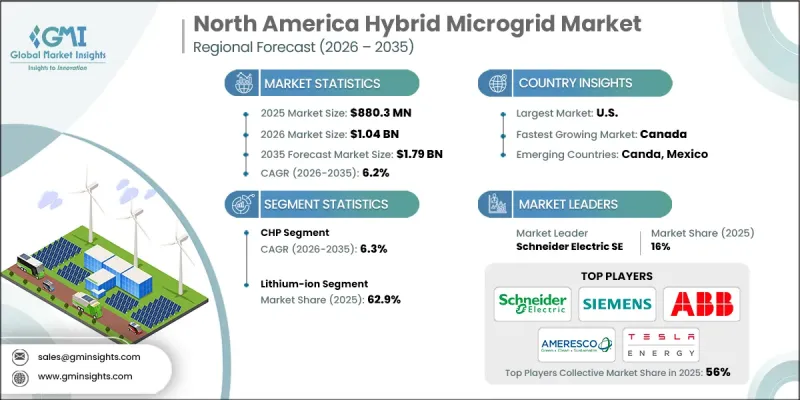
Increasing concerns about power reliability are driving utilities, campuses, and industrial facilities across the region to consider hybrid microgrids as a reliable solution for maintaining operations when the main grid fails. Organizations are recognizing the benefits of localized energy management, faster outage response, and systems that efficiently balance renewable energy inputs with storage. This growing emphasis on resilient electricity supply is boosting hybrid microgrid adoption, particularly as communities seek dependable energy during extreme weather events and address aging infrastructure challenges. Advancements in control software, predictive maintenance, and real-time energy monitoring are enhancing the appeal of hybrid microgrids, allowing commercial and institutional users to optimize loads, automate operations, and integrate multiple energy assets with reduced complexity. As grid edge technologies evolve, hybrid microgrids are increasingly seen as a modern, data-driven approach to energy management and operational continuity.
| Market Scope | |
|---|---|
| Start Year | 2025 |
| Forecast Year | 2026-2035 |
| Start Value | $880.3 Million |
| Forecast Value | $1.79 Billion |
| CAGR | 6.2% |
The CHP segment held a 40.3% share in 2025 and is projected to grow at a CAGR of 6.3% through 2035. The integration of CHP with hybrid microgrids ensures uninterrupted thermal and electrical output while providing redundancy, distributed control, and seamless islanding during grid outages. This combination offers a highly reliable energy platform, strengthening adoption across industrial and institutional applications.
The lithium-ion storage segment held 62.9% share in 2025 and is expected to grow at a CAGR of 6.9% from 2026 to 2035. Lithium-ion batteries provide fast response times, high efficiency, and dependable peak shaving capabilities, encouraging utilities and businesses to include them in hybrid microgrid setups. Expanding domestic lithium-ion production in the U.S. is further boosting confidence in supply reliability and long-term system support, promoting broader deployment.
U.S. Hybrid Microgrid Market is anticipated to reach USD 1.3 billion by 2035. Government incentives, including tax credits, renewable portfolio standards, and targeted grants, are lowering initial costs and enabling long-term planning for hybrid microgrid projects. Increasing exposure to hurricanes, wildfires, and grid-disruptive events is encouraging organizations and communities to adopt resilient energy solutions that maintain operations under crisis conditions.
Key players in the North America Hybrid Microgrid Market include FlexGen Power Systems, Piller Power Systems, HomER Energy, ABB, BoxPower Inc, Schneider Electric SE, Siemens AG, Honeywell International, Langley Holdings, ENGIE, S&C Electric Company, Tesla Energy, Yanmar Holdings Co., Ltd, Caterpillar Inc., Clarke Energy, PowerSecure, MTU Solution, Danfoss, and General Electric. Companies in the North America Hybrid Microgrid Market are strengthening their presence through strategic investments in research and development, focusing on enhancing system efficiency, automation, and energy optimization. They are expanding service networks and providing integrated energy solutions tailored to commercial, industrial, and institutional clients. Partnerships with technology providers and local governments help facilitate large-scale deployments. Firms are also leveraging software-driven platforms for predictive maintenance, real-time monitoring, and asset integration to offer superior operational reliability. Incentives for renewable integration and energy resilience, combined with educational initiatives and demonstration projects, improve market awareness and adoption, while strategic pricing and financing solutions enable broader accessibility across diverse customer segments.
Table of Contents
Chapter 1 Methodology & Scope
- 1.1 Research design
- 1.2 Quality commitment
- 1.2.1 GMI AI policy & data integrity commitment
- 1.2.1.1 Source consistency protocol
- 1.2.1 GMI AI policy & data integrity commitment
- 1.3 Research trail & confidence scoring
- 1.3.1 Research trail components
- 1.3.2 Scoring components
- 1.4 Data Collection
- 1.4.1 Partial list of primary sources
- 1.5 Data mining sources
- 1.5.1 Paid sources
- 1.5.1.1 Sources, by region
- 1.5.1 Paid sources
- 1.6 Base estimates and calculations
- 1.6.1 Base year calculation for any one approach
- 1.7 Forecast model
- 1.8 Research transparency addendum
- 1.8.1 Source attribution framework
- 1.8.2 Quality assurance metrics
- 1.8.3 Our commitment to trust
- 1.9 Market definitions
Chapter 2 Executive Summary
- 2.1 Industry synopsis, 2022 - 2035
- 2.2 Business trends
- 2.3 Connectivity trends
- 2.4 Power source trends
- 2.5 Storage device trends
- 2.6 Application trends
- 2.7 Country trends
Chapter 3 Industry Insights
- 3.1 Industry ecosystem
- 3.1.1 Raw material availability & sourcing analysis
- 3.1.2 Manufacturing capacity assessment
- 3.1.3 Supply chain resilience & risk factors
- 3.1.4 Distribution network analysis
- 3.2 Regulatory landscape
- 3.3 Industry impact forces
- 3.3.1 Growth drivers
- 3.3.2 Industry pitfalls & challenges
- 3.4 Growth potential analysis
- 3.5 Porter's analysis
- 3.5.1 Bargaining power of suppliers
- 3.5.2 Bargaining power of buyers
- 3.5.3 Threat of new entrants
- 3.5.4 Threat of substitutes
- 3.6 PESTEL analysis
- 3.6.1 Political factors
- 3.6.2 Economic factors
- 3.6.3 Social factors
- 3.6.4 Technological factors
- 3.6.5 Legal factors
- 3.6.6 Environmental factors
- 3.7 Cost structure analysis
- 3.8 Price trend analysis (USD/MW)
- 3.8.1 By connectivity
- 3.8.2 By country
- 3.9 Emerging opportunities & trends
- 3.9.1 Digitalization & IoT integration
- 3.9.2 Emerging market penetration
- 3.10 Investment analysis and future outlook
Chapter 4 Competitive landscape, 2026
- 4.1 Introduction
- 4.2 Company market share analysis, by country, 2025
- 4.2.1 U.S.
- 4.2.2 Canada
- 4.2.3 Mexico
- 4.3 Competitive benchmarking
- 4.4 Key developments
- 4.4.1 Mergers & acquisitions
- 4.4.2 Partnerships & collaborations
- 4.4.3 New product launches
- 4.4.4 Expansion plans and funding
Chapter 5 Market Size and Forecast, By Connectivity, 2022 - 2035 (USD Million & MW)
- 5.1 Key trends
- 5.2 Grid connected
- 5.3 Off grid
Chapter 6 Market Size and Forecast, By Power Source, 2022 - 2035 (USD Million & MW)
- 6.1 Key trends
- 6.2 Diesel generators
- 6.3 Natural gas
- 6.4 Solar PV
- 6.5 CHP
- 6.6 Others
Chapter 7 Market Size and Forecast, By Storage Device, 2022 - 2035 (USD Million & MW)
- 7.1 Key trends
- 7.2 Lithium-ion
- 7.3 Lead acid
- 7.4 Flow battery
- 7.5 Flywheels
- 7.6 Others
Chapter 8 Market Size and Forecast, By Application, 2022 - 2035 (USD Million & MW)
- 8.1 Key trends
- 8.2 Healthcare
- 8.3 Educational institutes
- 8.4 Military
- 8.5 Utility
- 8.6 Industrial/ commercial
- 8.7 Remote
- 8.8 Others
Chapter 9 Market Size and Forecast, By Country, 2022 - 2035 (USD Million & MW)
- 9.1 Key trends
- 9.2 U.S.
- 9.3 Canada
- 9.4 Mexico
Chapter 10 Company Profiles
- 10.1 ABB
- 10.2 Ameresco
- 10.3 BoxPower Inc
- 10.4 Caterpillar Inc.
- 10.5 Clarke Energy
- 10.6 ENGIE
- 10.7 FlexGen Power Systems
- 10.8 General Electric
- 10.9 HOMER Energy
- 10.10 Honeywell International
- 10.11 Langley Holdings
- 10.12 MTU Solution
- 10.13 Piller Power Systems
- 10.14 PowerSecure
- 10.15 S&C Electric Company
- 10.16 Schneider Electric SE
- 10.17 Siemens AG
- 10.18 Stellae Energy
- 10.19 Tesla Energy
- 10.20 Yanmar Holdings Co., Ltd

