PUBLISHER: Global Market Insights Inc. | PRODUCT CODE: 1998779

PUBLISHER: Global Market Insights Inc. | PRODUCT CODE: 1998779
Residential Cooling Meters Market Opportunity, Growth Drivers, Industry Trend Analysis, and Forecast 2026 - 2035
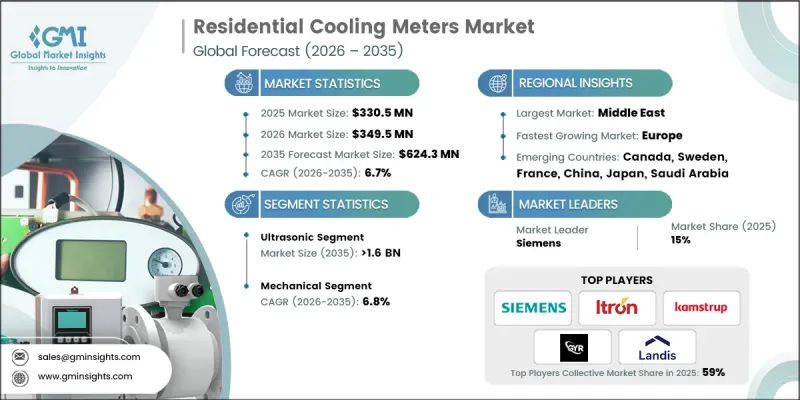
The Global Residential Cooling Meters Market was valued at USD 330.5 million in 2025 and is estimated to grow at a CAGR of 6.7% to reach USD 624.3 million by 2035.
Cooling meters are essential devices that track the energy consumed by air conditioning systems or district cooling networks in residential units, ensuring fair billing and optimized energy usage. Market expansion is being driven by increasing adoption of IoT-enabled smart home platforms that allow residents to monitor and control cooling consumption in real time. Rising demand in regions with extreme climates, such as the Middle East and Asia Pacific, is further encouraging the installation of individual cooling meters in multi-unit residential buildings. Sustainability initiatives, environmental regulations, and government incentives for energy-efficient solutions are prompting property owners to replace traditional mechanical meters with smart and ultrasonic alternatives. Additionally, the growing number of smart city projects and urban infrastructure developments is supporting widespread adoption of advanced cooling metering systems.
| Market Scope | |
|---|---|
| Start Year | 2025 |
| Forecast Year | 2026-2035 |
| Start Value | $330.5 Million |
| Forecast Value | $624.3 Million |
| CAGR | 6.7% |
The ultrasonic cooling meters segment is expected to reach USD 1.6 billion by 2035, owing to their ability to deliver highly accurate readings of cooling energy consumption. Governments and utilities are promoting more precise metering systems to improve energy management, enabling residents to optimize cooling usage and lower overall consumption. Features such as remote reading eliminate manual data collection, providing significant benefits in multi-residential buildings.
The mechanical cooling meters segment is expected to grow at a CAGR of 6.8% by 2035, driven by regulatory requirements, affordability, and strong demand from low- to mid-income households. Their low maintenance requirements make them suitable for regions with limited access to advanced technologies, while their cost-effectiveness supports broader market adoption.
U.S. Residential Cooling Meters Market is anticipated to grow at a CAGR of 5.5% by 2035. Increasing focus on reducing energy costs and improving sustainability is driving the adoption of electronic meters equipped with remote reading and data logging capabilities. Integration with smart thermostats and home automation systems allows residents to control cooling usage through apps or smart platforms, enhancing energy efficiency and user convenience. Condominiums and housing complexes with shared cooling networks are increasingly adopting individual meters, reinforcing the demand for advanced cooling measurement solutions across North America.
Key players in the Global Residential Cooling Meters Market include ABB, Aclara Technologies, Axioma Metering, Apator SA, Badger Meter, BMETERS, Danfoss, Diehl Stiftung & Co. KG, Elster Group, Honeywell International, Itron, ista Energy Solutions Limited, Kamstrup, Landis+Gyr, Metrix Polska, RB Flowmeter, Sensus, Schneider Electric, Secure Meters Ltd., Siemens, Sontex, and ZENNER International GmbH & Co. KG. Companies in the Global Residential Cooling Meters Market are adopting multiple strategies to expand their market presence and strengthen their position. Many are investing in the development of smart and ultrasonic meters with IoT capabilities for real-time monitoring and remote management. Strategic partnerships with residential developers, utilities, and smart city projects are enabling wider distribution and faster adoption. Product differentiation through features such as energy analytics, automated reporting, and mobile app integration is helping firms attract tech-savvy consumers. Several companies are also focusing on regulatory compliance and energy efficiency certifications to gain trust among property owners and government entities.
Table of Contents
Chapter 1 Methodology & Scope
- 1.1 Research design
- 1.1.1 Research approach
- 1.1.2 Data collection methods
- 1.2 Base estimates and calculations
- 1.2.1 Base year calculation
- 1.2.2 Key trends for market estimates
- 1.3 Forecast model
- 1.3.1 Key trends for market estimates
- 1.3.1.1 Quantified market impact analysis
- 1.3.1.2 Mathematical impact of growth parameters on forecast
- 1.3.2 Scenario analysis framework
- 1.3.1 Key trends for market estimates
- 1.4 Primary research and validation
- 1.4.1 Some of the primary sources (but not limited to)
- 1.5 Data mining sources
- 1.5.1 Paid Sources
- 1.5.2 Sources, by region
- 1.6 Research trail & scoring components
- 1.6.1 Research trail components
- 1.6.2 Scoring components
- 1.7 Research transparency addendum
- 1.7.1 Source attribution framework
- 1.7.2 Quality assurance metrics
- 1.7.3 Our commitment to trust
- 1.8 Market definitions
Chapter 2 Executive Summary
- 2.1 Industry 360-degree synopsis, 2022 - 2035
- 2.2 Business trends
- 2.3 Product trends
- 2.4 Technology trends
- 2.5 Regional trends
Chapter 3 Industry Insights
- 3.1 Industry ecosystem
- 3.1.1 Raw material availability & sourcing analysis
- 3.1.2 Manufacturing capacity assessment
- 3.1.3 Supply chain resilience & risk factors
- 3.1.4 Distribution network analysis
- 3.2 Regulatory landscape
- 3.3 Industry impact forces
- 3.3.1 Growth drivers
- 3.3.2 Industry pitfalls & challenges
- 3.4 Growth potential analysis
- 3.5 Price trend analysis
- 3.5.1 By product
- 3.5.2 By region
- 3.6 Porter's analysis
- 3.6.1 Bargaining power of suppliers
- 3.6.2 Bargaining power of buyers
- 3.6.3 Threat of new entrants
- 3.6.4 Threat of substitutes
- 3.7 PESTEL analysis
- 3.7.1 Political factors
- 3.7.2 Economic factors
- 3.7.3 Social factors
- 3.7.4 Technological factors
- 3.7.5 Legal factors
- 3.7.6 Environmental factors
- 3.8 Emerging opportunities & trends
- 3.8.1 Digitalization & IoT integration
- 3.8.2 Emerging market penetration
- 3.9 Investment analysis and future outlook
Chapter 4 Competitive landscape, 2026
- 4.1 Introduction
- 4.2 Company market share analysis, 2025
- 4.2.1 North America
- 4.2.2 Europe
- 4.2.3 Asia Pacific
- 4.2.4 Middle East
- 4.3 Strategic dashboard
- 4.4 Strategic initiatives
- 4.5 Innovation & technology landscape
Chapter 5 Market Size and Forecast, By Product, 2022 - 2035 (USD Million & ‘000 Units)
- 5.1 Key trends
- 5.2 Ultrasonic
- 5.3 Vortex
- 5.4 Others
Chapter 6 Market Size and Forecast, By Technology, 2022 - 2035 (USD Million & ‘000 Units)
- 6.1 Key trends
- 6.2 Mechanical
- 6.3 Static
Chapter 7 Market Size and Forecast, By Region, 2022 - 2035 (USD Million & ‘000 Units)
- 7.1 Key trends
- 7.2 North America
- 7.2.1 U.S.
- 7.2.2 Canada
- 7.3 Europe
- 7.3.1 Germany
- 7.3.2 Poland
- 7.3.3 Sweden
- 7.3.4 Italy
- 7.3.5 France
- 7.3.6 Finland
- 7.3.7 Austria
- 7.4 Asia Pacific
- 7.4.1 China
- 7.4.2 Japan
- 7.4.3 South Korea
- 7.4.4 Singapore
- 7.4.5 India
- 7.5 Middle East
- 7.5.1 Saudi Arabia
- 7.5.2 UAE
- 7.5.3 Qatar
- 7.5.4 Oman
- 7.5.5 Kuwait
Chapter 8 Company Profiles
- 8.1 ABB
- 8.2 Aclara Technologies
- 8.3 Axioma Metering
- 8.4 Apator SA
- 8.5 Badger Meter
- 8.6 BMETERS
- 8.7 Danfoss
- 8.8 Diehl Stiftung & Co. KG
- 8.9 Elster Group
- 8.10 Honeywell International
- 8.11 Itron
- 8.12 ista Energy Solutions Limited
- 8.13 Kamstrup
- 8.14 Landis+Gyr
- 8.15 Metrix Polska
- 8.16 RB Flowmeter
- 8.17 Sensus
- 8.18 Schneider Electric
- 8.19 Secure Meters Ltd.
- 8.20 Siemens
- 8.21 Sontex
- 8.22 ZENNER International GmbH & Co. KG

