PUBLISHER: Global Market Insights Inc. | PRODUCT CODE: 1998782

PUBLISHER: Global Market Insights Inc. | PRODUCT CODE: 1998782
Baby Sling Market Opportunity, Growth Drivers, Industry Trend Analysis, and Forecast 2026 - 2035
The Global Baby Sling Market was valued at USD 2.5 billion in 2025 and is estimated to grow at a CAGR of 6.1% to reach USD 4.5 billion by 2035.
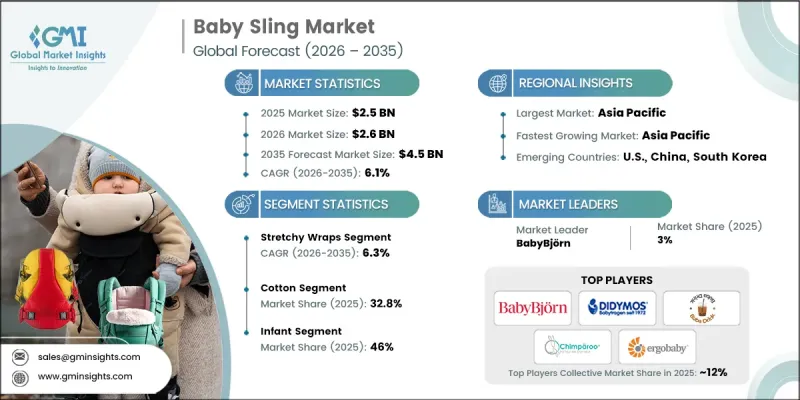
Market growth is fueled by rising parental awareness of the benefits of baby wearing and increasing demand for ergonomic, convenient, and safe infant care products. Manufacturers are leveraging this momentum by expanding distribution channels and introducing innovative designs that cater to regional preferences. Companies such as BabyBjorn and Ergobaby are offering slings with breathable fabrics, adjustable features, and ergonomic designs to meet modern parenting needs. Local producers in emerging regions, including India and Indonesia, provide affordable alternatives for middle-income households. Research shows that baby wearing enhances parent-infant bonding, supports emotional development, and provides caregivers with hands-free convenience. Additionally, slings offer physiological benefits such as promoting skin-to-skin contact, stabilizing infants' heart rates, and regulating body temperature. Environmentally conscious parents are increasingly driving the adoption of sustainable materials like organic cotton, bamboo fibers, and recycled textiles. The market is also shaped by rising interest in non-toxic, skin-friendly, and eco-friendly options.
| Market Scope | |
|---|---|
| Start Year | 2025 |
| Forecast Year | 2026-2035 |
| Start Value | $2.5 Billion |
| Forecast Value | $4.5 Billion |
| CAGR | 6.1% |
The stretchy wraps segment generated USD 1 billion in 2025 and is projected to grow at a CAGR of 6.3% through 2035. Stretchy wraps dominate due to their comfort, ease of use, and suitability for newborns. Elastic fabrics allow a snug, womb-like fit that enhances infant security and parent bonding. Their forgiving stretch reduces user error, making them ideal for first-time parents. The adaptability of stretchy wraps to various body types and shared caregivers, along with their affordability compared to structured carriers, drives high adoption, particularly in urban markets seeking cost-effective yet ergonomic options.
The cotton segment held a 32.8% share in 2025 and is expected to grow at a CAGR of 6.9% through 2035. Cotton's breathability, softness, and hypoallergenic properties make it highly preferred by parents. It regulates temperature for long periods of wear and is suitable across diverse climates. Cotton's versatility, durability, and ability to support vibrant colors and designs allow manufacturers to maintain high-quality standards while producing visually appealing products.
U.S. Baby Sling Market accounted for USD 0.6 billion in 2025 and is projected to grow at a CAGR of 6.3% from 2026 to 2035. Growth is supported by high consumer awareness, strong purchasing power, and preference for premium, ergonomic baby care products. Parents prioritize comfort, safety certifications, and convenience, fueling demand for quality slings and wraps. The U.S. market benefits from established brands, expansive retail networks, and widespread e-commerce adoption. Active parenting communities, social media influence, and expert endorsements educate caregivers on developmental and health benefits, further driving adoption.
Key players in the Global Baby Sling Market include Tula, Didymos, Chimparoo, Boba, Lenny Lamb, Moby, Infantino, Ergobaby, BabyBjorn, Onya Baby, Hip Baby Wrap, Solly Baby, Lillebaby, Nalakai, and Sakura Bloom. Companies in the Global Baby Sling Market are implementing strategies to strengthen their foothold and market presence by investing in research and development to improve ergonomic designs, comfort, and safety. They are expanding distribution networks and e-commerce channels to reach broader audiences. Brands are incorporating sustainable and eco-friendly materials to meet consumer demand for non-toxic, skin-friendly options. Partnerships with pediatric experts, parenting communities, and influencers help raise product awareness and build trust. Customization, innovative design features, and competitive pricing strategies also allow companies to target both premium and mid-income segments, enhancing brand loyalty and long-term growth potential.
Table of Contents
Chapter 1 Methodology & Scope
- 1.1 Market scope & definitions
- 1.2 Research design
- 1.2.1 Research approach
- 1.2.2 Data collection methods
- 1.3 Base estimates and calculations
- 1.3.1 Base year calculation
- 1.3.2 Market estimates & forecasts parameters
- 1.4 Forecast Model
- 1.4.1 Key trends for market estimates
- 1.4.2 Quantified market impact analysis
- 1.4.2.1 Mathematical impact of growth parameters on forecast
- 1.4.3 Scenario analysis framework
- 1.5 Primary research and validation
- 1.5.1 Some of the primary sources (but not limited to)
- 1.6 Data mining sources
- 1.6.1 Paid Sources
- 1.7 Primary research and validation
- 1.7.1 Primary sources
- 1.8 Research Trail & confidence scoring
- 1.8.1 Research trail components
- 1.8.2 Scoring components
- 1.9 Research transparency addendum
- 1.9.1 Source attribution framework
- 1.9.2 Quality assurance metrics
- 1.9.3 Our commitment to trust
- 1.10 Market Definitions
Chapter 2 Executive Summary
- 2.1 Industry 360° synopsis
- 2.2 Key market trends
- 2.2.1 Regional
- 2.2.2 Product type
- 2.2.3 Material
- 2.2.4 Age group
- 2.2.5 Price range
- 2.2.6 Distribution channel
Chapter 3 Industry Insights
- 3.1 Industry ecosystem analysis
- 3.1.1 Supplier landscape
- 3.1.2 Profit margin
- 3.1.3 Value addition at each stage
- 3.1.4 Factor affecting the value chain
- 3.2 Industry impact forces
- 3.2.1 Growth drivers
- 3.2.1.1 Increasing number of birth rates.
- 3.2.1.2 Increasing consumer awareness about baby wearing.
- 3.2.1.3 Increasing busy lifestyle trends
- 3.2.2 Pitfalls & Challenges
- 3.2.2.1 Intense competition and market saturation.
- 3.2.2.2 Safety concerns.
- 3.2.3 Opportunities
- 3.2.3.1 Growth in eco friendly and organic products
- 3.2.3.2 Innovation in ergonomic and smart features
- 3.2.1 Growth drivers
- 3.3 Growth potential analysis
- 3.4 Future market trends
- 3.5 Technology and innovation landscape
- 3.5.1 Current technological trends
- 3.5.2 Emerging technologies
- 3.6 Price trends
- 3.6.1 By region
- 3.6.2 By product
- 3.7 Regulatory landscape
- 3.7.1 North America
- 3.7.1.1 US: Consumer Product Safety Commission (CPSC) 16 Code of Federal Regulations (CFR) part 1512
- 3.7.1.2 Canada: International Organization for Standardization (ISO) 4210
- 3.7.2 Europe
- 3.7.2.1 Germany: Deutsches Institut fur Normung (DIN) European Norm (EN) ISO 4210
- 3.7.2.2 UK: European Norm (EN) ISO 4210 / United Kingdom Conformity Assessed (UKCA)
- 3.7.2.3 France: European Norm (EN) ISO 4210
- 3.7.3 Asia Pacific
- 3.7.3.1 China: Guobiao (GB) 3565
- 3.7.3.2 India: Indian Standard (IS) 10613
- 3.7.3.3 Japan: Japanese Industrial Standard (JIS) D 9110
- 3.7.4 Latin America
- 3.7.4.1 Brazil: Associacao Brasileira de Normas Tecnicas (ABNT) Norma Brasileira (NBR) ISO 4210
- 3.7.4.2 Mexico: International Organization for Standardization (ISO) 4210
- 3.7.5 Middle East & Africa
- 3.7.5.1 South Africa: South African National Standard (SANS) 311
- 3.7.5.2 Saudi Arabia: Saudi Standards, Metrology and Quality Organization (SASO) Gulf Standardization Organization (GSO) ISO 4210
- 3.7.1 North America
- 3.8 Trade data analysis (HS Code - 6209)
- 3.8.1 Import/export volume & value trends
- 3.8.2 Key trade corridors & tariff impact
- 3.9 Impact of ai & generative ai on the market
- 3.9.1 AI-driven disruption of existing business models
- 3.9.2 Genai use cases & adoption roadmap by segment
- 3.9.3 Risks, limitations & regulatory considerations
- 3.10 Porter's analysis
- 3.11 PESTEL analysis
- 3.12 Consumer buying behaviour analysis
- 3.12.1 Demographic trends
- 3.12.2 Factors affecting buying decisions
- 3.12.3 Consumer product adoption
- 3.12.4 Preferred distribution channel
Chapter 4 Competitive Landscape, 2025
- 4.1 Introduction
- 4.2 Company market share analysis
- 4.2.1 By Region
- 4.2.1.1 North America
- 4.2.1.2 Europe
- 4.2.1.3 Asia Pacific
- 4.2.1.4 Latin America
- 4.2.1.5 Middle East & Africa
- 4.2.1 By Region
- 4.3 Company matrix analysis
- 4.4 Competitive analysis of major market players
- 4.5 Competitive positioning matrix
- 4.6 Key developments
- 4.6.1 Mergers & acquisitions
- 4.6.2 Partnerships & collaborations
- 4.6.3 New product launches
- 4.6.4 Expansion plans
Chapter 5 Market Estimates & Forecast, By Type, 2022 - 2035, (USD Billion) (Million Units)
- 5.1 Key trends
- 5.2 Stretchy wraps
- 5.3 Hybrid wraps
- 5.4 Woven wraps
- 5.5 Ring slings
- 5.6 Others
Chapter 6 Market Estimates & Forecast, By Material, 2022 - 2035, (USD Billion) (Million Units)
- 6.1 Key trends
- 6.2 Cotton
- 6.3 Linen
- 6.4 Silk
- 6.5 Blends
- 6.6 Others
Chapter 7 Market Estimates & Forecast, By Age Group, 2022 - 2035, (USD Billion) (Million Units)
- 7.1 Key trends
- 7.2 Newborn (0-3months old)
- 7.3 Infant (3-10 months old)
- 7.4 Toddler (above 10 months old)
Chapter 8 Market Estimates & Forecast, By Price Range, 2022 - 2035, (USD Billion) (Million Units)
- 8.1 Key trends
- 8.2 Low
- 8.3 Mid
- 8.4 High
Chapter 9 Market Estimates & Forecast, By Distribution Channel, 2022 - 2035, (USD Billion) (Million Units)
- 9.1 Key trends
- 9.2 Online
- 9.2.1 E-commerce
- 9.2.2 Company websites
- 9.3 Offline
- 9.3.1 Specialty stores
- 9.3.2 Department stores
- 9.3.3 Others (Maternity & parenting boutiques, etc.)
Chapter 10 Market Estimates & Forecast, By Region, 2022 - 2035, (USD Billion) (Million Units)
- 10.1 Key trends
- 10.2 North America
- 10.2.1 U.S.
- 10.2.2 Canada
- 10.3 Europe
- 10.3.1 Germany
- 10.3.2 UK
- 10.3.3 France
- 10.3.4 Italy
- 10.3.5 Spain
- 10.4 Asia Pacific
- 10.4.1 China
- 10.4.2 India
- 10.4.3 Japan
- 10.4.4 South Korea
- 10.4.5 Australia
- 10.5 Latin America
- 10.5.1 Brazil
- 10.5.2 Mexico
- 10.5.3 Argentina
- 10.6 MEA
- 10.6.1 Saudi Arabia
- 10.6.2 UAE
- 10.6.3 South Africa
Chapter 11 Company Profiles
- 11.1 BabyBjorn
- 11.2 Boba
- 11.3 Chimparoo
- 11.4 Didymos
- 11.5 Ergobaby
- 11.6 Hip Baby Wrap
- 11.7 Infantino
- 11.8 Lenny Lamb
- 11.9 Lillebaby
- 11.10 Moby
- 11.11 Nalakai
- 11.12 Onya Baby
- 11.13 Sakura Bloom
- 11.14 Solly Baby
- 11.15 Tula

