PUBLISHER: Global Market Insights Inc. | PRODUCT CODE: 1998784

PUBLISHER: Global Market Insights Inc. | PRODUCT CODE: 1998784
Intra-abdominal Pressure Measurement Devices Market Opportunity, Growth Drivers, Industry Trend Analysis, and Forecast 2026 - 2035
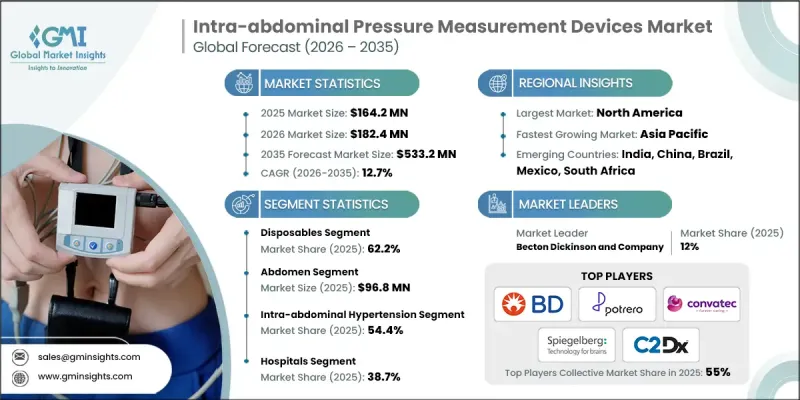
The Global Intra-abdominal Pressure Measurement Devices Market was valued at USD 164.2 million in 2025 and is estimated to grow at a CAGR of 12.7% to reach USD 533.2 million by 2035.
The growth is fueled by the rising incidence of trauma and abdominal surgeries, increasing awareness regarding the timely diagnosis and treatment of abdominal disorders, and the expansion of trauma care and surgical centers worldwide. Medical professionals are emphasizing early detection of conditions like intra-abdominal hypertension (IAH) and abdominal compartment syndrome (ACS) to prevent organ failure and improve patient survival. Hospitals and critical care units are increasingly adopting advanced, minimally invasive monitoring technologies to ensure precise and continuous measurement. Educational initiatives, updated clinical guidelines, and the growing adoption of evidence-based critical care practices are encouraging wider utilization of IAP devices. With clinicians and healthcare facilities recognizing their clinical value, intra-abdominal pressure measurement devices are becoming standard in modern critical and post-surgical care. Intra-abdominal pressure measurement devices are designed to monitor and measure the pressure within the abdominal cavity, providing crucial information for the detection and management of IAH and ACS. These devices help prevent severe complications by enabling timely clinical intervention, particularly in trauma, sepsis, and postoperative patients.
| Market Scope | |
|---|---|
| Start Year | 2025 |
| Forecast Year | 2026-2035 |
| Start Value | $164.2 Million |
| Forecast Value | $533.2 Million |
| CAGR | 12.7% |
The disposables segment held a 62.2% share in 2025. Single-use IAP monitoring products, such as disposable catheters, are favored in clinical environments for reducing cross-contamination and minimizing infection risks. Hospitals and ICUs increasingly prefer disposables to comply with strict hygiene protocols. Beyond infection control, disposable devices reduce the labor and costs associated with sterilization and reprocessing, making them a practical and efficient solution for continuous pressure monitoring while ensuring consistent reliability.
The abdomen segment reached USD 96.8 million in 2025. The abdomen is a critical focus for monitoring due to the high risk of intra-abdominal hypertension and abdominal compartment syndrome. Patients experiencing severe trauma, postoperative complications, or sepsis benefit from continuous IAP measurement, which is now routine in intensive care and surgical recovery units. Accurate abdominal pressure monitoring supports timely intervention, protects organ function, and enhances patient outcomes in critical care settings.
North America Intra-abdominal Pressure Measurement Devices Market accounted for 45.6% share in 2025. Adoption in the region is driven by advanced monitoring technologies and next-generation digital sensors that provide real-time, high-precision pressure readings. Integration with electronic medical records (EMR), automated data logging, and wireless communication enhances workflow efficiency and clinical decision-making. These innovations allow clinicians to detect complications like intra-abdominal hypertension early, improving patient safety and care outcomes.
Key players operating in the Global Intra-abdominal Pressure Measurement Devices Market include Accuryn Medical, Becton Dickinson and Company, C2Dx, Centurion Healthcare, Convatec Group PLC, Delta Med S.p.A., DOTSPACE Inc., Gaeltec Devices Ltd., Medline Industries, Inc., Potrero Medical, Sam Medical, Sentinel Medical Technologies, Spiegelberg GmbH & Co. KG., and SSEM Mthembu Medical. Companies in the intra-abdominal pressure measurement devices market are focusing on product innovation, expansion into emerging healthcare markets, and developing minimally invasive technologies to strengthen their market presence. Strategies include investing in R&D to enhance accuracy, reliability, and ease of use, launching disposable and single-use solutions to improve hygiene and reduce costs, and forming strategic partnerships with hospitals and healthcare networks to expand distribution channels. Firms are also integrating smart sensor technology, wireless monitoring, and EMR connectivity to differentiate products, enhance clinical outcomes, and establish long-term customer relationships.
Table of Contents
Chapter 1 Research Methodology
- 1.1 Research approach
- 1.2 Quality commitments
- 1.2.1 GMI AI policy & data integrity commitment
- 1.2.1.1 Source consistency protocol
- 1.2.1 GMI AI policy & data integrity commitment
- 1.3 Research trail & confidence scoring
- 1.3.1 Research trail components
- 1.3.2 Scoring components
- 1.4 Data collection
- 1.4.1 Partial list of primary sources
- 1.5 Data mining sources
- 1.5.1 Paid sources
- 1.5.1.1 Sources, by region
- 1.5.1 Paid sources
- 1.6 Base estimates and calculations
- 1.6.1 Base year calculation for any one approach
- 1.7 Forecast model
- 1.7.1 Quantified market impact analysis
- 1.7.1.1 Mathematical impact of growth parameters on forecast
- 1.7.1 Quantified market impact analysis
- 1.8 Research transparency addendum
- 1.8.1 Source attribution framework
- 1.8.2 Quality assurance metrics
- 1.8.3 Our commitment to trust
Chapter 2 Executive Summary
- 2.1 Industry 360° synopsis
- 2.2 Key market trends
- 2.2.1 Products trends
- 2.2.2 Procedure trends
- 2.2.3 Application trends
- 2.2.4 End Use trends
- 2.2.5 Regional trends
- 2.3 CXO perspectives: Strategic imperatives
Chapter 3 Industry Insights
- 3.1 Industry ecosystem analysis
- 3.2 Industry impact forces
- 3.2.1 Growth drivers
- 3.2.1.1 Increasing incidence of trauma and abdominal surgery
- 3.2.1.2 Growing awareness towards timely treatment of abdominal disorders
- 3.2.1.3 Advancements in monitoring technologies
- 3.2.1.4 Expansion of trauma care and surgical centers
- 3.2.2 Industry pitfalls and challenges
- 3.2.2.1 High costs associated with advanced monitoring equipment
- 3.2.2.2 Limited reimbursement for IAP monitoring procedures
- 3.2.3 Market opportunities
- 3.2.3.1 Increasing adoption of minimally invasive surgeries
- 3.2.1 Growth drivers
- 3.3 Growth potential analysis
- 3.4 Regulatory landscape (Driven by primary research)
- 3.4.1 North America
- 3.4.2 Europe
- 3.4.3 Asia Pacific
- 3.4.4 Latin America
- 3.4.5 Middle East and Africa
- 3.5 Technology landscape
- 3.5.1 Current technological trends
- 3.5.1.1 Shift toward continuous IAP monitoring (CIAP)
- 3.5.1.2 Integration of multi-parameter sensors
- 3.5.1.3 Enhanced compatibility with existing bedside monitors
- 3.5.2 Emerging technologies
- 3.5.2.1 Growth in AI-ready and EMR-integrated monitoring pipeline
- 3.5.2.2 Growing use of miniaturized sensors and smart catheters
- 3.5.1 Current technological trends
- 3.6 Future market trends (Driven by primary research)
- 3.7 Patent analysis
- 3.8 Pricing analysis
- 3.9 Porter's analysis
- 3.10 PESTEL analysis
Chapter 4 Competitive Landscape, 2025
- 4.1 Introduction
- 4.2 Company market share analysis
- 4.2.1 North America
- 4.2.2 Europe
- 4.2.3 Asia Pacific
- 4.3 Company matrix analysis
- 4.4 Competitive analysis of major market players
- 4.5 Competitive positioning matrix
- 4.6 Key developments
- 4.6.1 Mergers and acquisitions
- 4.6.2 Partnerships and collaborations
- 4.6.3 New product launches
- 4.6.4 Expansion plans
Chapter 5 Market Estimates and Forecast, By Product, 2022 - 2035 ($ Mn)
- 5.1 Key trends
- 5.2 Disposables
- 5.3 Equipment
Chapter 6 Market Estimates and Forecast, By Procedure, 2022 - 2035 ($ Mn)
- 6.1 Key trends
- 6.2 Abdomen
- 6.3 Muscle
Chapter 7 Market Estimates and Forecast, By Application, 2022 - 2035 ($ Mn)
- 7.1 Key trends
- 7.2 Intra-abdominal hypertension
- 7.3 Intra-compartment pressure
Chapter 8 Market Estimates and Forecast, By End Use, 2022 - 2035 ($ Mn)
- 8.1 Key trends
- 8.2 Hospitals
- 8.3 Clinics
- 8.4 Trauma centers
- 8.5 Ambulatory surgical centers
Chapter 9 Market Estimates and Forecast, By Region, 2022 - 2035 ($ Mn)
- 9.1 Key trends
- 9.2 North America
- 9.2.1 U.S.
- 9.2.2 Canada
- 9.3 Europe
- 9.3.1 Germany
- 9.3.2 UK
- 9.3.3 France
- 9.3.4 Spain
- 9.3.5 Italy
- 9.3.6 Netherlands
- 9.4 Asia Pacific
- 9.4.1 China
- 9.4.2 Japan
- 9.4.3 India
- 9.4.4 Australia
- 9.4.5 South Korea
- 9.5 Latin America
- 9.5.1 Brazil
- 9.5.2 Mexico
- 9.5.3 Argentina
- 9.6 Middle East and Africa
- 9.6.1 South Africa
- 9.6.2 Saudi Arabia
- 9.6.3 UAE
Chapter 10 Company Profiles
- 10.1 Accuryn Medical
- 10.2 Becton Dickinson and Company
- 10.3 C2Dx
- 10.4 Centurion Healthcare
- 10.5 Convatec Group PLC
- 10.6 Delta Med S.p.A.
- 10.7 DOTSPACE Inc.
- 10.8 Gaeltec Devices Ltd.
- 10.9 Medline Industries Inc.
- 10.10 Potrero Medical
- 10.11 Sam Medical
- 10.12 Sentinel Medical Technologies
- 10.13 Spiegelberg GmbH & Co KG
- 10.14 SSEM Mthembu Medical

