PUBLISHER: Global Market Insights Inc. | PRODUCT CODE: 1998789

PUBLISHER: Global Market Insights Inc. | PRODUCT CODE: 1998789
Marine Derived Proteins Market Opportunity, Growth Drivers, Industry Trend Analysis, and Forecast 2026 - 2035
The Global Marine Derived Proteins Market was valued at USD 9.1 billion in 2025 and is estimated to grow at a CAGR of 9.4% to reach USD 22.3 billion by 2035.
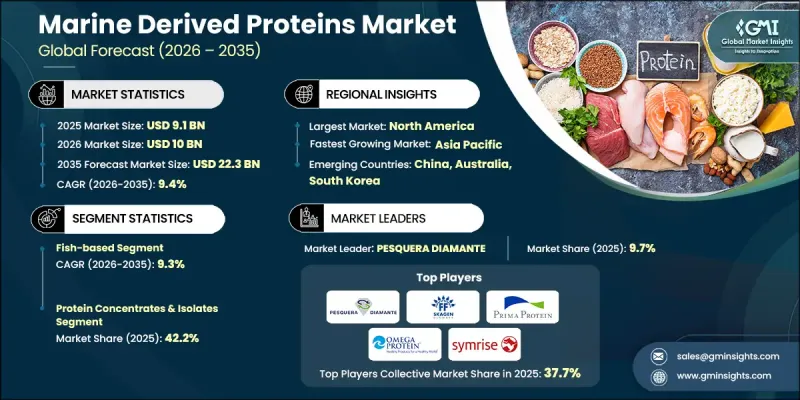
Market growth is fueled by rising consumer awareness of the nutritional benefits associated with marine-based protein sources. These proteins are widely recognized for containing essential amino acids, omega fatty acids, and bioactive compounds that support overall wellness. Increasing interest in sustainable and responsibly sourced nutrition is further strengthening demand, as consumers seek environmentally conscious alternatives to traditional protein sources. Marine-derived proteins are gaining traction across dietary supplements, functional foods, and nutraceutical formulations, contributing to consistent industry expansion. In addition, the need for cost-effective and nutrient-dense ingredients in animal nutrition and aquaculture feed applications is supporting broader adoption. Advancements in processing technologies are enabling manufacturers to enhance product quality while maintaining sustainability standards. Growing focus on health, fitness, and performance-oriented nutrition is also encouraging higher consumption of marine proteins. As awareness of sustainable food systems continues to increase globally, the marine derived proteins market is positioned for substantial long-term growth.
| Market Scope | |
|---|---|
| Start Year | 2025 |
| Forecast Year | 2026-2035 |
| Start Value | $9.1 Billion |
| Forecast Value | $22.3 Billion |
| CAGR | 9.4% |
The fish-based proteins segment accounted for 67.8% share in 2025 and is expected to grow at a CAGR of 9.3% through 2035. Their dominance is supported by high protein concentration, established extraction infrastructure, and consistent raw material availability. These proteins remain integral to supplement and functional nutrition formulations due to their recognized nutritional profile. Continued improvements in responsible sourcing and resource management practices are further reinforcing stable supply and market confidence.
The protein concentrates and isolates segment held 42.2% share in 2025. Their leadership position stems from high purity levels and versatile applications across sports nutrition, dietary supplements, and functional food products. Increasing demand for clean-label and easily digestible protein ingredients is accelerating segment growth. At the same time, protein hydrolysates and bioactive peptides are experiencing rapid adoption because of their enhanced absorption characteristics and targeted nutritional benefits, particularly within performance and clinical nutrition segments.
North America Marine Derived Proteins Market is projected to grow at a CAGR of 9.3% between 2026 and 2035. Regional expansion is driven by heightened demand for sustainable, clean-label ingredients across functional foods, dietary supplements, and personal care formulations. Consumers in the region are demonstrating a stronger preference for responsibly sourced and environmentally friendly nutritional solutions, further supporting product adoption and innovation.
Key companies operating in the Global Marine Derived Proteins Market include Cargill, Symrise AG, Hofseth BioCare, Omega Protein Corporation, Gelita, Epax, PESQUERA DIAMANTE, Prima Protein AS, FF Skagen A/S, and Gensei Global Industries Co., Ltd. Companies in the Marine Derived Proteins Market are strengthening their competitive position through continuous product innovation, sustainability initiatives, and expanded distribution networks. Leading manufacturers are investing in advanced material technologies to enhance durability, stain resistance, and environmental performance. Strategic partnerships with residential developers and commercial contractors are increasing project-based sales opportunities. Businesses are also adopting omnichannel retail strategies that integrate digital platforms with traditional showrooms to improve customer engagement. Capacity modernization and supply chain optimization are helping reduce operational costs and delivery timelines.
Table of Contents
Chapter 1 Methodology & Scope
- 1.1 Market scope and definition
- 1.2 Research design
- 1.2.1 Research approach
- 1.2.2 Data collection methods
- 1.3 Data mining sources
- 1.3.1 Global
- 1.3.2 Regional/Country
- 1.4 Base estimates and calculations
- 1.4.1 Base year calculation
- 1.4.2 Key trends for market estimation
- 1.5 Primary research and validation
- 1.5.1 Primary sources
- 1.6 Forecast model
- 1.7 Research assumptions and limitations
Chapter 2 Executive Summary
- 2.1 Industry 360° synopsis
- 2.2 Key market trends
- 2.2.1 Regional
- 2.2.2 Source
- 2.2.3 Product Type
- 2.2.4 Distribution channel
- 2.2.5 Application
- 2.3 TAM Analysis, 2026-2035
- 2.4 CXO perspectives: Strategic imperatives
Chapter 3 Industry Insights
- 3.1 Industry ecosystem analysis
- 3.1.1 Supplier landscape
- 3.1.2 Profit margin
- 3.1.3 Value addition at each stage
- 3.1.4 Factor affecting the value chain
- 3.1.5 Disruptions
- 3.2 Industry impact forces
- 3.2.1 Growth drivers
- 3.2.1.1 Rich in essential nutrients
- 3.2.1.2 Improved athletic performance
- 3.2.1.3 Enhanced cognitive function
- 3.2.2 Industry pitfalls and challenges
- 3.2.2.1 Pollution and contaminants
- 3.2.3 Market opportunities
- 3.2.3.1 Growing demand for natural and sustainable protein sources in health and wellness products
- 3.2.3.2 Increasing adoption of marine proteins in sports nutrition and dietary supplements for muscle recovery and overall health
- 3.2.1 Growth drivers
- 3.3 Growth potential analysis
- 3.4 Regulatory landscape
- 3.4.1 North America
- 3.4.2 Europe
- 3.4.3 Asia Pacific
- 3.4.4 Latin America
- 3.4.5 Middle East & Africa
- 3.5 Porter's analysis
- 3.6 PESTEL analysis
- 3.7 Price trends
- 3.7.1 By region
- 3.7.2 By product type
- 3.8 Future market trends
- 3.9 Technology and innovation landscape
- 3.9.1 Current technological trends
- 3.9.2 Emerging technologies
- 3.10 Patent Landscape
- 3.11 Trade statistics (HS code)
- 3.11.1 Major importing countries
- 3.11.2 Major exporting countries
- 3.12 Sustainability and environmental aspects
- 3.12.1 Sustainable practices
- 3.12.2 Waste reduction strategies
- 3.12.3 Energy efficiency in production
- 3.12.4 Eco-friendly initiatives
- 3.13 Carbon footprint consideration
Chapter 4 Competitive Landscape, 2025
- 4.1 Introduction
- 4.2 Company market share analysis
- 4.2.1 By region
- 4.2.1.1 North America
- 4.2.1.2 Europe
- 4.2.1.3 Asia Pacific
- 4.2.1.4 LATAM
- 4.2.1.5 MEA
- 4.2.1 By region
- 4.3 Competitive analysis of major market players
- 4.4 Competitive positioning matrix
- 4.5 Key developments
- 4.5.1 Mergers & acquisitions
- 4.5.2 Partnerships & collaborations
- 4.5.3 New Product Launches
- 4.5.4 Expansion Plans
Chapter 5 Market Estimates and Forecast, By Source, 2022-2035 (USD Billion) (Kilo Tons)
- 5.1 Key trends
- 5.2 Fish-based
- 5.3 Shellfish-based
- 5.4 Algae-based
- 5.5 Other
Chapter 6 Market Estimates and Forecast, By Product Type, 2022-2035 (USD Billion) (Kilo Tons)
- 6.1 Key trends
- 6.2 Protein concentrates & isolates
- 6.2.1 Fish protein concentrate (fpc)
- 6.2.2 Fish protein isolate
- 6.2.3 Seaweed protein concentrate
- 6.3 Protein hydrolysates & bioactive peptides
- 6.3.1 Enzymatic hydrolysates
- 6.3.2 Acid/alkali hydrolysates
- 6.3.3 Bioactive peptide fractions
- 6.4 Collagen & gelatin
- 6.4.1 Marine collagen
- 6.4.2 Fish gelatin
- 6.4.3 Hydrolyzed collagen peptides
- 6.5 Fishmeal & fish oil
- 6.6 Functional marine compounds
Chapter 7 Market Estimates and Forecast, By Distribution Channel, 2022-2035 (USD Billion) (Kilo Tons)
- 7.1 Key trends
- 7.2 Direct sales (B2B)
- 7.3 Distributors
- 7.4 Online channels
Chapter 8 Market Estimates and Forecast, By Application, 2022-2035 (USD Billion) (Kilo Tons)
- 8.1 Key trends
- 8.2 Food & beverages
- 8.2.1 Protein fortification
- 8.2.2 Functional foods
- 8.2.3 Gelling & stabilizing agents
- 8.2.4 Meat & seafood products
- 8.2.5 Bakery & confectionery
- 8.2.6 Others
- 8.3 Dietary supplements & nutraceuticals
- 8.3.1 Omega-3 supplements
- 8.3.2 Collagen supplements
- 8.3.3 Joint & bone health
- 8.3.4 Weight management
- 8.3.5 Others
- 8.4 Pharmaceuticals & therapeutics
- 8.5 Cosmetics & personal care
- 8.5.1 Anti-aging products
- 8.5.2 Skin hydration & elasticity
- 8.5.3 Hair & nail care
- 8.5.4 Others
- 8.6 Aquaculture & animal feed
- 8.7 Sports nutrition
- 8.7.1 Protein powders & bars
- 8.7.2 Recovery supplements
- 8.7.3 Others
- 8.8 Others
Chapter 9 Market Estimates and Forecast, By Region, 2022-2035 (USD Billion) (Kilo Tons)
- 9.1 Key trends
- 9.2 North America
- 9.2.1 U.S.
- 9.2.2 Canada
- 9.3 Europe
- 9.3.1 Germany
- 9.3.2 UK
- 9.3.3 France
- 9.3.4 Spain
- 9.3.5 Italy
- 9.3.6 Rest of Europe
- 9.4 Asia Pacific
- 9.4.1 China
- 9.4.2 India
- 9.4.3 Japan
- 9.4.4 Australia
- 9.4.5 South Korea
- 9.4.6 Rest of Asia Pacific
- 9.5 Latin America
- 9.5.1 Brazil
- 9.5.2 Mexico
- 9.5.3 Argentina
- 9.5.4 Rest of Latin America
- 9.6 Middle East and Africa
- 9.6.1 Saudi Arabia
- 9.6.2 South Africa
- 9.6.3 UAE
- 9.6.4 Rest of Middle East and Africa
Chapter 10 Company Profiles
- 10.1 Cargill
- 10.2 Epax
- 10.3 FF Skagen A/S
- 10.4 Gelita
- 10.5 Gensei Global Industries Co.,Ltd
- 10.6 Hofseth BioCare
- 10.7 Omega Protein Corporation
- 10.8 PESQUERA DIAMANTE
- 10.9 Prima Protein AS
- 10.10 Symrise AG

