
PUBLISHER: Mordor Intelligence | PRODUCT CODE: 2034983

PUBLISHER: Mordor Intelligence | PRODUCT CODE: 2034983
Japan Protein - Market Share Analysis, Industry Trends & Statistics, Growth Forecasts (2026 - 2031)
The Japan Protein Market size is estimated at USD 564.92 million in 2026, and is expected to reach USD 728.93 million by 2031, at a CAGR of 5.23% during the forecast period (2026-2031).
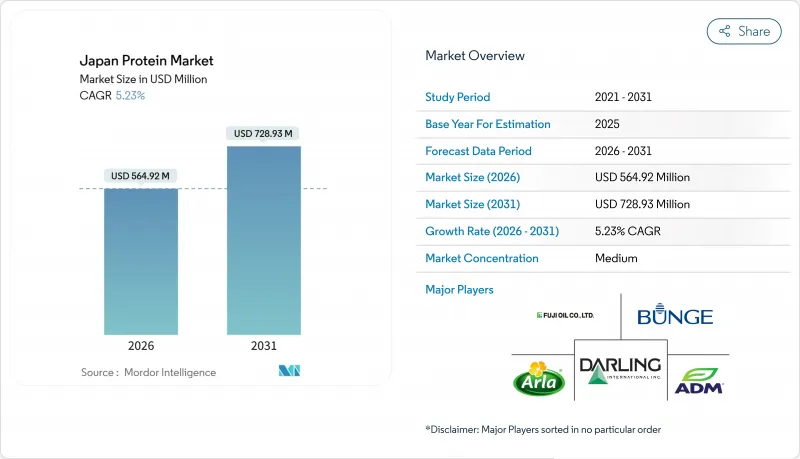
This growth reflects a significant shift in how protein is consumed, positioned, and integrated into daily nutrition. The market's expansion is driven by protein's evolution from a niche, performance-focused ingredient to a fundamental component of preventive health and functional diets. Simultaneously, advancements in processing technologies, formulation science, and ingredient functionality are enhancing digestibility, taste, and versatility. These improvements allow protein to be seamlessly integrated into a wide range of consumption occasions. Additionally, the market is adapting to clean-label expectations, sustainability concerns, and the demand for scientifically validated nutrition. These factors are reshaping product development strategies and strengthening consumer trust.
Japan Protein Market Trends and Insights
Rapidly aging society and healthy longevity focus
The rapidly aging population and the national emphasis on healthy longevity are key factors driving the Japan protein market. Dietary protein is increasingly recognized as vital for maintaining muscle mass, mobility, immune function, and overall quality of life among older adults. Japan's demographic structure, heavily skewed toward older age groups, heightens the demand for nutritional solutions targeting age-related conditions such as sarcopenia, frailty, and reduced metabolic efficiency. Protein-rich diets, delivered through fortified foods, functional beverages, supplements, and medical nutrition, are actively promoted to address these needs. This demand is further supported by the preference of elderly consumers for easy-to-consume, highly digestible, and clinically validated protein formats, such as whey, collagen peptides, and plant-based blends incorporated into everyday foods. The scale and urgency of this trend are highlighted by demographic data from the United Nations Population Fund (UNFPA), which indicates that individuals aged 65 years and older accounted for 29.56% of Japan's population in 2023, one of the highest proportions globally . This demographic reality is driving food, beverage, and nutrition manufacturers to focus on protein fortification and age-specific formulations.
Expansion of sports, fitness, and active lifestyle culture
The growth of sports, fitness, and active lifestyle culture serves as a significant structural driver for the Japan protein market. Protein consumption is increasingly associated with physical performance, muscle recovery, and overall functional health across various age groups. Japan has experienced a consistent shift toward regular exercise, gym participation, recreational sports, and structured fitness routines. This lifestyle change is directly contributing to a rising demand for sports nutrition products, including whey and plant-based protein powders. Protein is now being positioned as a daily nutritional necessity rather than a specialized bodybuilding supplement, broadening its appeal among office workers, recreational athletes, and health-conscious individuals. Supporting this trend, data from the Ministry of Economy, Trade and Industry (METI) indicates that Japan had approximately 2.88 million fitness club members in 2024, underscoring the scale of organized fitness participation in the country . This expanding fitness ecosystem is promoting consistent protein consumption as part of active lifestyle habits. Consequently, manufacturers are increasingly focusing on innovation in this space.
Taste, texture, and sensory acceptance challenges
Taste, texture, and sensory acceptance challenges are significant restraints in the Japan protein market, as consumer purchase decisions are heavily influenced by flavor authenticity, mouthfeel, and overall eating experience. Japanese consumers are highly particular about sensory quality, often expecting protein-enriched products to meet the same standards as traditional foods in terms of taste, aroma, and texture. Many protein formulations, particularly plant-based, microbial, and hybrid proteins, face issues such as bitterness, beany or earthy off-notes, chalky mouthfeel, or excessive thickness, which can deter repeat purchases. These sensory challenges are especially pronounced in ready-to-drink beverages, bakery products, and functional snacks, where protein inclusion can disrupt texture and flavor balance. Furthermore, elderly consumers, a key demographic for protein-fortified foods, are especially sensitive to texture and palatability, favoring smooth, mild, and easy-to-swallow formats, which limits formulation flexibility.
Other drivers and restraints analyzed in the detailed report include:
- Clean label and minimalist ingredient preferences
- Growing demand for plant-based and hybrid protein products
- Regulatory complexity for functional and health claims
For complete list of drivers and restraints, kindly check the Table Of Contents.
Segment Analysis
In 2025, animal protein accounted for a substantial 32.56% share of the Japan protein market, highlighting its continued preference among Japanese consumers. This dominance is largely attributed to the perception of animal proteins, such as whey, casein, collagen, and egg proteins, as high-quality, complete proteins that supply all essential amino acids required for muscle development, recovery, and overall health. The aging population in Japan further drives demand, as older adults increasingly adopt protein-rich diets to address sarcopenia and maintain bone and muscle health. Additionally, the growing fitness and sports nutrition trend has bolstered animal protein consumption, with gym-goers, athletes, and active individuals favoring whey and casein-based supplements for their benefits in muscle repair and sustained energy.
Microbial protein is emerging as the fastest-growing segment in the Japan protein market, with a projected CAGR of 5.64% through 2031. This growth is fueled by its alignment with Japan's priorities in food security, sustainability, and technological innovation. Advancements in biotechnology and fermentation processes have enabled the efficient production of high-purity proteins from microorganisms such as yeast, fungi, bacteria, and algae. Unlike traditional animal protein, microbial protein offers consistent quality, controlled production conditions, and reduced susceptibility to agricultural variability, making it well-suited for industrial-scale applications. The segment's expansion is further supported by Japan's robust Research and Development (R&D) ecosystem and government initiatives promoting alternative protein development as part of future food systems.
The Japan Protein Market is Segmented by Source (Animal, Microbial, Insects, and Plant), and Application (Food and Beverages, Nutritional Supplements, Animal Feed, Cosmetics and Personal Care, Pharmaceutical, and Others). The Market Forecasts are Provided in Terms of Value (USD) and Volume (Tons).
List of Companies Covered in this Report:
- Archer Daniels Midland Company
- Arla Foods amba
- Bunge Limited
- Fuji Oil Holdings Inc.
- Darling Ingredients Inc.
- International Flavors & Fragrances Inc.
- Lacto Japan Co., Ltd.
- Morinaga Milk Industry Co., Ltd.
- Nagata Group Holdings, Ltd.
- Nitta Gelatin Inc.
- Ajinomoto Co., Inc.
- Kyowa Hakko Bio Co., Ltd.
- Nippon Protein Co., Ltd.
- Meiji Holdings Co., Ltd.
- Roquette Freres (Japan)
- J-Oil Mills, Inc.
- San-Ei Gen F.F.I., Inc.
- GELITA Japan K.K.
- Kewpie Corporation (Protein Solutions)
- Kanematsu Corporation (Food-Tech Division)
Additional Benefits:
- The market estimate (ME) sheet in Excel format
- 3 months of analyst support
TABLE OF CONTENTS
1 INTRODUCTION
- 1.1 Study Assumptions and Market Definition
- 1.2 Scope of the Study
2 RESEARCH METHODOLOGY
3 EXECUTIVE SUMMARY
4 MARKET LANDSCAPE
- 4.1 Market Overview
- 4.2 Market Drivers
- 4.2.1 Rapidly aging society and healthy longevity focus
- 4.2.2 Expansion of sports, fitness, and active lifestyle culture
- 4.2.3 Clean label and minimalist ingredient preferences
- 4.2.4 Growing demand for plant-b and hybrid protein products
- 4.2.5 Convenience-driven nutrition consumption patterns
- 4.2.6 Shift toward high-quality, easily digestible proteins
- 4.3 Market Restraints
- 4.3.1 Taste, texture, and sensory acceptance challenges
- 4.3.2 Digestive sensitivity among elderly consumers
- 4.3.3 Regulatory complexity for functional and health claims
- 4.3.4 Limited protein intake awareness relative to dietary norms
- 4.4 Supply Chain Analysis
- 4.5 Regulatory Landscape
- 4.6 Technological Outlook
- 4.7 Porter's Five Forces Analysis
- 4.7.1 Threat of New Entrants
- 4.7.2 Bargaining Power of Buyers
- 4.7.3 Bargaining Power of Suppliers
- 4.7.4 Threat of Substitutes
- 4.7.5 Intensity of Competitive Rivalry
5 MARKET SIZE AND GROWTH FORECASTS (VALUE AND VOLUME)
- 5.1 By Source Type
- 5.1.1 Animal
- 5.1.2 Microbial
- 5.1.3 Insects
- 5.1.4 Plant
- 5.2 By Application
- 5.2.1 Food and Beverages
- 5.2.2 Nutritional Supplements
- 5.2.3 Animal Feed
- 5.2.4 Cosmetics and Personal Care
- 5.2.5 Pharmaceutical
- 5.2.6 Others
6 COMPETITIVE LANDSCAPE
- 6.1 Market Concentration
- 6.2 Strategic Moves
- 6.3 Market Positioning Analysis
- 6.4 Company Profiles (includes Global level Overview, Market level overview, Core Segments, Financials as available, Strategic Information, Market Rank/Share for key companies, Products and Services, and Recent Developments)
- 6.4.1 Archer Daniels Midland Company
- 6.4.2 Arla Foods amba
- 6.4.3 Bunge Limited
- 6.4.4 Fuji Oil Holdings Inc.
- 6.4.5 Darling Ingredients Inc.
- 6.4.6 International Flavors & Fragrances Inc.
- 6.4.7 Lacto Japan Co., Ltd.
- 6.4.8 Morinaga Milk Industry Co., Ltd.
- 6.4.9 Nagata Group Holdings, Ltd.
- 6.4.10 Nitta Gelatin Inc.
- 6.4.11 Ajinomoto Co., Inc.
- 6.4.12 Kyowa Hakko Bio Co., Ltd.
- 6.4.13 Nippon Protein Co., Ltd.
- 6.4.14 Meiji Holdings Co., Ltd.
- 6.4.15 Roquette Freres (Japan)
- 6.4.16 J-Oil Mills, Inc.
- 6.4.17 San-Ei Gen F.F.I., Inc.
- 6.4.18 GELITA Japan K.K.
- 6.4.19 Kewpie Corporation (Protein Solutions)
- 6.4.20 Kanematsu Corporation (Food-Tech Division)
7 MARKET OPPORTUNITIES AND FUTURE OUTLOOK

