PUBLISHER: Global Market Insights Inc. | PRODUCT CODE: 1998796

PUBLISHER: Global Market Insights Inc. | PRODUCT CODE: 1998796
Ultra-Luxury Home Automation Market Opportunity, Growth Drivers, Industry Trend Analysis, and Forecast 2026 - 2035
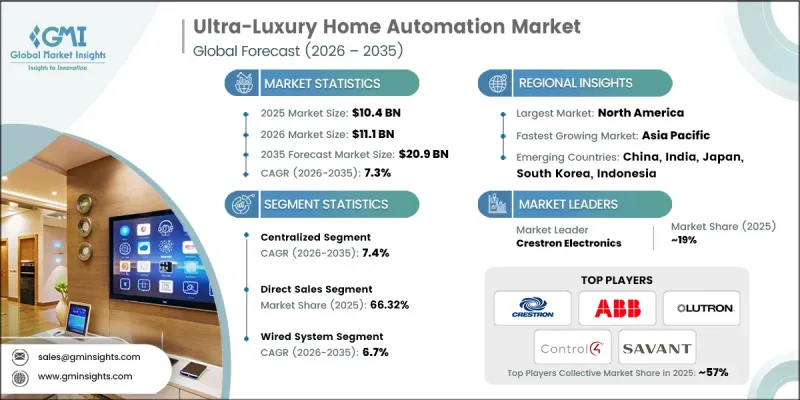
The Global Ultra-Luxury Home Automation Market was valued at USD 10.4 billion in 2025 and is estimated to grow at a CAGR of 7.3% to reach USD 20.9 billion by 2035.
Growth in the industry is driven by the rising preference among affluent homeowners for highly personalized smart living environments. Property owners in the premium residential segment increasingly seek integrated control over essential home functions, including lighting, climate management, safety systems, and multimedia infrastructure through customized automation platforms. Tailored automation solutions allow homeowners to configure their living spaces according to personal routines, preferences, and lifestyle requirements. In addition, modern automation technologies enable the integration of multiple smart devices into a single centralized management interface, making complex residential operations more convenient and efficient. Ultra-luxury residences are evolving toward highly curated digital ecosystems where technology enhances comfort, exclusivity, and ease of use. Property owners expect automation platforms that align with architectural design, spatial layout, and daily usage behavior. Scenario-based automation further enhances living experiences by coordinating multiple functions through intelligent programming. Premium residential developments increasingly incorporate advanced automation capabilities to deliver a refined lifestyle experience that reflects personal identity and status. To address these evolving expectations, providers in the ultra-luxury home automation market are focusing on delivering sophisticated combinations of hardware infrastructure and intelligent software platforms designed to meet the highly specific requirements of their clientele.
| Market Scope | |
|---|---|
| Start Year | 2025 |
| Forecast Year | 2026-2035 |
| Start Value | $10.4 Billion |
| Forecast Value | $20.9 Billion |
| CAGR | 7.3% |
The centralized automation segment generated USD 5 billion in 2025 and is forecast to grow at a CAGR of 7.4% between 2026 and 2035. This segment holds a dominant position in the ultra-luxury home automation market because it enables comprehensive system coordination through a unified control framework. Centralized platforms allow homeowners to efficiently oversee multiple residential systems from a single interface, improving operational efficiency across large properties. Affluent homeowners prefer this architecture because it ensures reliable communication between connected technologies and reduces the likelihood of system incompatibility. Advanced control systems also enable the development of highly customized automation routines and scheduling capabilities that support personalized residential experiences.
The wired technology segment accounted for 63.22% share in 2025 and is anticipated to grow at a CAGR of 6.7% through 2035. This system type continues to lead the market because of its dependable performance and stable data transmission capabilities. Physical infrastructure ensures consistent connectivity across extensive residential environments where uninterrupted communication between devices is essential. High bandwidth capacity supports sophisticated automation processes without interference or connectivity fluctuations. Homeowners in the luxury residential segment often favor wired installations due to their reliability, enhanced cybersecurity potential, and long-term system stability. Strong integration across multiple residential technologies further improves the efficiency and responsiveness of centralized automation frameworks.
United States Ultra-Luxury Home Automation Market was valued at USD 3.3 billion in 2025 and is expected to grow at a CAGR of 7.4% from 2026 to 2035. Demand in the country is supported by a growing population of affluent homeowners investing in technologically advanced residential environments. Newly developed luxury properties increasingly incorporate fully customized automation infrastructure to enhance living standards and operational efficiency. Rising consumer awareness of advanced digital technologies is accelerating the adoption of intelligent residential systems across premium housing developments. Continued investment in high-end real estate is also contributing to consistent demand for advanced automation platforms within the ultra-luxury residential segment.
Prominent participants operating in the Global Ultra-Luxury Home Automation Market include Crestron Electronics, Savant Systems, Control4, Lutron Electronics, Legrand, Schneider Electric, ABB, Siemens, Johnson Controls, Honeywell International, Vivint, Ecobee, Bang & Olufsen, Aurum HomeTech, and Heyo Smart. Companies operating in the Ultra-Luxury Home Automation Market are strengthening their market presence through a combination of technology innovation, strategic collaborations, and premium service offerings. Leading players are investing in advanced software platforms that enable seamless integration between multiple home automation technologies while maintaining high system reliability. Firms are also developing customized automation ecosystems designed specifically for luxury residential environments, allowing them to address highly specialized homeowner requirements. Partnerships with luxury real estate developers, architects, and interior designers are becoming an important strategy to secure early involvement in high-end construction projects.
Table of Contents
Chapter 1 Methodology & Scope
- 1.1 Market scope and definition
- 1.2 Research design
- 1.2.1 Research approach
- 1.2.2 Data collection methods
- 1.3 Data mining sources
- 1.3.1 Global
- 1.3.2 Regional/Country
- 1.4 Base estimates and calculations
- 1.4.1 Base year calculation
- 1.4.2 Key trends for market estimation
- 1.5 Primary research and validation
- 1.5.1 Primary sources
- 1.6 Forecast model
- 1.7 Research assumptions and limitations
Chapter 2 Executive Summary
- 2.1 Industry 360° synopsis
- 2.2 Key market trends
- 2.2.1 Regional
- 2.2.2 Product type
- 2.2.3 Automation Type
- 2.2.4 Technology Type
- 2.2.5 Distribution channel
- 2.3 CXO perspectives: Strategic imperatives
- 2.3.1 Key decision points for industry executives
- 2.3.2 Critical success factors for market players
- 2.4 Future outlook and strategic recommendations
Chapter 3 Industry Insights
- 3.1 Industry ecosystem analysis
- 3.1.1 Supplier landscape
- 3.1.2 Profit margin
- 3.1.3 Value addition at each stage
- 3.1.4 Factor affecting the value chain
- 3.2 Industry impact forces
- 3.2.1 Growth drivers
- 3.2.1.1 Rising demand for personalized smart living experiences
- 3.2.1.2 Integration of advanced technologies such as AI and IoT
- 3.2.1.3 Growth in luxury real estate development
- 3.2.2 Pitfalls & Challenges
- 3.2.2.1 High upfront costs of premium systems and installation
- 3.2.2.2 Data security and privacy concerns
- 3.2.3 Opportunities
- 3.2.3.1 Partnerships with luxury real estate developers and architects
- 3.2.3.2 Integration of biometric and next-gen security technologies
- 3.2.1 Growth drivers
- 3.3 Growth potential analysis
- 3.4 Future market trends
- 3.5 Technology and innovation landscape
- 3.5.1 Current technological trends
- 3.5.2 Emerging technologies
- 3.6 Price trends
- 3.6.1 By region
- 3.6.2 By product
- 3.7 Regulatory landscape
- 3.7.1 Standards and compliance requirements
- 3.7.2 Regional regulatory frameworks
- 3.7.3 Certification standards
- 3.8 Porter's analysis
- 3.9 PESTEL analysis
Chapter 4 Competitive Landscape, 2025
- 4.1 Introduction
- 4.2 Company market share analysis
- 4.2.1 By Region
- 4.2.1.1 North America
- 4.2.1.2 Europe
- 4.2.1.3 Asia Pacific
- 4.2.1.4 Latin America
- 4.2.1.5 Middle East & Africa
- 4.2.1 By Region
- 4.3 Company matrix analysis
- 4.4 Competitive analysis of major market players
- 4.5 Competitive positioning matrix
- 4.6 Key developments
- 4.6.1 Mergers & acquisitions
- 4.6.2 Partnerships & collaborations
- 4.6.3 New product launches
- 4.6.4 Expansion plans
Chapter 5 Market Estimates & Forecast, By Product Type, 2022 - 2035, (USD Million) (Thousand Units)
- 5.1 Key trends
- 5.2 Lighting devices
- 5.2.1 In-wall modules/ smart bulbs
- 5.2.2 Smart switches
- 5.2.3 Smart plugs
- 5.2.4 Others (smart dimmer etc.)
- 5.3 Smart security devices
- 5.3.1 Motion/arrival sensor
- 5.3.2 Door/window sensor
- 5.3.3 Alarms
- 5.3.4 Smart wireless bells
- 5.3.5 Smart door locks
- 5.3.6 Others (security cameras etc.)
- 5.4 Entertainment devices
- 5.4.1 Speakers/ audio distribution
- 5.4.2 Video distribution
- 5.4.3 Others (virtual personal assistant etc.)
- 5.5 Protection sensors
- 5.5.1 Flood/fire sensors
- 5.5.2 UV sensors
- 5.5.3 Others (humidity sensors etc.)
- 5.6 Others
Chapter 6 Market Estimates & Forecast, By Automation Type, 2022 - 2035, (USD Million) (Thousand Units)
- 6.1 Key trends
- 6.2 Distributed
- 6.3 Centralized
- 6.4 Hybrid
Chapter 7 Market Estimates & Forecast, By Technology, 2022 - 2035, (USD Million) (Thousand Units)
- 7.1 Key trends
- 7.2 Wired system
- 7.3 Wireless system
Chapter 8 Market Estimates & Forecast, By Distribution Channel, 2022 - 2035, (USD Million) (Thousand Units)
- 8.1 Key trends
- 8.2 Direct sales
- 8.3 Indirect sales
Chapter 9 Market Estimates & Forecast, By Region, 2022 - 2035, (USD Million) (Thousand Units)
- 9.1 Key trends
- 9.2 North America
- 9.2.1 U.S.
- 9.2.2 Canada
- 9.3 Europe
- 9.3.1 Germany
- 9.3.2 UK
- 9.3.3 France
- 9.3.4 Italy
- 9.3.5 Spain
- 9.4 Asia Pacific
- 9.4.1 China
- 9.4.2 India
- 9.4.3 Japan
- 9.4.4 South Korea
- 9.4.5 Australia
- 9.5 Latin America
- 9.5.1 Brazil
- 9.5.2 Mexico
- 9.5.3 Argentina
- 9.6 MEA
- 9.6.1 Saudi Arabia
- 9.6.2 UAE
- 9.6.3 South Africa
Chapter 10 Company Profiles
- 10.1 ABB
- 10.2 Aurum HomeTech
- 10.3 Bang & Olufsen
- 10.4 Control4
- 10.5 Crestron Electronics
- 10.6 Ecobee
- 10.7 Heyo Smart
- 10.8 Honeywell International
- 10.9 Johnson Controls
- 10.10 Legrand
- 10.11 Lutron Electronics
- 10.12 Savant Systems
- 10.13 Schneider Electric
- 10.14 Siemens
- 10.15 Vivint

