PUBLISHER: Global Market Insights Inc. | PRODUCT CODE: 1998807

PUBLISHER: Global Market Insights Inc. | PRODUCT CODE: 1998807
EV Battery Reuse Market Opportunity, Growth Drivers, Industry Trend Analysis, and Forecast 2026 - 2035
The Global EV Battery Reuse Market was valued at USD 759.9 million in 2025 and is estimated to grow at a CAGR of 45.8% to reach USD 32.9 billion by 2035.
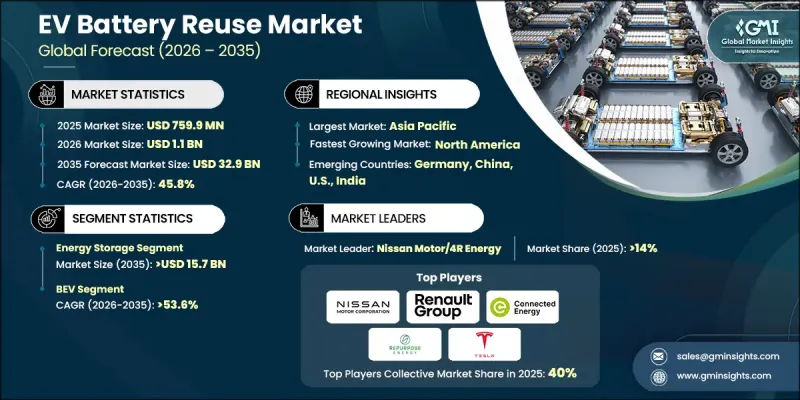
The market growth is supported by the rapid adoption of electric vehicles and the increasing need to manage battery lifecycles in a sustainable and economically viable manner. As EV deployment continues to accelerate worldwide, a significant number of batteries are reaching the end of their initial automotive usage phase, creating opportunities for second-life applications. Policies promoting circular economy practices, falling costs associated with battery refurbishment technologies, and the expanding demand for energy storage solutions are also shaping the market landscape. Reused EV batteries are increasingly deployed in energy storage systems that support renewable energy integration and power management applications. Automotive manufacturers and energy storage companies are heavily investing in second-life battery programs because these initiatives extend battery value while reducing environmental impact. Additionally, advancements in artificial intelligence-driven diagnostics and predictive analytics are improving the evaluation of battery health, enabling more efficient sorting, refurbishment, and repurposing processes. Companies across various regions are also establishing specialized business units focused on repurposing used EV batteries for secondary applications, which is further accelerating industry expansion.
| Market Scope | |
|---|---|
| Start Year | 2025 |
| Forecast Year | 2026-2035 |
| Start Value | $759.9 Million |
| Forecast Value | $32.9 Billion |
| CAGR | 45.8% |
The EV charging application segment is expected to grow at a CAGR of 60.5% through 2035. Reused batteries are increasingly integrated into charging infrastructure to support fast-charging networks by reducing peak load pressure on electricity grids. These storage systems allow charging operators to balance energy demand more effectively, enhance energy distribution efficiency, and lower operational costs associated with high-power charging infrastructure. As the EV charging ecosystem expands rapidly, the role of second-life battery storage systems is becoming increasingly important for maintaining grid stability while improving overall charging network performance.
The hybrid electric vehicles (HEVs) and plug-in hybrid electric vehicles (PHEVs) accounted for 52.6% share in 2025. However, these vehicles contribute relatively less to the EV battery reuse market compared to fully electric vehicles because their batteries generally experience less intensive charge and discharge cycles. Improvements in hybrid battery design and extended vehicle lifespan have reduced the number of batteries entering the reuse stream from these vehicle types. As a result, while HEVs and PHEVs maintain a notable share of the market landscape, the volume of reusable batteries from this segment remains comparatively limited.
U.S. EV Battery Reuse Market was valued at USD 75.1 million in 2025. Increasing adoption of electric vehicles, ambitious sustainability targets, and the rising need for cost-effective energy storage solutions are driving strong market momentum across the country. Government measures encouraging circular economy practices, including regulations related to waste management and sustainability frameworks, are motivating automotive manufacturers and energy companies to invest in battery repurposing initiatives. These policies are helping create a supportive ecosystem for second-life battery applications within the broader clean energy transition.
Major players operating in the Global EV Battery Reuse Market include Nissan Motor, Renault Group, Tesla, 4R Energy Corporation, Spiers New Technologies, B2U Storage, Connected Energy, Enel X, Moment Energy, BeePlanet Factory, BatteryLoop, RWE + Audi, Evyon, Element Energy, RePurpose Energy, Cactos, EcarACCU, OCTAVE, Higher Wire, Second Life EV Batteries, and Stena Metall. Companies operating in the EV Battery Reuse Market are focusing on multiple strategies to strengthen their market presence and expand their competitive position. Industry participants are investing in advanced battery diagnostics technologies, artificial intelligence-driven health assessment tools, and automated refurbishment systems to improve efficiency and scalability. Strategic partnerships between automakers, energy storage providers, and technology companies are becoming increasingly common to accelerate the development of second-life battery ecosystems. Firms are also expanding into energy storage markets by integrating reused batteries into renewable energy systems and charging infrastructure projects. Additionally, companies are establishing dedicated subsidiaries and pilot projects to refine repurposing processes and improve battery lifecycle management.
Table of Contents
Chapter 1 Methodology & Scope
- 1.1 Research design
- 1.1.1 Research approach
- 1.1.2 Data collection methods
- 1.2 Base estimates and calculations
- 1.2.1 Base year calculation
- 1.2.2 Market estimates & forecast parameters
- 1.3 Forecast
- 1.3.1 Key trends for market estimates
- 1.3.2 Quantified market impact analysis
- 1.3.2.1 Mathematical impact of growth parameters on forecast
- 1.3.3 Scenario analysis framework
- 1.4 Primary research and validation
- 1.4.1 Some of the primary sources (but not limited to)
- 1.5 Data mining sources
- 1.5.1 Paid Sources
- 1.5.2 Sources, by region
- 1.6 Research trail & scoring components
- 1.6.1 Research trail components
- 1.6.2 Scoring components
- 1.7 Research transparency addendum
- 1.7.1 Source attribution framework
- 1.7.2 Quality assurance metrics
- 1.7.3 Our commitment to trust
- 1.8 Market definitions
Chapter 2 Executive Summary
- 2.1 Industry synopsis, 2022 - 2035
- 2.2 Business trends
- 2.3 Application trends
- 2.4 Source trends
- 2.5 Regional trends
Chapter 3 Industry Insights
- 3.1 Industry ecosystem analysis
- 3.2 Regulatory landscape
- 3.3 Industry impact forces
- 3.3.1 Growth drivers
- 3.3.2 Industry pitfalls & challenges
- 3.4 Growth potential analysis
- 3.5 Porter's analysis
- 3.5.1 Bargaining power of suppliers
- 3.5.2 Bargaining power of buyers
- 3.5.3 Threat of new entrants
- 3.5.4 Threat of substitutes
- 3.6 PESTEL analysis
- 3.6.1 Political factors
- 3.6.2 Economic factors
- 3.6.3 Social factors
- 3.6.4 Technological factors
- 3.6.5 Legal factors
- 3.6.6 Environmental factors
- 3.7 Price trend analysis, 2022-2035
- 3.8 Emerging opportunities & trends
- 3.9 Investment analysis & future prospects
Chapter 4 Competitive landscape, 2025
- 4.1 Introduction
- 4.2 Company market share analysis, 2025
- 4.3 Key developments
- 4.3.1 Mergers & acquisitions
- 4.3.2 Partnerships & collaborations
- 4.3.3 New product launches
- 4.3.4 Expansion plans and funding
- 4.4 Competitive benchmarking
- 4.5 Innovation & sustainability landscape
Chapter 5 Market Size and Forecast, By Application, 2022 - 2035 (MWh & USD Million)
- 5.1 Key trends
- 5.2 Energy storage
- 5.3 EV charging
- 5.4 Base stations
- 5.5 Low speed vehicles
Chapter 6 Market Size and Forecast, By Source, 2022 - 2035 (MWh & USD Million)
- 6.1 Key trends
- 6.2 BEV
- 6.3 HEV & PHEV
Chapter 7 Market Size and Forecast, By Region, 2022 - 2035 (MWh & USD Million)
- 7.1 Key trends
- 7.2 North America
- 7.2.1 U.S.
- 7.2.2 Canada
- 7.3 Europe
- 7.3.1 UK
- 7.3.2 Germany
- 7.3.3 Italy
- 7.3.4 Spain
- 7.3.5 Russia
- 7.3.6 France
- 7.4 Asia Pacific
- 7.4.1 China
- 7.4.2 Japan
- 7.4.3 South Korea
- 7.4.4 India
- 7.4.5 Australia
- 7.5 Rest of the world
Chapter 8 Company Profiles
- 8.1 4R Energy Corporation
- 8.2 B2U Storage
- 8.3 BatteryLoop
- 8.4 BeePlanet Factory
- 8.5 Cactos
- 8.6 Connected Energy
- 8.7 EcarACCU
- 8.8 Element Energy
- 8.9 Enel X
- 8.10 Evyon
- 8.11 Higher Wire
- 8.12 Moment Energy
- 8.13 Nissan Motor
- 8.14 OCTAVE
- 8.15 RePurpose Energy
- 8.16 Renault Group
- 8.17 RWE + Audi
- 8.18 Second Life EV Batteries
- 8.19 Spiers New Technologies
- 8.20 Stena Metall
- 8.21 Tesla

