PUBLISHER: Mordor Intelligence | PRODUCT CODE: 2097324

PUBLISHER: Mordor Intelligence | PRODUCT CODE: 2097324
EV Battery Reuse - Market Share Analysis, Industry Trends & Statistics, Growth Forecasts (2026 - 2031)
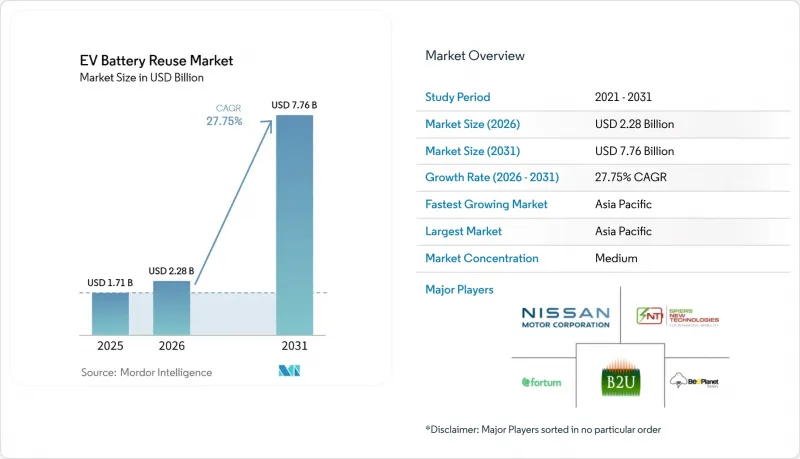
According to Mordor Intelligence, the EV battery reuse market size is expected to increase from USD 1.71 billion in 2025 to USD 2.28 billion in 2026 and reach USD 7.76 billion by 2031, growing at a CAGR of 27.75% over 2026-2031.
This report is Segmented by Battery Chemistry (Lithium-Iron-Phosphate (LFP), and More), Application (Grid-Scale Energy Storage Systems, EV Charging Infrastructure Buffering, and More), End-User (Utilities and IPPs, Commercial and Industrial Facilities, and More), and Geography (North America, Europe, Asia-Pacific, South America, Middle East and Africa). Market Forecasts are Provided in Value (USD).
Global EV Battery Reuse Market Trends and Insights
Rapid Decline in EV-Grade Li-ion Battery Costs
In 2025, new automotive-grade battery packs averaged USD 108 per kWh, with projections indicating a decrease to USD 80 per kWh by late 2026. Lower residual values are expected to increase inventory availability for reuse channels. Stationary developers purchasing modules at USD 30-50 per kWh achieve cost parity with lead-acid systems while benefiting from improved cycle life. This narrower cost spread supports module-level harvesting, facilitated by AI diagnostics that identify functional cells within degraded packs, thereby driving additional volumes into the EV battery reuse market. Shorter testing cycles reduce screening expenses to USD 50-80 per pack, supporting profit margins even as new battery prices fall.
Surging Grid-Scale ESS Demand for Frequency Balancing
Utilities installed over 50 GWh of grid-scale storage in 2025, with second-life assets accounting for up to 12% of new capacity in certified markets. Element Energy's 53 MWh project in Texas demonstrated that repurposed battery packs can achieve sub-one-second response times and 99% availability, qualifying for frequency-regulation payments under ERCOT tariffs. Additional deployments in Texas and California highlight the alignment of the EV battery reuse market with increasing renewable energy penetration, which drives intraday volatility. As wholesale markets enhance ancillary-service products, certified second-life systems gain access to stable revenue streams, strengthening the economic viability of reuse.
Lack of Unified Reuse Standards and Testing Protocols
Despite the existence of IEC 63330-1, varying regional standards such as EN 18061 and SAE J2997 require operators to follow multiple certification processes, increasing compliance costs by up to 25%. While UL 1974 is the most widely recognized standard, it does not include provisions for remaining-life disclosure, leading to gaps that deter insurers from providing cost-effective coverage. The absence of a harmonized global standard, which is unlikely to be established before 2027, continues to hinder the rapid international expansion of the EV battery reuse market.
Other drivers and restraints analyzed in the detailed report include:
- OEM Circular-Economy Mandates and EPR Regulations
- Emerging global second-life battery certification schemes
- Residual-Value Warranty and Liability Uncertainty
For complete list of drivers and restraints, kindly check the Table Of Contents.
Segment Analysis
LFP is projected to capture 42.3% of the EV battery reuse market share in 2025, driven by its long cycle life and thermal stability, which reduce warranty risks for stationary duty cycles. NCA, despite a smaller market base, is expected to grow at a CAGR of 31.2%, supported by its energy density of 200-260 Wh/kg, which facilitates compact, containerized systems for applications such as marine and data centers where space is limited.
Nickel-manganese-cobalt is experiencing slower adoption due to higher impedance rise under partial-state-of-charge conditions, restricting its use to climate-controlled environments. The replacement of lead-acid batteries is accelerating as second-life lithium-ion batteries offer cost advantages over refreshed valve-regulated lead-acid alternatives. For instance, GPT Telco's TowerBox demonstrates a threefold improvement in cycle life without additional cost. Solid-state batteries remain outside commercial reuse streams, with no standards for their assessment currently in place, suggesting minimal impact on the EV battery reuse market before 2030.
Complete Report Scope:
- By Battery Chemistry
- Lithium-iron-phosphate (LFP)
- Nickel-manganese-cobalt (NMC)
- Nickel-cobalt-aluminum (NCA)
- Nickel-metal-hydride (NiMH)
- Lead-acid
- Solid-state
- By Application
- Grid-scale Energy Storage Systems
- EV Charging Infrastructure Buffering
- Industrial and Data-center Backup Power
- Telecom Towers / Remote BTS
- Off-grid Solar and Microgrids
- Marine and Light-Rail Auxiliary Power
- By End-user
- Utilities and IPPs
- Commercial and Industrial Facilities
- Residential and Community Energy
- Automotive OEMs and Mobility Providers
- EPCs / Project Developers
- By Geography
- North America
- United States
- Canada
- Mexico
- Europe
- Germany
- United Kingdom
- France
- Italy
- NORDIC Countries
- Russia
- Rest of Europe
- Asia-Pacific
- China
- India
- Japan
- South Korea
- ASEAN Countries
- Rest of Asia-Pacific
- South America
- Brazil
- Argentina
- Rest of South America
- Middle East and Africa
- Saudi Arabia
- United Arab Emirates
- South Africa
- Egypt
- Rest of Middle East and Africa
- North America
Geography Analysis
Asia-Pacific accounted for 35.7% of global revenue in 2024 and will post a 35.9% CAGR by 2030, underpinned by China's 580,000-ton retired-battery stream and a nationwide collection network covering 85% of volume. CATL's 37.5% global cell share ensures robust feedstock and technological leadership as it scales 30,000 swapping stations by 2030. Japan and South Korea collaborate with EU partners to harmonize digital passport data frameworks, fostering cross-border trade.
North America accelerates on the back of DOE funding and state-level EPR mandates. Element Energy's 53 MWh Texas facility validates multi-hour grid services using retired packs, amplifying investor confidence. New Jersey's legislation sets a U.S. precedent for producer responsibility, and California's warranty rules refine consumer safeguards. Canada ties into continental recovery hubs, yet a unified federal framework remains pending.
Europe advances through the EU Battery Regulation's 2026 passport deadline and escalating collection quotas. Germany spearheads recycling alliances like BASF-Stena, while Nordic ferry electrification experiments create maritime second-life niches. The UK readies for bi-directional charging law changes by 2026, tapping Nissan LEAF batteries to cut household energy costs by 50%. Emerging regions in LATAM and Africa look to donor-funded microgrids to jump-start adoption; however, capacity-building for reverse logistics and safety oversight remains essential.
- B2U Storage Solutions, Inc.
- BeePlanet Factory S.L.
- BYD - Second-Life ESS
- CATL - Echelon Use
- Connected Energy Limited
- ECO STOR AS
- Element Energy Inc.
- Fortum Battery Solutions
- Hyundai Motor Group - Battery Reuse
- LG Energy Solution - Second-Life
- Mercedes-Benz Energy
- Nissan 4R Energy Corporation
- Octillion Power Systems, Inc.
- RePurpose Energy Inc.
- Redwood Materials - Reuse Division
- Renault Mobilize Power Solutions
- Smartville, Inc.
- Spiers New Technologies, Inc.
- TES Sustainable Battery Solutions Pte. Ltd.
- Volvo Energy
Additional Benefits:
- The market estimate (ME) sheet in Excel format
- 3 months of analyst support
TABLE OF CONTENTS
1 Introduction
- 1.1 Study Assumptions & Market Definition
- 1.2 Scope of the Study
2 Research Methodology
3 Executive Summary
4 Market Landscape
- 4.1 Market Overview
- 4.2 Market Drivers
- 4.2.1 Rapid decline in EV-grade Li-ion battery costs
- 4.2.2 Surging grid-scale ESS demand for frequency balancing
- 4.2.3 OEM circular-economy mandates & EPR regulations
- 4.2.4 Emerging global second-life battery certification schemes
- 4.2.5 AI-enabled SoH analytics unlocking pack-level reuse
- 4.2.6 Microgrid adoption in underserved regions
- 4.3 Market Restraints
- 4.3.1 Lack of unified reuse standards & testing protocols
- 4.3.2 Residual-value warranty and liability uncertainty
- 4.3.3 High reverse-logistics & diagnostic costs
- 4.3.4 Fire-safety perception of repurposed packs
- 4.4 Supply-Chain Analysis
- 4.5 Regulatory Landscape
- 4.6 Technological Outlook
- 4.7 Porters Five Forces Analysis
- 4.7.1 Threat of New Entrants
- 4.7.2 Bargaining Power of Buyers
- 4.7.3 Bargaining Power of Suppliers
- 4.7.4 Threat of Substitutes
- 4.7.5 Competitive Rivalry
5 Market Size & Growth Forecasts
- 5.1 By Battery Chemistry
- 5.1.1 Lithium-iron-phosphate (LFP)
- 5.1.2 Nickel-manganese-cobalt (NMC)
- 5.1.3 Nickel-cobalt-aluminum (NCA)
- 5.1.4 Nickel-metal-hydride (NiMH)
- 5.1.5 Lead-acid
- 5.1.6 Solid-state
- 5.2 By Application
- 5.2.1 Grid-scale Energy Storage Systems
- 5.2.2 EV Charging Infrastructure Buffering
- 5.2.3 Industrial and Data-center Backup Power
- 5.2.4 Telecom Towers / Remote BTS
- 5.2.5 Off-grid Solar and Microgrids
- 5.2.6 Marine and Light-Rail Auxiliary Power
- 5.3 By End-user
- 5.3.1 Utilities and IPPs
- 5.3.2 Commercial and Industrial Facilities
- 5.3.3 Residential and Community Energy
- 5.3.4 Automotive OEMs and Mobility Providers
- 5.3.5 EPCs / Project Developers
- 5.4 By Geography
- 5.4.1 North America
- 5.4.1.1 United States
- 5.4.1.2 Canada
- 5.4.1.3 Mexico
- 5.4.2 Europe
- 5.4.2.1 Germany
- 5.4.2.2 United Kingdom
- 5.4.2.3 France
- 5.4.2.4 Italy
- 5.4.2.5 NORDIC Countries
- 5.4.2.6 Russia
- 5.4.2.7 Rest of Europe
- 5.4.3 Asia-Pacific
- 5.4.3.1 China
- 5.4.3.2 India
- 5.4.3.3 Japan
- 5.4.3.4 South Korea
- 5.4.3.5 ASEAN Countries
- 5.4.3.6 Rest of Asia-Pacific
- 5.4.4 South America
- 5.4.4.1 Brazil
- 5.4.4.2 Argentina
- 5.4.4.3 Rest of South America
- 5.4.5 Middle East and Africa
- 5.4.5.1 Saudi Arabia
- 5.4.5.2 United Arab Emirates
- 5.4.5.3 South Africa
- 5.4.5.4 Egypt
- 5.4.5.5 Rest of Middle East and Africa
- 5.4.1 North America
6 Competitive Landscape
- 6.1 Market Concentration
- 6.2 Strategic Moves (M&A, Partnerships, PPAs)
- 6.3 Market Share Analysis (Market Rank/Share for key companies)
- 6.4 Company Profiles (includes Global level Overview, Market level overview, Core Segments, Financials as available, Strategic Information, Products & Services, and Recent Developments)
- 6.4.1 B2U Storage Solutions, Inc.
- 6.4.2 BeePlanet Factory S.L.
- 6.4.3 BYD - Second-Life ESS
- 6.4.4 CATL - Echelon Use
- 6.4.5 Connected Energy Limited
- 6.4.6 ECO STOR AS
- 6.4.7 Element Energy Inc.
- 6.4.8 Fortum Battery Solutions
- 6.4.9 Hyundai Motor Group - Battery Reuse
- 6.4.10 LG Energy Solution - Second-Life
- 6.4.11 Mercedes-Benz Energy
- 6.4.12 Nissan 4R Energy Corporation
- 6.4.13 Octillion Power Systems, Inc.
- 6.4.14 RePurpose Energy Inc.
- 6.4.15 Redwood Materials - Reuse Division
- 6.4.16 Renault Mobilize Power Solutions
- 6.4.17 Smartville, Inc.
- 6.4.18 Spiers New Technologies, Inc.
- 6.4.19 TES Sustainable Battery Solutions Pte. Ltd.
- 6.4.20 Volvo Energy
7 Market Opportunities & Future Outlook
- 7.1 White-space & Unmet-need Assessment

